If you have employees, you need workers’ compensation. If you use vehicles for the job, you need commercial auto. General liability isn’t always mandated by law, but nearly every commercial client will ask for it before signing a contract, so buy it on day one anyway.
Here’s the starter bundle most cleaning businesses need immediately:
- General liability ($1M/occurrence is the common baseline clients expect)
- Commercial auto once anyone drives a company vehicle or uses their own car for jobs
- Workers’ compensation the moment you hire your first employee
Beyond that, contracts often push you toward a janitorial bond, umbrella coverage, tools and equipment protection, or pollution liability for specialty work. California enforces some of these triggers more aggressively than other states, which we’ll cover in the state-specific section below.
Key Takeaways
Cleaning businesses need workers’ compensation and commercial auto where legally triggered, general liability as a near-universal contract requirement, and a Certificate of Insurance ready to produce on demand.
| Point | Details |
|---|---|
| Buy general liability first | Even without a legal mandate, nearly every commercial contract requires it. |
| Match legal triggers to your operations | Hiring employees or using vehicles activates state-required workers’ comp and commercial auto. |
| Close the theft gap with a bond | A janitorial bond covers employee theft, which general liability does not. |
| Keep COIs current and accessible | Store digital copies and track expiration dates to avoid losing contracts. |
| Confirm California-specific rules early | California’s workers’ comp trigger applies at your first employee, not a threshold. |
Ready to work with a fully insured, contract-ready cleaning team? Explore Neatandtidypros’ commercial cleaning services or browse the full service lineup to see how properly covered crews handle everything from offices to specialty jobs.
Table of Contents
- Why Insurance Actually Matters for a Cleaning Business
- What Does the Law Actually Require vs. What Clients Demand?
- Which Insurance Policies Do Cleaning Services Actually Need?
- What Do Commercial Contracts Typically Require for Proof of Insurance?
- How Much Does Cleaning Business Insurance Cost?
- How Do You Actually Buy and Manage These Policies?
- How Do State Rules Differ, and What Should California Owners Watch?
- Your Rapid Contract Onboarding Checklist
- What I Learned Running Cleaning Contracts Without the Right Coverage in Place
- Where to Verify These Requirements Yourself
- Frequently Asked Questions
- Sources
Why Insurance Actually Matters for a Cleaning Business
A client trips over your vacuum cord and breaks a wrist. A homeowner claims a $3,000 necklace vanished during a move-out clean. Your van rear-ends someone on the way to a job. Any one of these can wipe out a small cleaning company’s bank account and expose the owner’s personal assets if the business isn’t properly covered.
Insurance does more than pay out after disaster strikes. It:
- Keeps your personal savings, home, and car separate from business liability
- Meets the insurance clauses buried in nearly every commercial and property management contract
- Signals to landlords and clients that you run a legitimate operation, not a side hustle
One slip-and-fall lawsuit with no general liability behind it can shut down operations for months while legal costs pile up. That’s the real cost of skipping coverage, not the premium you saved.
What Does the Law Actually Require vs. What Clients Demand?
State law usually requires workers’ compensation once you hire employees, and commercial auto insurance if you own or lease vehicles for work. Some cities or states also require specific licensing bonds for cleaning or janitorial businesses. General liability, by contrast, is rarely mandated by state law, but it’s the single most common item written into commercial cleaning contracts.
Here’s how to sort out your own triggers:
- Hired your first employee? Workers’ comp becomes a legal requirement in almost every state.
- Bought or leased a company vehicle? Commercial auto coverage is required, and your personal auto policy won’t cover business use.
- Opened a physical office or storage location? Some states require minimum liability coverage tied to the address.
- Bidding on public or government contracts? Expect mandatory bonding and higher liability minimums as a condition of eligibility.
According to a government fact sheet on cleaning business insurance, the standard advice is to work with a licensed insurance agent who can match coverage to your specific operations rather than guessing at a generic package. Requirements vary enough by state that a quick call to your state insurance department, or a licensed broker, beats relying on what a competitor down the street carries.
Which Insurance Policies Do Cleaning Services Actually Need?
Every cleaning company should build around three core policies: general liability, workers’ compensation once you have employees, and commercial auto once vehicles enter the picture. Everything past that depends on how your business operates.
| Policy | What it covers | When required | Typical trigger |
|---|---|---|---|
| General liability | Third-party bodily injury and property damage | Contractually, almost always | Any client-facing work |
| Workers’ compensation | Employee injury and lost wages | Legally required with employees | Hiring first W2 employee |
| Commercial auto | Vehicle accidents, damage, liability | Legally required for business vehicles | Buying/leasing a van or using personal car for work |
| Janitorial bond | Theft by employees at client sites | Contractually common | Unsupervised access to homes/offices |
| Tools & equipment (inland marine) | Vacuums, buffers, supplies in transit | Optional, recommended | Owning expensive mobile equipment |
| Commercial property/BOP | Owned office, storage, or supplies | Optional | Leasing a physical location |
| Pollution liability | Chemical exposure, mold, biohazard cleanup | Situational | Specialty or biohazard work |
| Professional liability | Errors in service delivery | Situational | Consulting or specialized service contracts |
| Cyber liability | Data breach, client PII exposure | Situational | Storing client info digitally |
| Umbrella | Extra liability above underlying limits | Contractually for large accounts | Bidding on big commercial contracts |
A few situations create immediate coverage gaps: hiring your first employee without workers’ comp in place, sending a crew into a client’s home unsupervised without a bond, or handling office cleaning contracts that involve access to sensitive client records.
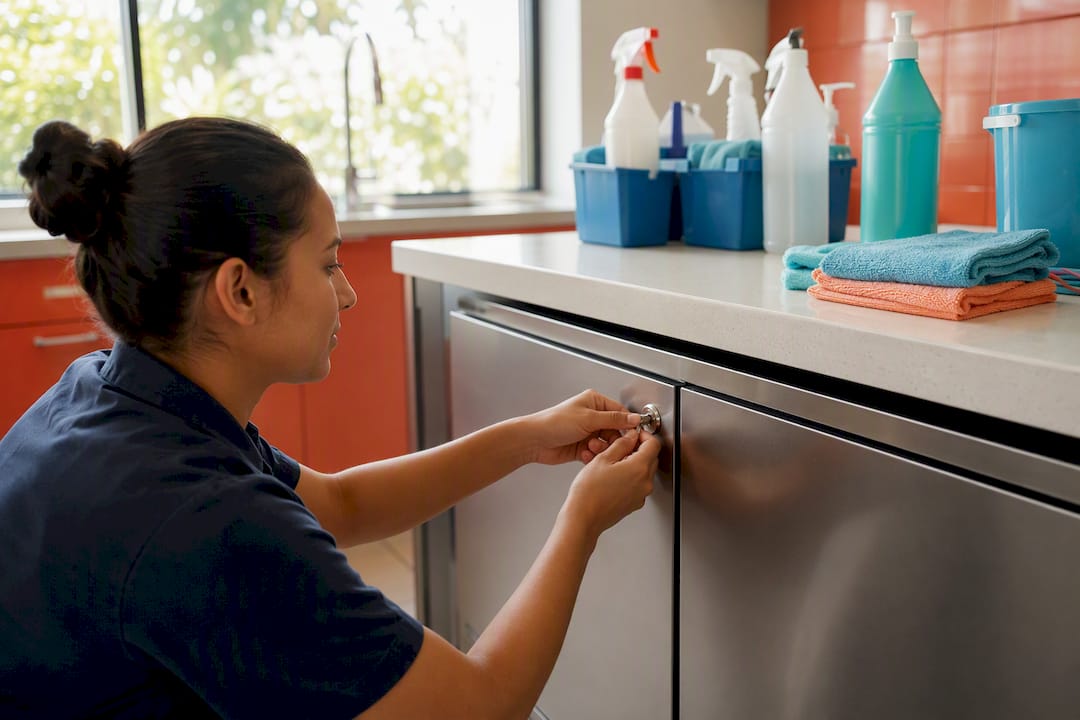
Pro Tip: General liability doesn’t cover theft by your own staff. That gap, known as Care, Custody, and Control, is exactly what a janitorial bond closes, and commercial clients ask for it specifically because GL won’t.
What Do Commercial Contracts Typically Require for Proof of Insurance?
Most commercial cleaning contracts request general liability at $1 million per occurrence or higher, plus a handful of standard endorsements: Additional Insured status, a Waiver of Subrogation, Primary and Noncontributory wording, and a 30 day cancellation notice. Property managers and larger commercial accounts increasingly ask for all four before they’ll sign.
Your Certificate of Insurance needs to show:
- Named insured (your legal business name and any DBA)
- Policy numbers and effective/expiration dates
- Coverage limits per occurrence and aggregate
- Certificate holder (the client or property manager requesting proof)
A few terms worth understanding before a client’s property manager throws them at you:
- Additional Insured extends your liability coverage to protect the client if a claim arises from your work on their property.
- Waiver of Subrogation stops your insurer from going after the client to recover a payout, even if the client shares some blame.
- Primary and Noncontributory means your policy pays first, before the client’s own insurance kicks in.
If a contract requests something your current carrier can’t add, call your broker before you sign. Not every carrier offers every endorsement, and finding out after a claim is the wrong time.
How Much Does Cleaning Business Insurance Cost?
Most small cleaning companies carry $1 million per occurrence and $2 million aggregate on general liability. Larger commercial clients often push for $2 million or more, sometimes layered with an umbrella policy to hit the number without inflating the base GL premium.

Real cost ranges vary by business size. A solo cleaner’s full insurance stack typically runs $500 to $1,500 a year, while a small firm with a few employees and a vehicle often lands between $2,500 and $6,500 annually. General liability alone for a $1M/$2M policy usually costs $400 to $1,200 a year.
What actually moves the price:
- Payroll size drives workers’ comp rates, typically charged per $100 of payroll
- Number and type of vehicles, plus how often they’re on the road
- Specialty exposures like window cleaning at height or biohazard work
- Claims history, where even one prior payout raises renewal quotes
- Limits and endorsements requested, since umbrella layers and Additional Insured add cost
A solo operator buying $1M/$2M GL might pay around $400 a year, while a five-person crew with a van and workers’ comp could see a combined annual bill closer to $4,000 to $5,000 once every policy is stacked together.
How Do You Actually Buy and Manage These Policies?
- List out your exposures: employee count, vehicles, equipment value, and any specialty services like biohazard or high-rise window work.
- Decide between a broker and a digital carrier. Complex contracts and specialty exposures usually need a broker who can negotiate endorsements; solo cleaners with straightforward needs can often get a quote through providers like Progressive or The Hartford, or compare multiple carriers at once through a platform like InsuranceBee.
- Confirm your carrier can add Additional Insured, Waiver of Subrogation, and Primary and Noncontributory language before you commit.
- Get your Certificate of Insurance issued and store a digital copy you can send instantly.
- Set a calendar reminder for renewals and payroll audits, since workers’ comp premiums adjust based on actual payroll reported.
Pro Tip: Keep a folder of current COIs ready to email on request. Losing a contract because a certificate took three days to produce is a completely avoidable failure.
How Do State Rules Differ, and What Should California Owners Watch?
Insurance requirements are set at the state level, and what’s mandatory in one state may be optional in the next. Confirm your obligations directly with your state insurance department or a licensed broker rather than assuming your neighbor’s setup applies to you.
Common triggers to check locally:
- Employee count thresholds that activate mandatory workers’ comp
- Whether personal auto policies exclude business use in your state
- Local bonding requirements for janitorial or cleaning-specific licenses
California enforces workers’ compensation strictly, and the trigger is a single employee, not a headcount threshold. Commercial clients in California frequently request $1M to $2M in general liability plus Additional Insured endorsements as standard contract language, similar to national norms but often verified more rigorously by property managers. Review the California Labor Code requirements before your first hire, and use a government resource format like the DC business insurance fact sheet as a model for what a proper state disclosure should include.
Your Rapid Contract Onboarding Checklist
This is the checklist to run through every time you bid on a new commercial contract or client that asks for proof of insurance.
- Confirm your general liability limit meets or exceeds what the contract requests (usually $1M/$2M).
- Check whether the client requires Additional Insured status and confirm your carrier can add it.
- Secure a janitorial bond if the contract involves unsupervised access to homes or offices.
- Generate a current Certificate of Insurance and send it to the client or property manager.
- Log the COI’s expiration date so you renew before the client notices it lapsed.
A sample COI should include:
- Named insured and any DBA
- Policy types and limits (GL, auto, workers’ comp)
- Policy numbers and effective/expiration dates
- Certificate holder name and address
- Carrier name and broker contact information
Keep this as a one-page template in a shared folder so any office manager or property manager request can be answered in minutes, not days.
What I Learned Running Cleaning Contracts Without the Right Coverage in Place
Losing a commercial bid because our Certificate of Insurance was missing an Additional Insured endorsement taught me more than any policy brochure ever could. The property manager didn’t ask twice. They moved to the next bidder.
The lesson: insurance isn’t a back-office chore, it’s part of your sales pitch. Keep your COI current and your endorsements ready before a client asks, not after.
Where to Verify These Requirements Yourself
These sources are the fastest way to confirm your state’s legal triggers and typical contract language before you sign anything.
- DC government fact sheet on cleaning business insurance for a government-format breakdown of common coverages
- MoneyGeek’s cleaning insurance coverage guide for a categorized policy decision framework
- MoneyGeek’s requirements and needs guide for the legal vs. contractual distinction
- GetBusinessCoverage’s cleaning insurance guide for cost benchmarks and bond details
- ZenMaid’s cleaning insurance and bonding guide for endorsement language and provider comparisons
- California Department of Industrial Relations FAQ for workers’ comp specifics in California
For contract-specific endorsements your carrier doesn’t automatically include, a licensed broker remains the fastest way to close the gap.
Frequently Asked Questions
Is general liability legally required for cleaning businesses?
No state mandates general liability by law for most cleaning businesses, but nearly every commercial contract requires it, typically at $1 million per occurrence.
Do I need workers’ compensation if I only have one employee?
In most states, including California, hiring even one employee triggers a legal requirement for workers’ compensation coverage.
What’s the difference between a janitorial bond and general liability insurance?
General liability covers third-party injury and property damage; a janitorial bond specifically covers theft committed by your employees at a client’s property, which GL does not.
How much does a full cleaning insurance package cost?
A solo cleaner’s package typically runs $500 to $1,500 a year, while a small firm with employees and a vehicle often pays $2,500 to $6,500 annually.
What should be on my Certificate of Insurance for a commercial client?
Include your named insured, policy numbers, coverage limits, effective and expiration dates, and the certificate holder’s name and address, along with any requested endorsements like Additional Insured.
This article is general information, not a substitute for advice from a qualified lawyer. Consult a qualified legal professional about your own circumstances before acting on anything here.
Sources
- Insurance coverage for a cleaning business (DC government fact sheet)
- Cleaning Business Insurance: Types to Consider (MoneyGeek)
- Cleaning Business Insurance: Coverage Guide (2026)
- Cleaning Business Insurance and Bonding: Types, Cost, Requirements & Best Providers in 2026 (ZenMaid)