Ask about several important aspects before you hire anyone: credentials and insurance, exact scope of work, pricing and scheduling terms, chemical and product safety, day-to-day operations and quality control, and the contract itself. These six categories of questions for a cleaning company separate operators who can prove their claims from ones who just talk a good game. Use the grouped checklist below, and insist on written proof, an insurance certificate, a Safety Data Sheet, a scope document, before any money changes hands.
TL;DR:
- Verify that the cleaning company provides a current certificate of insurance and confirm coverage directly with the insurer to prevent fraud.
- Obtain detailed, written definitions of scope, including specific tasks for standard and deep cleans, especially for move-in, move-out, or post-construction jobs.
- Clarify whether prices are hourly, flat-rate, or based on square footage, and request a written estimate that specifies which add-ons could increase the final cost.
- Ask for product names, Safety Data Sheets, and proof of EPA Safer Choice or equivalent certification to assess environmental and chemical safety claims.
- Ensure the company has documented training, quality control procedures, and contingency plans for staff absence to guarantee consistent service quality.
Table of Contents
- Credentials, Insurance, and Background Check Questions
- Questions About Services and Scope of Work
- Pricing, Estimates, and Scheduling Questions
- Chemical Safety and Environmental Claims: What to Verify
- Operations, Training, and Quality Control Questions
- Contracts, Guarantees, and Trial Cleaning Questions
- How to Actually Ask These Questions Without Getting the Runaround
- Why We Ask Ourselves These Same Questions
- Get Documented Answers, Not Just Promises
- Sources
- FAQ
Credentials, Insurance, and Background Check Questions
Insurance is the first thing to verify, not the last. Ask for a current certificate of insurance showing general liability coverage, and if the company sends employees onto your property, ask for proof of workers’ compensation too. A legitimate operator hands this over without hesitation, because it protects them as much as it protects you.
Background checks matter more for in-home work than most people assume. Ask directly whether cleaning staff go through a criminal background check before their first assignment, and whether that screening is repeated for long-term employees. Homeowner resources consistently list references, insurance, and background screening among the table-stakes questions consumers should ask before hiring, and commercial clients need the same answers, just at higher stakes given building access and after-hours entry.
Here’s what to ask and verify:
- Can I see a certificate of insurance, and can I call the insurer to confirm it’s active?
- Do you carry workers’ compensation for every employee who enters my property?
- What does your background check process cover, and how often is it renewed?
- How do liability and bonding requirements change for commercial sites versus private homes?
- Can you provide references from clients with a similar property type to mine?
A five-minute call to the insurance carrier listed on the certificate catches more fraud than any glowing testimonial.
Questions About Services and Scope of Work
“We do deep cleaning” means nothing until you get a definition in writing. Ask the company to spell out, room by room, what separates their standard clean from their deep clean, and get that breakdown before you compare prices between providers.
Here’s a practical order for asking scope questions:
- Ask for their definitions. What does “standard clean” include in the kitchen, bathrooms, and bedrooms, and what tasks move into the “deep clean” category?
- Ask about specialty work. How is carpet cleaning, inside-appliance cleaning, or post-construction debris removal priced, as an add-on or a separate quote?
- Request a written scope. Can they send a room-level checklist you can attach directly to the service agreement?
- Compare scopes side by side. If you’re getting quotes from more than one provider, lay the written scopes next to each other and look for missing rooms, vague line items, or tasks one company includes that the other skips entirely.
This matters most for move-in/move-out and post-construction jobs, where “clean” can mean anything from wiping counters to scrubbing drywall dust out of vent covers. A move in/out clean and a construction cleaning job are priced and scoped completely differently, so never assume one quote translates to the other.
Pricing, Estimates, and Scheduling Questions
Ask how the price is calculated before you ask what it costs. Some companies charge hourly, others quote per project or by square footage, and each model rewards different behavior. Hourly pricing can drag out a slow team’s invoice; flat per-project pricing protects you from that but only if the scope was defined accurately upfront.
Get the estimate in writing and ask specifically which items could add to that number later. Pet hair, extreme clutter, or a kitchen that hasn’t been touched in months are common triggers for a higher final bill.
Questions worth asking directly:
- Is your pricing hourly, flat-rate, or based on square footage, and what changes the final number?
- Can I get a written estimate, and which add-ons are billable separately?
- Is there a minimum charge per visit, and do you offer a discount for recurring service?
- What’s your cancellation window, and is there a fee for canceling late?
- What payment methods do you accept, and when is payment due?
- How long should I expect the visit to take, and does team size affect that?
A provider who can’t answer the cancellation question clearly is one you’ll have trouble reaching after the invoice is paid.
Chemical Safety and Environmental Claims: What to Verify
“Eco-friendly” is a marketing phrase, not a credential. Ask for the actual product names and labels instead of accepting the term at face value. The EPA’s Safer Choice program evaluates specific finished products and ingredients against defined criteria, so a company that can name Safer Choice certified products is telling you something concrete. A company that just says “we use green products” is making a vague claim that requires further verification.
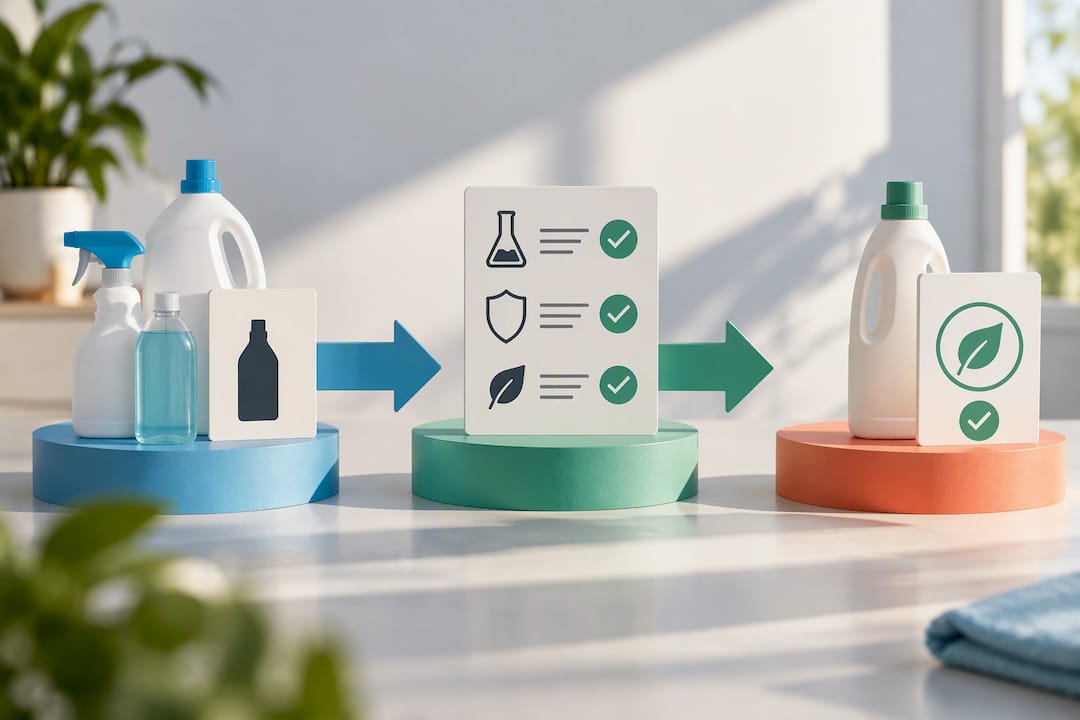
Ask whether they can produce a Safety Data Sheet (SDS) for their primary cleaning chemicals. Under OSHA’s Hazard Communication Standard, employers using hazardous chemicals must maintain SDSs and train workers on them, and those documents list composition, handling instructions, and first-aid measures. Ask, too, how concentrated products are diluted on-site. Cleaning organizations following the ISSA CIMS standard typically use documented dilution-control systems rather than eyeballing measurements.
For commercial contracts, push further: ask for a written green-cleaning purchasing policy, not just a verbal assurance.
- Can you name the specific products you use, not just describe them as “green” or “natural”?
- Will you provide SDSs for your primary chemicals on request?
- Do you follow EPA Safer Choice or a comparable certification standard?
- How are chemicals diluted, and is that process documented?
- How do your staff receive OSHA Hazard Communication training?
Pro Tip: Ask to see the SDS binder or digital equivalent during a walkthrough, not just hear about it. A company that has one ready to show usually has the rest of its safety documentation in order too.
For more on what these labels actually verify, see our guide on what green cleaning certifications actually verify and this supplier-side breakdown of eco-friendly facility cleaning solutions.
Operations, Training, and Quality Control Questions
A one-time great clean doesn’t tell you much. What matters is whether the company has systems that make good performance repeatable. Ask how staff are trained, who supervises them on-site or remotely, and whether there’s a written quality-assurance checklist used after each visit. These are the same signals the ISSA CIMS standard uses to judge a cleaning organization’s management maturity, and asking for a written quality plan or sample QA form is a fair request, not an unusual one.
Ask what happens when a scheduled cleaner calls out sick. A company with no backup plan will leave you scrambling; one with cross-trained staff or a substitution protocol will barely miss a beat.
Key questions to bring to this conversation:
- How are new employees trained, and who supervises their work in the field?
- Do you use a written QA checklist or inspection process after each cleaning?
- What’s your contingency plan if a scheduled cleaner is unavailable?
- Can you connect me with a reference from a similar property?
- What’s your process for handling a complaint, and how fast is it resolved?
Details on training standards are covered in our piece on how professional cleaners are trained.
Contracts, Guarantees, and Trial Cleaning Questions
Before you sign anything recurring, ask to see a sample contract. It should spell out the scope of work, the fee structure, how either party can terminate the agreement, and what happens if a task gets missed, credit, redo, or something else.
- Ask about satisfaction guarantees. If you’re not happy with a specific area, will they send someone back, and how fast?
- Ask about damage claims. What’s the process if something gets broken or a surface gets damaged, and what documentation do they require from you?
- Ask for a trial visit. A single paid appointment before committing to a recurring schedule lets you score the work against the written scope with zero long-term risk.
A practical sequence works well here: get the written scope, confirm insurance with the carrier directly, request the SDS for their main products, then book a trial clean and grade it against everything they promised in writing.
How to Actually Ask These Questions Without Getting the Runaround
Don’t fire off a giant list and hope for the best. A short, structured conversation gets better answers than a wall of text in an email.
Step 1: Call or email and ask for three things at once: a written estimate, a certificate of insurance, and a sample scope of work. Step 2: Once you have those, ask the chemical-safety questions, product names and SDS availability, and note how quickly and specifically they respond. Step 3: Ask for one reference tied to a property similar to yours, and actually call it.
Some answers are acceptable; others are red flags dressed up as confidence:
- Acceptable: “Here’s our certificate, you can call our carrier at this number to confirm.”
- Red flag: “Don’t worry, we’re fully insured,” with no documentation offered.
- Acceptable: “Here’s our SDS binder for the three products we use most.”
- Red flag: “Everything we use is natural and safe,” with no product names given.
Pro Tip: Score the trial visit against the written scope line by line, not by general impression. A clean that “felt great” but skipped baseboards and window tracks is a preview of what recurring service will look like.
For a fuller walkthrough of this process, our guide on choosing a cleaning service covers the verification steps in more depth.
Why We Ask Ourselves These Same Questions
We built our business around the idea that clients shouldn’t have to take any company’s word for anything. Reputable cleaning services carry insurance, screen and train staff, and can produce product information on request for various cleaning services. Documentation should be available because clients expect it, not simply because forms require it.
Internally, quality checks ideally work like an inspection checklist: identify issues, fix them, and adjust processes to prevent repeat mistakes. Prompt corrections occur when missed tasks are treated as system problems rather than isolated incidents.
It’s preferable for companies to answer detailed questions before a contract rather than after a complaint.
— Neat
Get Documented Answers, Not Just Promises
A responsible cleaning service provides paperwork such as an insurance certificate you can verify, written scopes for services, and product information you can check before committing to recurring cleaning appointments.
If you’re weighing a standard clean against something deeper, our basic cleaning service covers the everyday upkeep, while commercial cleaning is built for offices, medical facilities, and other business spaces with recurring schedules. Ask us for a sample contract, an SDS for the products we use, and a one-time trial appointment before you sign anything long-term. Request a quote today and see the documentation for yourself.
Sources
Verify environmental claims against the EPA’s Safer Choice program, which certifies specific products rather than accepting vague marketing language. Confirm chemical-safety training expectations through OSHA’s Hazard Communication Standard, which governs SDS and labeling requirements. For management and quality-system maturity, the ISSA CIMS standard outlines what a professionally run cleaning organization should have in place.
- Safer Choice Standard and Criteria | US EPA
- 1910.1200 – Hazard Communication. | Occupational Safety and Health Administration
- CIMS-GB and CIMS standard (ISSA)
- 17 Go-To Questions You Should Ask a House Cleaning Service | Angi
FAQ
What Is the 5-5-5 Rule for Cleaning?
The “5-5-5 rule” isn’t a recognized industry standard, definitions vary depending on who’s using the phrase. If a provider brings it up, ask them to explain exactly what it means in their process rather than assuming it matches a standard you’ve seen elsewhere.
What Are Some Common Questions to Ask a Cleaning Service?
The most useful questions cover insurance and background checks, the exact scope of “standard” versus “deep” cleaning, how pricing is calculated, and whether they can provide SDSs for their products. Homeowner resources consistently list references, insurance, and written contracts as the baseline items to confirm before hiring.
What Should I Ask in a Cleaning Company Interview If I’m Hiring Staff Directly?
Ask about prior experience with similar property types, availability and schedule flexibility, and comfort working with specific cleaning chemicals or equipment. Also ask how they handle a missed task or a client complaint, since the answer reveals more about work ethic than a resume does.
Does Neatandtidypros Provide Written Scopes and Insurance Proof?
Yes. Neatandtidypros provides written service scopes and insurance documentation on request for both residential and commercial clients. Current pricing for services like basic cleaning and deep cleaning is available directly on the site.
How Do I Verify a Cleaning Company’s Green Cleaning Claims?
Ask for specific product names and check whether they carry a real certification like the EPA’s Safer Choice label, rather than accepting the word “eco-friendly” on its own. For commercial accounts, ask whether they can show a written purchasing policy tied to a recognized standard.
One Response