
Construction cleaning is normally done in three ordered passes: rough, light or detail, then final or touch-up, each with distinct tasks and timing. Rough clean follows demolition and major trade work, detail clean happens once finishes are in, and final clean occurs right before handover. Silica and lead rules can change which tools and methods are acceptable at each stage.
TL;DR:
- Schedule rough cleaning after heavy trades, detail work after finishes but before furnishings, and final cleaning within 24 to 48 hours of dust producing work.
- OSHA requires wet methods or HEPA vacuuming for concrete, masonry, or drywall dust, and restricts dry sweeping and compressed air.
- For buildings built before 1978, EPA rules require lead safe practices and disposable wipe verification, so specify the documented test in the contract.
- Book two to four weeks ahead of handover, and compare quotes by phase and extras because debris hauling, access, and floor treatments may cost extra.
- Use general contractor labor for basic rough debris removal, but hire specialists for detail and final passes; attach a written scope to every phase.
Table of Contents
- The Three Phases of Post-Construction Cleanup
- Phase-by-Phase Checklist: Tasks, Tools, and Deliverables
- When to Schedule Each Pass and Who Should Handle It
- Silica Dust and Lead Safety Rules That Shape Every Phase
- What Construction Cleaning Typically Costs and How to Book It
- Residential vs. Commercial: How the Phases Differ
- Common Problems That Show Up During Each Cleaning Phase
- How We Approach Phased Construction Cleaning
- Book a Phased Construction Clean With Neat and Tidy Pros
- FAQ
- Sources
The Three Phases of Post-Construction Cleanup
Each phase of a construction clean has a different job, and confusing them is the fastest way to pay for work that has to be redone.
The rough clean happens right after major demolition, framing, or heavy trade work wraps up. Its goal is safety and access: clearing bulk debris, scrap material, and packaging so other trades and inspectors can move through the space without hazards underfoot. This pass is not about shine. It is about getting a site walkable and workable again.
The light, standard, or detail clean comes next, usually once drywall, paint, flooring, and fixtures are installed. This pass targets the fine dust that settles on every horizontal and vertical surface during finish work: window sills, cabinet interiors, light fixtures, baseboards, and any manufacturer stickers still clinging to appliances or glass.
The final or touch-up clean happens closest to occupancy, often the day before or the morning of a walkthrough. This is the inspection-level polish: streak-free glass, spotless flooring, dust-free vents, and a space that looks ready for photos or move-in rather than just “done.”
Some projects add optional extras on top of these three:
- Exterior window washing and pressure washing of entryways or hardscape.
- A post-occupancy touch-up scheduled a week or two after move-in to catch settling dust.
Commercial projects sometimes split the detail phase further by floor or zone, but the underlying three-stage logic rarely changes.
Phase-by-Phase Checklist: Tasks, Tools, and Deliverables
A clear task list keeps crews and clients aligned on what each pass actually covers, which matters more than the price on a quote.
- Rough clean: haul bulk debris and packaging to dumpsters, sweep or HEPA-vacuum coarse dust, remove protective floor and surface coverings once trades confirm they are no longer needed, and knock down cobwebs and loose material from ceilings and corners.
- Light or standard clean: peel off manufacturer stickers and protective films, dust light fixtures and vents, wipe cabinet interiors and shelving, clean interior glass and window tracks, and detail baseboards, outlets, and switch plates.
- Final or touch-up clean: polish all glass and mirrors, apply the final floor finish or deep mop, wipe down HVAC registers and returns one last time, and stage the space with trash removed and surfaces ready for a walkthrough.
Each pass has its own toolkit. Rough clean leans on HEPA-filtered vacuums, heavy-duty brooms, and disposal bins. Detail clean adds microfiber cloths, wet-mop systems, and glass cleaner. Final clean relies on lint-free towels, disposable wipes for fixtures, and the same HEPA equipment for one last dust pass. Basic PPE (gloves, eye protection, and a properly rated respirator where dust is present) carries through all three stages.
Pro Tip: Keep a written log of what was cleaned in each pass, dated and signed off, so disputes over scope or rework never come down to memory.
Our post-construction cleaning checklist breaks these tasks down by room if you want a printable version for your crew.
When to Schedule Each Pass and Who Should Handle It
Timing mistakes cause more rework than skipped tasks do. Rough clean should happen as soon as a trade finishes its heavy work, not after the next trade has already layered more dust on top. Detail clean belongs after flooring, paint, and fixtures are installed but before furniture or equipment arrives. Final clean should sit as close to handover as the schedule allows, ideally with a 24 to 48 hour buffer after the last dust-producing activity so settled particles don’t resurface on freshly cleaned surfaces.
Crew-hour estimates vary by square footage and condition, but most teams plan more hours per square foot for rough clean than for the lighter detail and final passes, since bulk debris removal is more labor-intensive than surface wiping.
Who does what also shifts by phase:
- General contractors often handle basic rough-clean debris removal themselves or assign it to laborers already on site.
- Detail and final cleaning benefit from a specialist cleaning contractor who brings the right equipment and knows inspection standards.
- Every phase should have a written scope attached to it, tied to a milestone or punch-list item, so no one assumes a pass is “included” when it wasn’t quoted.
Silica Dust and Lead Safety Rules That Shape Every Phase
Cleaning methods on a construction site aren’t just a matter of preference. Federal rules govern how dust gets removed, and skipping them creates liability as well as a lesser clean.
OSHA’s silica construction standard requires wet methods or HEPA-filtered vacuuming wherever concrete, masonry, or drywall dust is present, and restricts dry sweeping or compressed air in those conditions. Rough-clean crews often face the same respirable dust that trade workers do, since cutting, grinding, and demolition leave fine particles suspended long after the work itself stops.
- Avoid dry sweeping or dry sanding on any surface where concrete, tile, or drywall dust has settled.
- Use HEPA-rated vacuums and wet wiping or mopping as the default rough-clean and detail-clean methods.
- Keep minimum PPE on hand: gloves, eye protection, and a properly fitted respirator rated for the dust present.
- Treat hard-hat zones, fall-protection areas, and any space marked for containment as off-limits until the general contractor clears them for cleaning.
On projects involving pre-1978 buildings, the EPA’s Renovation, Repair, and Painting program requires lead-safe work practices and a cleaning verification step using disposable wipes to confirm that dust levels meet federal standards. That verification step is worth specifying in a cleaning contract up front, since it gives both sides a documented pass or fail result instead of a visual guess. Sites with prior lead abatement work may also require containment to remain in place until that verification clears.
Written exposure control plans and medical surveillance become relevant mainly for crews who work with these conditions routinely rather than for a single project, but any contractor working rough clean on an active demolition site should have respiratory protection built into standard procedure, not treated as optional gear.
What Construction Cleaning Typically Costs and How to Book It
Quotes for construction cleaning often look wildly different because they’re pricing different things, not because one company is simply cheaper.
- Rough-clean pricing generally runs lower per square foot than the detail or final passes, since it’s mostly bulk removal rather than surface-level work.
- Detail and final cleaning tend to cost more per square foot because they’re labor-intensive, fixture-by-fixture work.
- Debris haul-off, limited access (stairs, freight elevators), floor sealing or waxing, exterior window cleaning, and HVAC duct work are commonly billed as add-ons rather than included in a base price.
- Booking two to four weeks ahead, especially near a known handover date, helps avoid rescheduling fees when a project’s timeline shifts.
- A written scope confirming which phases and extras are included prevents disputes once the invoice arrives.
Pro Tip: When comparing quotes, line up each phase and extra side by side instead of comparing bottom-line totals, since a lower price often just means fewer phases are included.
Residential vs. Commercial: How the Phases Differ
The three-phase model holds for both residential and commercial projects, but the scale and coordination look different.
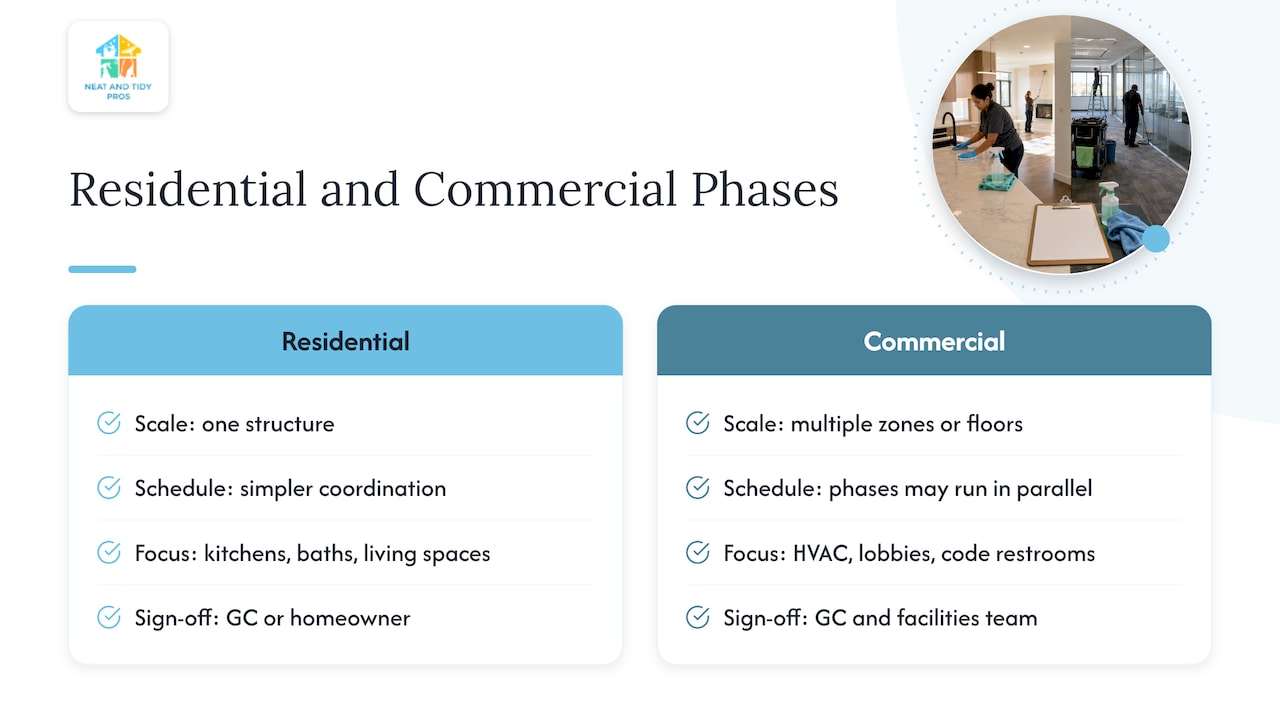
A residential rough clean usually covers a single structure with a handful of trades to track: framing, drywall, flooring, and paint. Detail and final passes focus on kitchens, bathrooms, and living spaces, with cabinet interiors and appliance surfaces as the main fixture-level work. Scheduling tends to be simpler because one general contractor or homeowner coordinates the whole timeline.
Commercial projects multiply the complexity. A single building might have several zones or floors finishing on different schedules, which means rough, detail, and final cleans can be running in parallel across the site rather than in one straight sequence. Commercial spaces also bring fixtures residential jobs rarely have: large HVAC systems, elevator lobbies, restrooms built to code, and sometimes specialized areas like medical suites or display centers that need extra care around sensitive equipment or finishes.
Access and safety requirements shift too. Commercial sites are more likely to involve multiple contractors on site at once, stricter hard-hat zone enforcement, and sign-off from a property manager or facilities team in addition to the general contractor. Written scope documents matter even more here, since more stakeholders means more room for assumptions about what’s included in each pass.
Common Problems That Show Up During Each Cleaning Phase
Even a well-planned schedule runs into friction, and most of it is predictable.
During rough clean, the most common issue is starting too early, before a trade has genuinely finished, which means the crew cleans up dust that gets replaced within hours. The fix is simple: confirm with the site supervisor that a zone is complete before sending in the cleaning crew, rather than working off a calendar date alone.
Detail clean often runs into leftover adhesive from protective film or stickers that won’t come off with a dry wipe. A combination of a plastic scraper and a mild adhesive remover usually solves this without damaging the finish underneath, but it’s worth testing on a small area first on delicate surfaces like painted trim or specialty glass.
Final clean’s biggest risk is dust resettling before the walkthrough. If HVAC systems are running or trades are still finishing punch-list items nearby, fresh dust can land on surfaces cleaned just hours earlier. Building in that 24 to 48 hour buffer after the last dust-producing work, and doing a final pass on glass and flooring last, cuts down on last-minute redo work.
Across all phases, the most persistent challenge is scope confusion: a crew shows up expecting to do a detail clean when the client expected a final clean. A written, phase-specific scope attached to each booking is still the simplest fix.
How We Approach Phased Construction Cleaning
Construction cleaning is often run as a structured three-phase package with checkpoints between each pass, so a rough clean is verified complete before detail work starts, and detail work is verified before final clean begins. This structure keeps silica and dust controls consistent from the first pass to the last, using HEPA-rated equipment and wet methods as standard rather than as an upgrade.
Coordination directly with general contractors and property managers to confirm trade completion dates and punch-list status before scheduling each pass can avoid the most common cause of rework: cleaning a zone before it’s actually ready. Such coordination, paired with a written scope for every phase, helps keep a three-pass clean from turning into a four-pass clean.
— Neat
Book a Phased Construction Clean With Neat and Tidy Pros
The full three-phase stack (rough, detail, and final) is often offered as well as single-phase bookings when only one pass is needed. Extras like exterior window washing, HVAC register cleaning, and post-occupancy touch-ups can be added to packages.

To get an accurate quote, have a few details ready: total square footage, which phases you need covered, site access conditions (stairs, elevators, loading docks), and whether the building falls under EPA RRP rules for lead-containing materials. That information lets us scope the job correctly the first time instead of adjusting mid-project.
- Request a quote through our Construction Cleaning page with your square footage and phase needs.
- Browse our full Services page if your project also needs commercial or move-in cleaning once construction wraps.
- Check our dust removal guidance if silica or heavy dust control is a concern on your site.
If exterior pavement markings or parking lot sweeping are part of your site cleanup, Pin Point Line & Marking handles that work as a specialist partner. And if new interior doors need low-dust installation alongside your final clean, One Day Doors and Closets has practical guidance on keeping that process mess-free.
Reach out through our Construction Cleaning page to lock in your dates and get a phase-by-phase quote.
FAQ
What does a construction clean include?
A construction clean typically includes three passes: rough clean (bulk debris removal), detail clean (surface dusting, fixture and window cleaning), and final clean (inspection-level polish before handover). Extras like exterior window washing or HVAC register cleaning are often added separately.
What is the sequence of cleaning in a construction project?
The sequence runs rough clean first, right after heavy demolition or framing work, followed by detail clean once finishes like paint and flooring are installed, and final clean last, right before occupancy or walkthrough. Each pass should wait until the trade work ahead of it is genuinely complete to avoid redoing work.
What are the stages of construction cleanup?
Most construction cleanup follows a three-stage model: rough, detail (sometimes called light or standard), and final or touch-up. Some guides describe a four-stage version that splits preparation from the rough-clean pass, but the underlying tasks are the same.
What is the 5-5-5 rule for cleaning?
The 5-5-5 rule isn’t a standard framework used in construction cleaning phases, and definitions of it vary depending on the source. If you’ve seen it referenced for general household cleaning, it doesn’t map directly to the rough, detail, and final phases used on construction sites.
When should I hire a professional for post-construction cleaning?
Hiring a specialist makes the most sense for the detail and final passes, where HEPA-rated equipment and inspection-level standards matter most. Booking two to four weeks ahead of your expected handover date helps secure your preferred dates and avoid rescheduling fees.
Sources
- Silica, Crystalline – Construction | Occupational Safety and Health Administration
- Lead Renovation, Repair and Painting (RRP) Program | EPA