
A clean office kitchen comes down to sorting tasks by how often the surface is touched. Wipe counters, sinks and handles every day. Empty the food trash daily. Clear the fridge weekly. Do the appliance interiors, cabinets and floor edges monthly. The checklist below follows that rhythm, and it works whether you call the room a kitchen, a breakroom or a pantry.
We clean offices and commercial spaces in Orange County and Corona, California. The list below is the one we would hand an office manager who asks what a kitchen should look like at 5 p.m. on a Friday.
TL;DR
- Split the work into daily, weekly and monthly tasks. The busiest surfaces (counters, sink, microwave, fridge handle, coffee station) need attention every day.
- Under OSHA’s sanitation standard, food waste receptacles must be emptied at least once every working day, so the kitchen trash is never a “skip it today” item.
- Clean first, then disinfect. A disinfectant only works if the surface is wet with it for the full contact time on the label.
- Give every task one named owner and one sign-off line. A checklist nobody signs is just a poster.
- Daily upkeep can be done in-house. Monthly deep work is where a professional crew saves the most time.
Table of Contents
- Why the office kitchen needs its own checklist
- Before you start: supplies and the order of work
- Daily office kitchen cleaning checklist
- Weekly checklist
- Monthly deep clean checklist
- The pantry and snack area
- Sanitizer basics: what the label tells you
- Who does what: set owners and a log
- Our perspective
- When to bring in professional cleaners
- FAQ
- Sources
Why the office kitchen needs its own checklist
Most office cleaning lists treat the kitchen as one line item between restrooms and floors. In practice it is the one room where food, hands, water and shared appliances meet. Spills dry on counters, a forgotten lunch turns in the fridge, and the microwave collects splatter from thirty people.
There is also a rule behind it. OSHA’s sanitation standard says that all places of employment must be kept clean to the extent the nature of the work allows, and it includes specific requirements for waste containers where employees are allowed to eat or drink. A checklist is how you show that standard is being met day after day.
If you want the whole building covered, pair this page with our 15 minute daily office cleaning list and scope of work. This one stays inside the kitchen door.
Before you start: supplies and the order of work
A short setup saves repeat trips. Gather these before the first wipe:
- Two color-coded cloth sets or disposable wipes (one for food surfaces, one for floors and the trash area)
- A general-purpose cleaner or dish soap for the cleaning step
- An EPA-registered sanitizer or disinfectant for the second step
- Non-abrasive scrub pads, a sink brush and a microwave-safe bowl
- Trash liners, gloves, a dust-mop or broom, and a mop
- A “wet floor” sign
Then work top to bottom, and clean to dirty: shelves and cabinet fronts first, then counters and appliances, then the sink, and finally the floor. Do the trash last so you are not carrying it past surfaces you just finished.
Clean first, then disinfect
This is the step most offices get wrong. Disinfectants are not cleaners. Crumbs, grease and film shield germs from the product, so remove visible soil with soap and water, then apply the disinfectant or sanitizer.
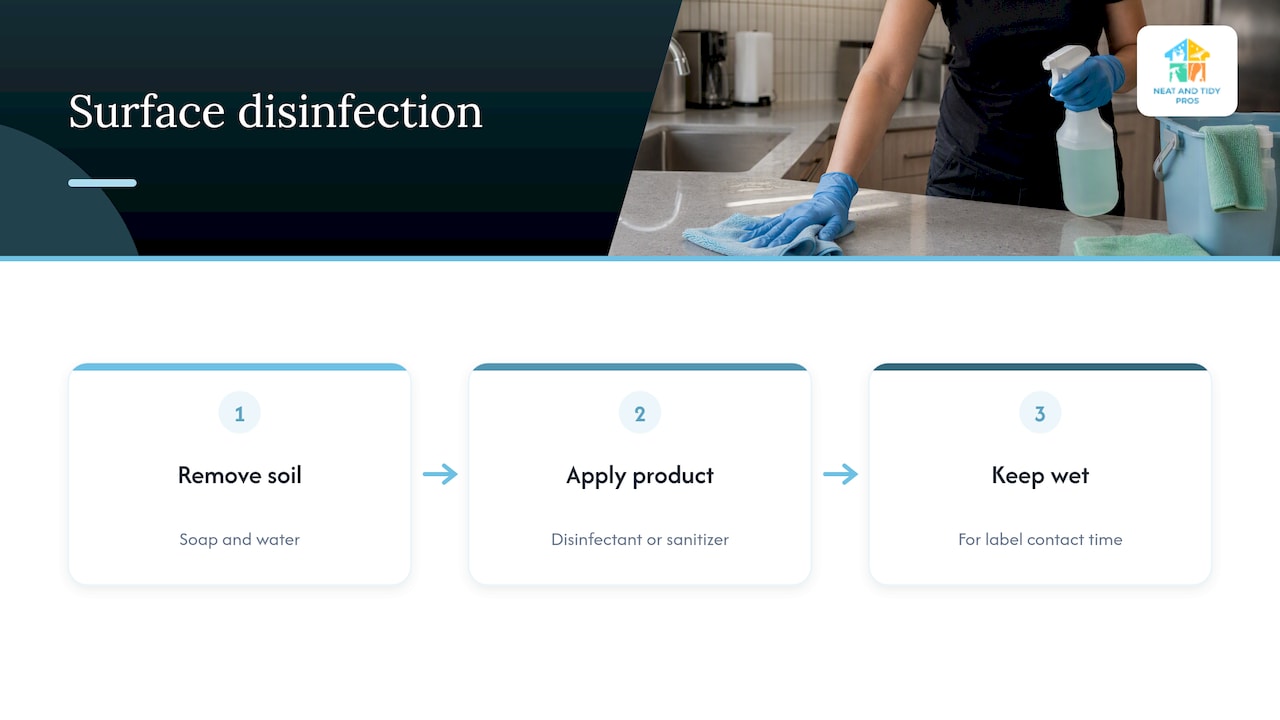
Then leave it wet. The EPA-registered label for a common hard-surface sanitizer calls for removing gross food particles and soil first, and sanitizing claims on food-contact surfaces depend on the surface staying wet for the stated time. Contact times differ by product, from seconds to several minutes, so read the label on the bottle in your cabinet rather than trusting a rule of thumb. If a wipe-on, wipe-off habit has been the norm in your office, that alone is a quick win.
For a deeper walk-through, see our guide to doing a surface disinfection process right.
Daily office kitchen cleaning checklist
These are the tasks that cannot wait. Plan on 10 to 15 minutes at close of business in a small office, plus a quick pass at midday in a busy one.
End-of-day tasks
- Empty the trash and recycling. Replace liners. Food waste must go out every working day under the OSHA rule, and bins that handle food waste need tight-fitting covers unless sanitary conditions can be kept without one.
- Load or wash dishes. Run the dishwasher if you have one, or clear the sink completely. Dishes left overnight are the top cause of morning odor.
- Wipe the counters. Clean with soap and water, then sanitize and let it sit for the label’s contact time.
- Clean the sink and faucet. Rinse out food particles, scrub the basin, and wipe the handles, which are touched by everyone.
- Wipe the microwave. Remove the splatter inside, then clean the door handle and keypad.
- Wipe appliance exteriors. Fridge door and handle, coffee maker, kettle, toaster and water dispenser buttons.
- Clean the tables and chair backs if people eat in the room.
- Sweep and spot-mop the floor. Focus on the area in front of the sink, fridge and trash.
- Restock. Soap, paper towels, napkins, dish detergent, coffee supplies and trash liners.
- Initial the log. One name, one time.
The midday pass
In offices with a steady lunch crowd, a five-minute reset around 1 p.m. keeps the room usable: wipe spills, clear the sink, top up soap and towels, and pull anything overflowing from the bin. This is not cleaning, it is damage control, and it means the evening work starts from a manageable place instead of a pile.
Handwashing sets the standard
The best-supported fact about shared kitchens is that hands spread the problem. The CDC’s norovirus guidelines say that hand washing with soap and running water for at least 20 seconds is the most effective way to reduce norovirus on the hands, with sanitizer as a backup rather than a replacement. A sign at the sink and a full soap dispenser do more than any extra wipe-down.
Weekly checklist
Weekly tasks catch what daily upkeep misses. Pick one day, such as Thursday or Friday, so the fridge is cleared before the weekend.
| Task | What to do | Why it matters |
|---|---|---|
| Clear the fridge | Toss expired and unlabeled food, wipe shelves, door seals and drawers | Stops odors and cross-contamination |
| Wipe cabinet fronts and handles | Clean, then sanitize handles | Handles are high touch |
| Clean the coffee station | Descale or rinse carafes, wipe spill trays, replace the filter basket | Residue and mold build up quickly |
| Clean small appliances | Toaster crumb tray, kettle exterior, blender or water dispenser spout | Crumbs attract pests |
| Mop the whole floor | Move chairs and trash cans, mop edges | Daily spot-mopping misses corners |
| Wipe walls near the sink and trash | Remove splashes and fingerprints | Grease and splashes stain |
| Disinfect the trash cans | Wash the inside and outside of bins | Liners leak |
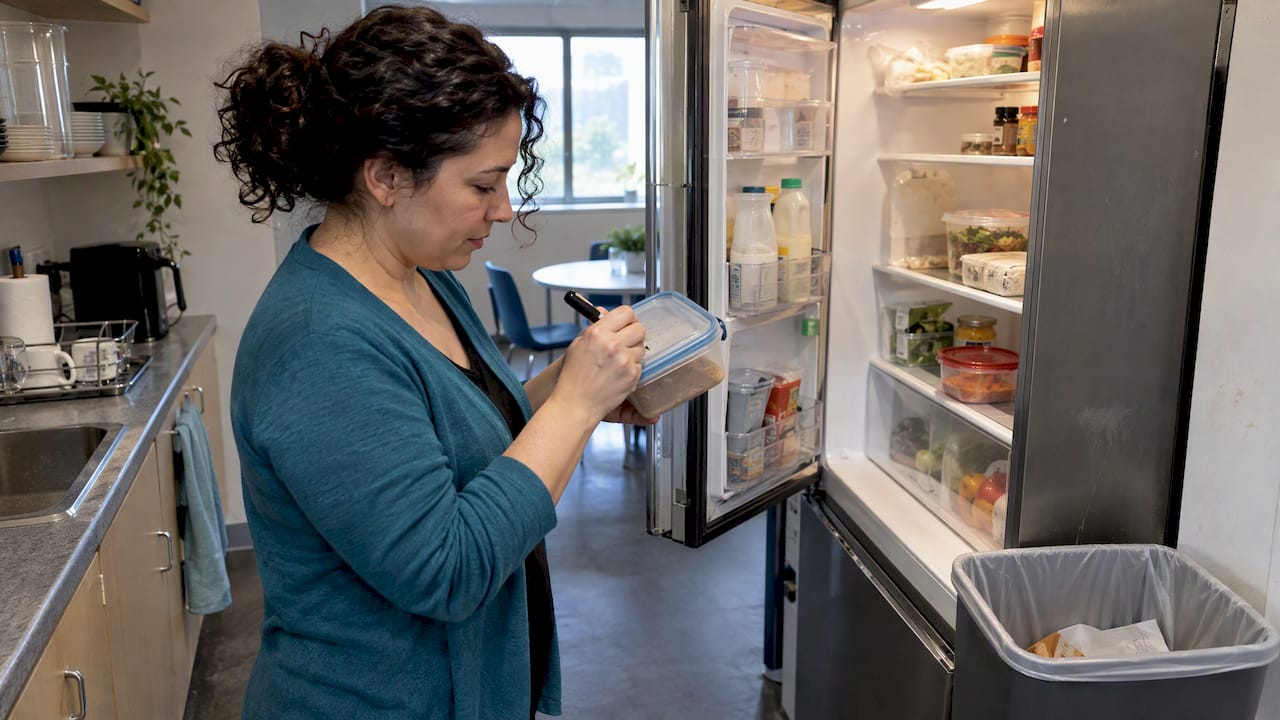
Make the fridge purge a habit
Choose a fixed day and announce it. A reminder in the team chat on Thursday afternoon (“fridge clear-out at 4 p.m., label it or lose it”) is enough. Ask people to write a name and date on anything they leave, and put a bin and a marker on the fridge door. It removes the awkward question of who is allowed to throw something out.
Monthly deep clean checklist
The monthly pass is what keeps a kitchen from slowly looking tired. It is also the work that takes real time and a bit of equipment, so many offices hand it to a pro crew.
- Deep clean the refrigerator and freezer. Empty, wash the shelves and drawers, clean the gaskets, wipe the interior walls and dry before restocking.
- Clean inside the microwave and any toaster oven. Steam a bowl of water to loosen baked-on food, then scrub.
- Descale the coffee machine and kettle, following the manufacturer’s instructions.
- Clean the dishwasher. Clear the filter, wipe the seal and run a cleaning cycle.
- Degrease the area around the sink and range if you have one: backsplash, cabinet faces and handles.
- Wipe the insides of cabinets and drawers and check for expired pantry items.
- Scrub floor grout and corners. Pull out appliances where you can do it safely.
- Clean the tops of cabinets and the fridge, where grease and dust collect.
- Dust vents and light fixtures within reach.
- Wash windowsills, blinds and glass doors, if the kitchen has them.
- Check the log, note any repairs (leaky tap, loose seal, cracked tile) and report them to facilities.
A monthly pass also gives you a natural moment to check that supplies and appliances are in good condition. Our office cleaning schedule for small businesses shows how to fit these monthly tasks around the rest of the building.
The pantry and snack area
Many offices now have a pantry, snack shelf or vending setup next to the kitchen. The same rules apply, with a few extras:
- Wipe shelves and containers weekly, and check dates on shared items.
- Keep open food in sealed containers, because loose snacks draw ants and mice.
- Wipe the coffee, tea and condiment station daily, since sticky spills collect there.
- If you stock the area through a vending or micro-market provider, agree who restocks and who cleans. Workplace vending and micro-market programs are typically serviced on a restocking schedule, so ask that your supplier wipes down its own machines and shelving during visits. That keeps the cleaning crew’s scope clear.
Sanitizer basics: what the label tells you
Three things on the label matter more than the brand name.
- The surface type. Food-contact surfaces and non-food surfaces can have different instructions. The EPA label for a common alcohol-based sanitizer, for example, has directions specific to food-contact use.
- The contact time. The surface stays visibly wet for the whole stated time. If it dries sooner, reapply.
- Rinse requirements. Some products require a potable-water rinse on food-contact surfaces, others allow air drying.
If you use bleach for a suspected stomach-bug outbreak, the CDC guidance for norovirus recommends an EPA-registered disinfectant or a bleach solution of 1,000 to 5,000 ppm on hard, nonporous surfaces, made fresh, and that is the sort of situation to run past your facility manager or a professional rather than improvise. Never mix bleach with ammonia-based or acidic products.
Who does what: set owners and a log
The most common reason office kitchens decline is unclear ownership. A simple layout works:
| Frequency | Owner | Sign-off |
|---|---|---|
| Midday reset | Office manager or rotating team member | Initials on the log |
| End of day | Office staff or evening cleaning crew | Initials and time |
| Weekly | Named person, plus the whole team for the fridge | Date and initials |
| Monthly | Professional crew or facilities | Signed checklist |
Post a one-page version on the fridge or inside a cabinet door. Keep the log for a few months so you can spot patterns, such as a drawer that is always overlooked.
Our perspective
After 15 years of cleaning homes and commercial spaces, we have learned that office kitchens rarely fail because the people there do not care. They fail because the list is vague, the supplies run out or nobody owns the fridge.
We write our commercial checklists by surface and by frequency, because that is how a cleaner moves through a room and how a manager inspects it. We use safe, eco-friendly products and send fully equipped teams, so the kitchen gets the same attention as the lobby. Our advice is to keep the daily list short enough to actually finish, and let the monthly deep clean carry the heavy work.
For most small and mid-size offices in Orange County and Corona, the best split is simple. Staff handle the midday reset and the Friday fridge purge. A professional team handles the nightly cleaning and the monthly deep clean.
— Neat
When to bring in professional cleaners
Doing it in-house is fine if the kitchen is small and one person truly owns it. Consider a professional service when:
- The kitchen is shared by a large team and the daily wipe-down keeps slipping.
- Appliances need a real deep clean (fridge interior, oven, dishwasher, grout).
- You manage several suites or a property where standards must be consistent.
- Inspections, tenants or clients visit regularly.
- Your staff would rather spend their time on their job.
Our commercial cleaning service covers offices and other business spaces in Orange County and Corona, with recurring or one-time visits, and you can book online or by phone. If your kitchen has fallen behind, a one-time deep clean resets it so a routine can start from a clean baseline. To see everything we offer, visit our services page. We don’t publish prices, so contact us for a quote based on your space.
Don’t forget the neighbors of the kitchen. Our restroom checklist for offices and high-touch disinfection checklist pair well with this one, and our cubicle cleaning routine covers the workspaces.
FAQ
What should be on a daily office kitchen cleaning checklist?
Empty the trash and recycling, wash or load dishes, wipe and sanitize counters, clean the sink, wipe the microwave and appliance exteriors, spot-mop the floor and restock soap and paper towels. Sign off on a log. Food waste in particular must be emptied at least once each working day under OSHA’s sanitation standard.
How often should the office fridge be cleaned?
Wipe the door handle and spills daily, clear out old and unlabeled food weekly, and do a full empty-and-wash monthly. Picking one fixed day for the weekly clear-out keeps it from turning into a debate.
What is the difference between cleaning and disinfecting in a break room?
Cleaning removes visible soil with soap and water. Disinfecting uses an EPA-registered product to kill germs, and it only works on a clean surface that stays wet for the label’s contact time. The EPA product label lists the exact steps for that product.
Does a break room checklist differ from a restaurant kitchen checklist?
Yes. A break room has lower volume and no commercial cooking, so there are no grease traps or hood systems to maintain. If your business prepares food for customers, see our restaurant kitchen cleaning checklist instead.
Why do a monthly office cleaning routine at all?
Daily work keeps surfaces presentable, but it does not reach appliance interiors, cabinet tops, grout or vents. A monthly pass catches that buildup before it becomes a smell, a pest problem or a repair.
Sources
- OSHA 1910.141, Sanitation
- CDC, Updated Norovirus Outbreak Management and Disease Prevention Guidelines
- US EPA pesticide product label, Alpet D2