
Commercial cleaning is quoted by calculating labor hours from a facility’s square footage and production rate, then multiplying by a fully loaded hourly cost plus a target profit margin. This method gives providers an accurate, defensible price rather than a gut-feel number. Three pricing models flow from this calculation: per square foot, hourly, and flat monthly rates. Each model suits different facility types and service complexities, and understanding which one applies to your building is the first step toward evaluating any estimate you receive.
How commercial cleaning is quoted using production rate formulas
The production rate is the number of square feet one cleaner can clean per hour under normal conditions. It is the engine behind every accurate commercial cleaning quote. ISSA standards are the industry gold standard for these rates, and most professional providers anchor their estimates to them.
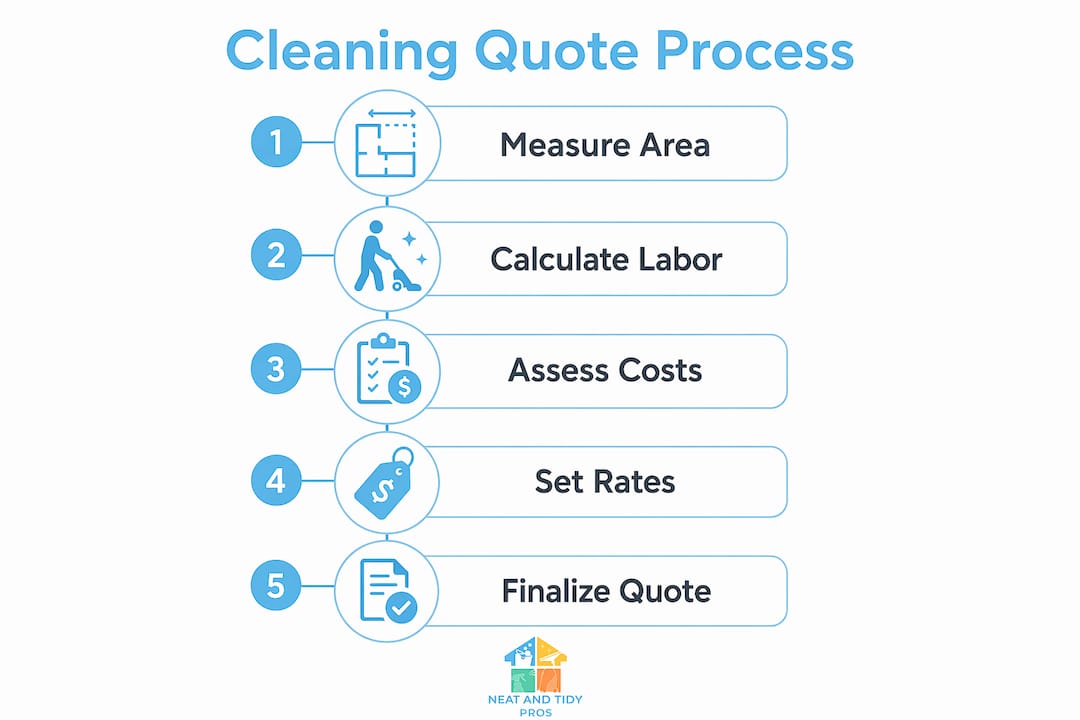
The calculation works in three steps:
- Measure total cleanable square footage. Exclude non-cleaned areas like mechanical rooms or locked storage.
- Divide by the applicable production rate. This gives you estimated labor hours per visit.
- Multiply labor hours by the fully loaded hourly cost. Add your target profit margin to reach the final price.
Facility type drives production rates significantly. A standard office runs roughly 3,000 sq ft per hour. A medical facility drops to around 1,800 sq ft per hour because of sanitization protocols. A warehouse can reach 5,000 sq ft per hour due to open floor plans and minimal detail work. That gap directly affects labor hours and, therefore, price.
Square-foot pricing alone is not sufficient for complex or unique facilities. Experienced providers use square footage as a starting anchor, then adjust for specifics like restroom count, floor type, and soiling level to protect profitability.
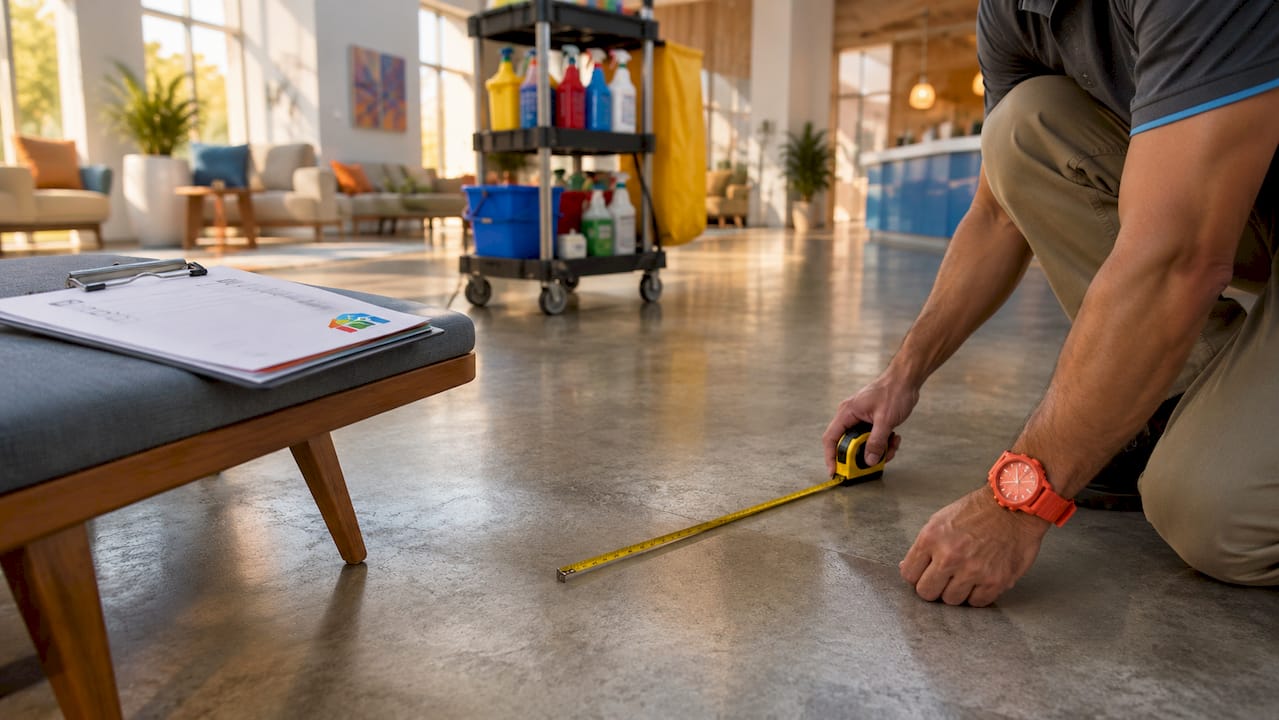
Pro Tip: Always conduct a physical site walk-through before finalizing any production rate assumption. Photos and floor plans miss critical details like high-traffic corridors, specialty flooring, and restroom configurations that directly affect labor time.
What goes into a fully loaded hourly labor cost?
Base wage is only one part of the true cost of putting a cleaner on-site. Most cleaning companies underestimate fully loaded labor costs by 30–50% by ignoring travel, administrative time, and overhead. That mistake turns a profitable contract into a money-losing one.
A fully loaded hourly cost includes all of the following:
- Base hourly wage (subject to California minimum wage laws and local Orange County rates)
- Payroll taxes (Social Security, Medicare, state unemployment)
- Workers’ compensation insurance (higher for cleaning than many industries)
- General liability insurance
- Uniforms and supplies allocated per labor hour
- Paid leave and benefits
- Non-billable time such as travel between sites and pre-shift setup
- Administrative overhead including scheduling, invoicing, and management
Payroll taxes, insurance, and overhead typically add 25–45% on top of base wages. In California, where labor costs run higher than the national average, that burden sits toward the upper end of that range.
Ignoring non-billable hours and overhead can cost a cleaning business 30–50% in lost potential revenue over time. Every hour a cleaner spends traveling between sites or handling pre-shift prep is a real cost that must appear somewhere in the quote.
Once you have the fully loaded cost, the billing rate formula is straightforward. Divide the fully loaded cost by the result of one minus your target gross margin. At a fully loaded cost of $32 per hour and a 45% target margin, the billing rate comes out to approximately $58 per hour. That is the number that should appear in your quote, not the base wage.
Pro Tip: Review your fully loaded cost assumptions at least twice a year. California labor law changes, insurance renewals, and fuel costs all shift the true cost of service. A quote built on stale numbers quietly erodes your margin.
How per-visit costs become flat monthly contract rates
Flat monthly pricing is the standard structure for recurring commercial cleaning contracts. Clients prefer it because it makes budgeting predictable. Providers benefit because it locks in a stable revenue stream tied to a defined scope.
The conversion from per-visit cost to monthly rate is direct. Multiply the cost per visit by the number of visits per month. A facility that costs $250 per visit and receives service five times per month generates a monthly contract value of $1,250. Rounding to a clean, quotable figure like $1,250 instead of $1,247 adds professionalism and builds client confidence without meaningfully affecting your margin.
Contract terms must tie scope and frequency to price. If a client adds a conference room to the scope or increases visit frequency, the contract price adjusts accordingly. Providers who fail to build these triggers into their agreements absorb the added cost silently. That is how profitable contracts become unprofitable ones over time.
The table below compares the four common rate structures used in commercial cleaning quotes:
| Rate structure | How it works | Best suited for | Sample figure |
|---|---|---|---|
| Per square foot | Fixed rate multiplied by cleanable sq ft | Quick estimates, standard offices | $0.07–$0.20 per sq ft |
| Hourly | Billing rate times actual hours worked | Variable-scope or one-time jobs | $30–$75 per hour |
| Per visit | Fixed cost per cleaning visit | Defined-scope recurring work | $150–$500 per visit |
| Flat monthly | Per-visit cost times monthly frequency | Ongoing contracts with stable scope | $500–$3,000+ per month |
Clients who understand this structure can evaluate quotes more accurately. A quote that looks low on a per-square-foot basis may carry hidden hourly overruns if the scope is not clearly defined.
What factors affect cleaning quote variability in Orange County?
Orange County’s commercial real estate mix spans medical offices in Irvine, industrial warehouses in Anaheim, and professional office parks in Newport Beach. Each facility type carries a different production rate and a different price range. Standard recurring office cleaning runs $0.07–$0.20 per square foot. Medical facilities command $0.15–$0.35 per square foot due to sanitization requirements. Warehouses typically fall in the $0.05–$0.12 range.
Beyond facility type, several variables shift the final number:
- Cleaning frequency: Daily service costs less per visit than weekly because crews maintain a baseline rather than restoring a neglected space.
- Soiling level: High-traffic lobbies, food service areas, and restrooms require more time per square foot than private offices.
- Building complexity: Multi-story buildings, elevator lobbies, and exterior-facing glass all add labor time.
- Add-on services: Floor stripping and waxing, carpet extraction, and window cleaning carry separate line items.
- Supply costs: Some contracts include consumables like paper products and soap; others do not.
A thorough site walk-through captures these variables before a quote is finalized. Restrooms, high-traffic areas, and floor types all influence labor time in ways that a floor plan cannot communicate.
The table below shows typical price ranges by facility type for Orange County in 2026:
| Facility type | Per sq ft range | Notes |
|---|---|---|
| Standard office | $0.07–$0.20 | Most common; production rates around 3,000 sq ft/hr |
| Medical or dental | $0.15–$0.35 | Sanitization protocols reduce production rate |
| Industrial or warehouse | $0.05–$0.12 | High production rate offsets lower per-sq-ft price |
| Retail or restaurant | $0.10–$0.25 | High soiling and foot traffic increase labor time |
Local labor costs also matter. Orange County wages run above the California state average in many trades, and cleaning is no exception. Providers who do not account for this in their fully loaded cost calculations will underprice their services relative to the true cost of delivery.
Key Takeaways
Accurate commercial cleaning quotes require production rate formulas, fully loaded labor costs, and a defined scope tied to a flat monthly rate that protects both client budgets and provider margins.
| Point | Details |
|---|---|
| Production rate drives labor hours | Divide total sq ft by the production rate to get hours per visit, then price from there. |
| Fully loaded cost beats base wage | Add taxes, insurance, overhead, and non-billable time to avoid underpricing by 30–50%. |
| Flat monthly rates need scope triggers | Build contract clauses that adjust price when scope or frequency changes. |
| Facility type sets the price range | Medical facilities cost more per sq ft than warehouses due to lower production rates. |
| Site walk-throughs validate assumptions | Floor plans miss restroom counts, floor types, and soiling levels that affect labor time. |
What I’ve learned about quoting commercial cleaning the right way
The biggest mistake I see in this industry is quoting to match a client’s budget instead of quoting to cover real costs. A facility manager in Irvine once told me a competitor had offered to clean their 8,000-square-foot medical office for $0.09 per square foot. That number is below the cost of delivery for a medical-grade clean. The competitor either did not understand their own costs or planned to cut corners on service. Neither outcome serves the client.
The production rate method works because it forces you to be honest about time. When you walk a site and count restrooms, assess floor types, and note high-touch surfaces, you stop guessing. The numbers tell you what the job actually costs. From there, applying a transparent pricing approach and a fair margin is not negotiation. It is professionalism.
Margin discipline is non-negotiable in Orange County’s market. Labor costs here are real, insurance is expensive, and clients expect consistent quality. Providers who negotiate their price down to win a contract often lose money on it within 90 days. The right client will pay a fair price for a well-documented scope. The wrong client will always want a lower number, and no margin can survive that pressure indefinitely.
— Neat
Neatandtidypros serves Orange County businesses with clear, accurate quotes
Neatandtidypros applies the production rate method and fully loaded cost calculation to every commercial cleaning quote it prepares for Orange County businesses. Every estimate starts with a site walk-through, not a floor plan guess.

Whether your facility is a medical office in Irvine, a professional suite in Newport Beach, or a warehouse in Anaheim, Neatandtidypros builds a quote that reflects the actual scope, frequency, and complexity of your space. Pricing is transparent, contract terms are clear, and adjustments are documented when scope changes. Visit the services page to review available options or request a customized quote for your facility.
FAQ
How is a commercial cleaning quote calculated?
A commercial cleaning quote is calculated by dividing a facility’s square footage by the applicable production rate to get labor hours, then multiplying by the fully loaded hourly cost and adding a profit margin.
What is a production rate in commercial cleaning?
A production rate is the number of square feet one cleaner can cover per hour. It varies by facility type: roughly 3,000 sq ft per hour for offices, 1,800 for medical facilities, and 5,000 for warehouses.
Why do commercial cleaning prices vary so much?
Prices vary because facility type, soiling level, cleaning frequency, and local labor costs all affect the true cost of service. Medical and dental offices cost more per square foot than warehouses due to stricter sanitization requirements.
What is a flat monthly cleaning contract?
A flat monthly contract multiplies the per-visit cost by the number of monthly visits to create a fixed, predictable billing amount. It protects client budgets and provider margins as long as the scope stays consistent.
How do I know if a commercial cleaning quote is accurate?
Ask the provider how they calculated labor hours and what their fully loaded hourly cost includes. A credible quote references a site walk-through, a defined scope, and a documented production rate rather than a simple square-foot estimate.