Commercial cleaning is defined as the professional cleaning and maintenance of non-residential spaces, structured to deliver consistent hygiene, safety, and operational results across shared-use environments. Unlike a one-time home scrub-down, commercial cleaning operates as an ongoing service program governed by documented procedures and compliance standards set by organizations like ISSA, the CDC, and OSHA. For business owners and facility managers in Orange County, understanding what commercial cleaning actually covers, and how it differs from residential cleaning, is the first step toward protecting your workforce, your clients, and your facility’s reputation.
What is commercial cleaning and what does it include?
Commercial cleaning is professional cleaning and maintenance of non-residential spaces focused on hygiene and operational outcomes. That definition covers a wide range of tasks, from the routine to the highly specialized, and the scope depends on your facility type, foot traffic, and regulatory environment.
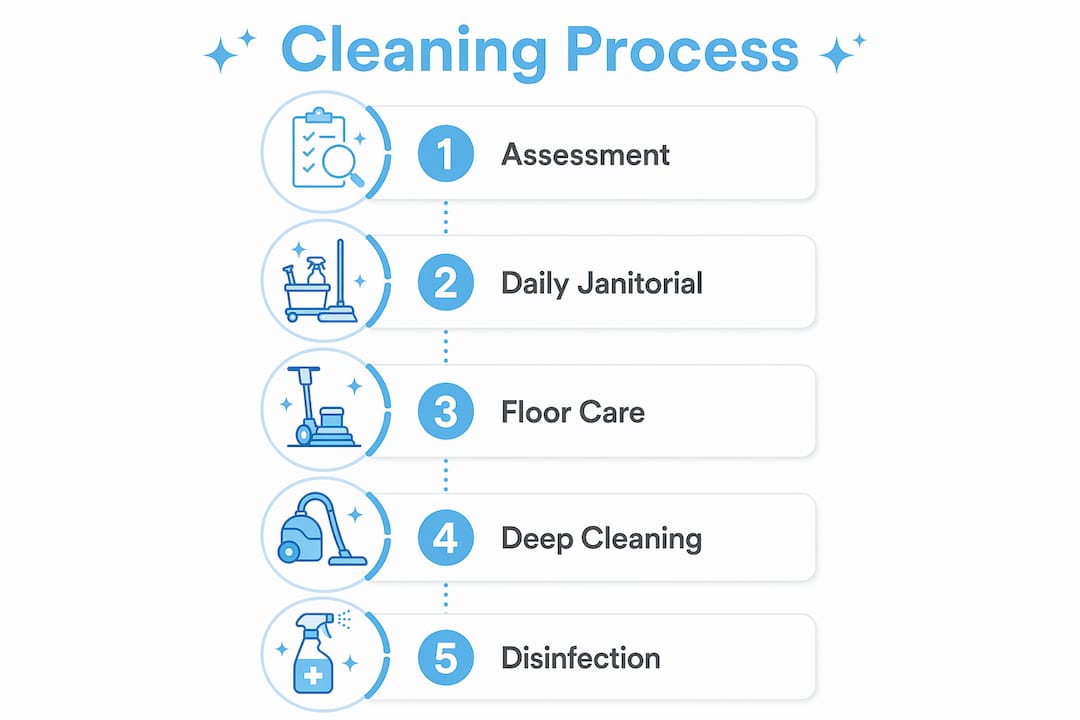
Routine janitorial services
The foundation of any commercial cleaning program includes daily or weekly janitorial tasks. These cover dusting surfaces, emptying trash, sanitizing restrooms, sweeping hard floors, and mopping. For an Orange County office building with 50 employees, these tasks alone require a structured schedule to prevent buildup and maintain a professional appearance.
Floor care and surface maintenance
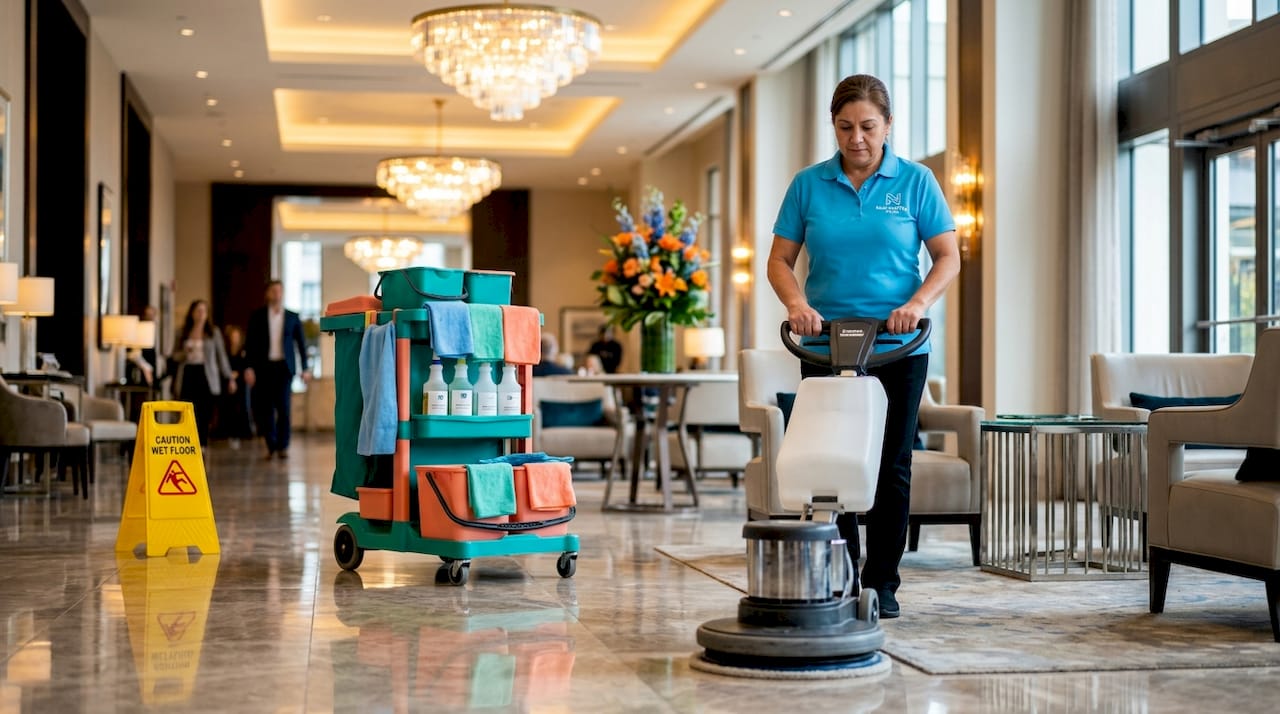
Commercial floor cleaning goes well beyond mopping. Professional programs include carpet extraction, hard floor stripping, buffing, and waxing. High-traffic lobbies and retail floors in particular require periodic restorative treatments that consumer-grade equipment simply cannot replicate. P&G PRO, for example, offers professional-grade products that reduce labor effort while improving consistency across commercial floor care tasks.
Specialty and deep cleaning services
Commercial cleaning programs are more comprehensive than standard janitorial work. They include specialty services such as window washing, pressure washing exterior surfaces, post-construction cleanup, and periodic deep cleaning of high-risk zones like break rooms and server areas. These tasks are not performed daily but are scheduled based on facility need and risk assessment.
Infection control and disinfection
Infection-control work is guided by CDC and OSHA, focusing on disinfection of high-touch, high-traffic surfaces in shared-use settings. This includes door handles, elevator buttons, shared workstations, and restroom fixtures. In healthcare, retail, and food service environments, this layer of service is not optional. It is a compliance requirement.
Pro Tip: Ask any prospective cleaning vendor to show you their written disinfection protocol. If they cannot produce one, their infection-control practices are likely inconsistent.
How does commercial cleaning differ from residential cleaning?
The distinction between commercial and residential cleaning is not just about building size. It comes down to purpose, process, and accountability.
Commercial cleaning follows documented procedures, schedules, and compliance standards tailored to workplace hygiene and operational continuity. Residential cleaning is informal and preference-driven. A homeowner might ask a cleaner to skip the guest bedroom or use a specific brand of surface spray. A facility manager at a medical office in Irvine cannot make those same informal calls because regulatory standards apply.
The table below captures the core differences that matter most to Orange County business owners evaluating their options.
| Factor | Commercial cleaning | Residential cleaning |
|---|---|---|
| Setting | Offices, retail, healthcare, industrial | Private homes and apartments |
| Frequency | Scheduled, protocol-driven | On-demand or preference-based |
| Compliance | CDC, OSHA, ISSA standards required | No regulatory requirements |
| Equipment | Industrial-grade machines and agents | Consumer-grade products |
| Accountability | Service agreements and quality audits | Informal arrangements |
| Scope | Includes specialty and infection-control tasks | General tidying and surface cleaning |
Higher foot traffic is the single biggest driver of complexity in commercial environments. A busy Orange County retail store might see hundreds of customers per day, each introducing contaminants to shared surfaces. That volume demands operational consistency that residential cleaning simply is not designed to provide.
What standards and regulations guide commercial cleaning?
Professional commercial cleaning does not operate on instinct. It operates on standards, and knowing which ones apply to your facility helps you hold vendors accountable.
The key regulatory and industry bodies shaping commercial cleaning practices include:
- ISSA (Worldwide Cleaning Industry Association): Sets training benchmarks, certification programs, and best-practice frameworks for commercial cleaning professionals. ISSA-certified vendors have demonstrated adherence to documented cleaning processes.
- CDC guidelines: The Centers for Disease Control and Prevention publishes specific disinfection protocols for shared-use environments. Structured cleaning programs align disinfection intensity with risk and traffic patterns, avoiding uniform chemical use across all zones.
- OSHA regulations: The Occupational Safety and Health Administration governs chemical handling, worker safety, and hazard communication in commercial cleaning operations. Vendors must comply with OSHA’s Hazard Communication Standard when using industrial cleaning agents.
- EPA-registered disinfectants: The Environmental Protection Agency maintains a list of approved disinfectants effective against specific pathogens. Reputable commercial cleaners use only EPA-registered products for infection-control tasks.
Facility managers should align disinfection protocols with CDC and OSHA guidance, integrating cleaning with broader public health strategies. For Orange County businesses in regulated industries like healthcare, food service, or childcare, this alignment is not a best practice. It is a legal obligation. Vendors who cannot demonstrate compliance with these standards expose your business to liability.
The practical impact of these standards shows up in product selection, cleaning frequency, and worker training. A compliant vendor will not use the same disinfectant on a food prep surface as on a concrete warehouse floor. That kind of site-specific judgment separates professional commercial cleaning from general maintenance.
How to choose the right commercial cleaning service in Orange County
Selecting a commercial cleaning provider is a business decision, not a commodity purchase. The wrong vendor creates compliance gaps, inconsistent results, and potential liability. Here is how to evaluate your options systematically.
-
Define your facility’s specific needs. An Orange County medical office requires infection-control expertise and EPA-registered disinfectants. A tech startup in Irvine needs reliable daily janitorial service and periodic post-construction cleaning after office renovations. Start with your actual requirements before comparing vendors.
-
Verify certifications and insurance. Confirm that any vendor holds general liability insurance and workers’ compensation coverage. Ask about ISSA certification or equivalent training credentials. Uninsured vendors leave your business exposed if an accident occurs on your property.
-
Assess customization and scheduling flexibility. Quality commercial cleaning programs tailor disinfection intensity to risk and traffic patterns rather than applying one routine across all areas. A vendor who offers only a fixed package cannot adapt to your facility’s actual needs.
-
Evaluate product standards. Ask whether the vendor uses industry-approved cleaners and EPA-registered disinfectants. Eco-friendly product lines are increasingly available and reduce chemical exposure for your employees without sacrificing efficacy.
-
Establish a service agreement with measurable quality checks. A written contract should specify task frequency, scope, response times for complaints, and inspection protocols. Verbal agreements create ambiguity. A formal service agreement protects both parties and sets clear performance expectations.
Pro Tip: Request a trial period of 30 to 60 days before signing a long-term contract. This gives you real-world data on reliability, communication, and cleaning quality before you commit.
Commercial cleaning enhances workplace health, supports brand image, and improves compliance with health codes. Healthcare, retail, and office sectors in Orange County benefit most from structured programs because their environments combine high foot traffic with regulatory scrutiny. Choosing the right vendor is how you turn that benefit into a consistent operational reality.
Key takeaways
Commercial cleaning is a professional, standards-driven service program that protects workplace health, ensures regulatory compliance, and maintains operational consistency across non-residential facilities.
| Point | Details |
|---|---|
| Core definition | Commercial cleaning covers routine janitorial work, floor care, specialty services, and infection control in non-residential spaces. |
| Regulatory framework | CDC, OSHA, and ISSA standards govern disinfection protocols, chemical handling, and worker safety in commercial environments. |
| Key difference from residential | Commercial cleaning is protocol-driven and compliance-focused; residential cleaning is informal and preference-based. |
| Vendor selection criteria | Verify insurance, certifications, product standards, and customization options before signing any service agreement. |
| Business impact | Consistent commercial cleaning programs improve employee health, support brand image, and reduce compliance risk. |
What most business owners get wrong about commercial cleaning
I have worked with dozens of Orange County businesses across office, retail, and healthcare settings, and the same mistake comes up repeatedly. Owners treat commercial cleaning as a cost to minimize rather than a program to manage. They hire the cheapest vendor, skip the service agreement, and then wonder why their facility looks inconsistent or why an OSHA inspection surfaces a chemical handling issue.
The shift that changes everything is viewing cleaning as an operational function with measurable outcomes, not a background service you set and forget. When a facility manager at a busy Anaheim retail location started tracking restroom complaint rates alongside cleaning schedules, they discovered that their vendor was skipping midday restroom checks on high-traffic days. That single data point led to a contract revision that solved a six-month problem in one conversation.
The other thing I see overlooked is the connection between cleaning quality and employee retention. People notice when their workspace is consistently clean. They also notice when it is not. A well-maintained office signals that leadership takes the work environment seriously. That signal matters more than most business owners realize, especially in competitive Orange County labor markets where talent has options.
Post-construction cleaning is another area where businesses consistently underinvest. After a renovation, fine construction dust infiltrates HVAC systems, settles on surfaces, and creates air quality issues that standard janitorial service cannot address. Specialty cleanup after construction is not a luxury. It is a health and safety requirement.
Commercial cleaning is an investment in workplace culture, compliance, and the long-term condition of your facility. Treat it that way, and the returns show up in ways that go well beyond a clean floor.
— Neat
Neatandtidypros commercial cleaning services for Orange County businesses
If you manage a facility in Orange County and want cleaning services that actually align with the standards covered in this article, Neatandtidypros delivers exactly that. From routine office cleaning and deep sanitation to post-construction cleanup and move-in/move-out services, every program is built around your facility’s specific needs and schedule.
Neatandtidypros uses professional-grade, industry-approved products and follows documented cleaning protocols for every job. Whether you need daily janitorial coverage for a busy Irvine office or a one-time deep clean before a facility inspection, the full range of cleaning services is available to fit your timeline and budget. Contact Neatandtidypros today to discuss a service plan built for your business.
FAQ
What is the commercial cleaning definition?
Commercial cleaning is the professional cleaning and maintenance of non-residential spaces, including offices, retail stores, healthcare facilities, and industrial sites, structured around documented procedures and compliance with CDC, OSHA, and ISSA standards.
How does commercial cleaning differ from residential cleaning?
Commercial cleaning follows standardized schedules and regulatory compliance requirements, while residential cleaning is informal and preference-driven. Commercial environments also require industrial-grade equipment and infection-control protocols that residential services do not provide.
What does commercial floor cleaning involve?
Commercial floor cleaning includes carpet extraction, hard floor stripping, buffing, waxing, and restorative treatments using professional-grade equipment. These processes go beyond mopping and are scheduled based on traffic volume and floor type.
How often should a commercial facility be cleaned?
Cleaning frequency depends on facility type, foot traffic, and regulatory requirements. High-traffic environments like retail stores and medical offices typically require daily janitorial service plus scheduled specialty cleaning, while lower-traffic offices may need less frequent deep cleaning cycles.
What certifications should a commercial cleaning vendor have?
Look for ISSA certification or equivalent training credentials, general liability insurance, and workers’ compensation coverage. Vendors should also demonstrate use of EPA-registered disinfectants and written compliance with OSHA chemical handling requirements.