Indoor air quality directly affects your health, comfort, and how well you think and work. If you do nothing else today, install a carbon monoxide alarm and test your home for radon.
- Poor IAQ causes immediate symptoms like headaches, eye irritation, and fatigue, and raises long-term risks for asthma, cardiovascular disease, and certain cancers.
- Research links cleaner indoor air to measurably better cognitive scores and lower workplace absenteeism.
- Children, elderly adults, pregnant people, and anyone with asthma or heart disease face the highest risk from polluted indoor air.
According to the EPA’s IAQ factsheet, indoor environments can be several times to many times more polluted than outdoor air. That gap exists because modern, energy-efficient buildings seal in contaminants that would otherwise disperse. You breathe that air for most of your waking hours.
Key Takeaways
Poor indoor air quality affects health, productivity, and long-term disease risk, and most of the highest-impact fixes cost very little to implement.
| Point | Details |
|---|---|
| Test radon and install CO alarms | Radon tests cost under $30; mitigate if results reach 4 pCi/L or above. |
| Prioritize source control | Eliminating pollutant sources is more effective and cheaper than filtration alone. |
| Use proper filtration | MERV 11–13 for HVAC systems; true HEPA with appropriate CADR for portable units. |
| Keep humidity at 30–50% | This range limits mold growth and dust mite activity without drying out airways. |
| Neatandtidypros deep cleaning | Removes dust and allergen reservoirs that recirculate into indoor air between professional visits. |
Table of Contents
- Why indoor air quality matters: what IAQ actually means
- What pollutants are in your indoor air?
- How poor indoor air affects your health now and later
- Does better air actually improve productivity and cognitive function?
- Why indoor air problems develop in the first place
- How to assess your indoor air: signs and tests
- How to improve your indoor air: a prioritized plan
- Room-by-room steps you can take today
- Common IAQ myths that can make things worse
- When to get medical care or call a professional
- A cleaning professional’s perspective on IAQ
- Clean air starts with a clean space
- Sources
Why indoor air quality matters: what IAQ actually means
Indoor air quality, or IAQ, refers to the types and concentrations of airborne contaminants inside buildings and how those concentrations affect occupant health, comfort, and well-being. Temperature, humidity, ventilation rates, and the mix of pollutants from indoor and outdoor sources all shape it. The EPA defines IAQ as driven primarily by indoor emission sources and the rate at which outdoor air dilutes or replaces contaminated indoor air.
The mechanics are straightforward. Pollutants enter the air from sources inside the building (cooking, furnishings, cleaning products, occupants) and from outdoor air that infiltrates through gaps and ventilation systems. Ventilation dilutes those concentrations by bringing in fresh outdoor air and exhausting stale indoor air. When ventilation rates fall below what the space needs, contaminants accumulate. When a building is sealed tightly for energy efficiency, that accumulation accelerates.
ASHRAE, the professional society that sets ventilation standards for buildings in the U.S. (including Standard 62.1 for commercial buildings and 62.2 for homes), states clearly that IAQ affects occupant health, comfort, learning outcomes, and work performance. Designing and operating buildings to meet those standards is not optional for good health outcomes.
What pollutants are in your indoor air?
Most indoor air problems trace back to a handful of pollutant categories. Knowing the source helps you target the fix.
- Particulate matter (PM2.5 and PM10): Cooking, candles, tobacco smoke, and tracked-in outdoor dust. Fine particles (PM2.5) penetrate deep into the lungs.
- Volatile organic compounds (VOCs), including formaldehyde: Off-gassing from new furniture, flooring, paints, adhesives, and cleaning products. Formaldehyde is common in pressed-wood products and some insulation.
- Carbon monoxide (CO): Gas stoves, furnaces, fireplaces, attached garages, and any combustion appliance that is not properly vented. Odorless and immediately dangerous at high concentrations.
- Nitrogen dioxide (NO2): Gas stoves and unvented combustion heaters. Chronic low-level exposure irritates airways and worsens asthma.
- Radon: A naturally occurring radioactive gas that seeps from soil and rock through foundation cracks. It has no odor or color.
- Mold and microbial contaminants: Damp basements, leaky roofs, poorly maintained HVAC drip pans, and any surface with persistent moisture.
- Allergens: Dust mite debris, pet dander, cockroach particles, and pollen that infiltrates from outside.
- Biological contaminants: Bacteria and viruses that spread through HVAC systems or accumulate in poorly ventilated spaces.
Radon deserves a separate mention. The EPA estimates it is the second leading cause of lung cancer in the United States. You cannot smell it, see it, or taste it. A short-term radon test kit costs under $30 at most hardware stores, and every home should have one.
If you are moving into a new home or completing a renovation, VOC exposure from fresh materials can be significant. New home cleaning priorities that address off-gassing and surface residues are worth understanding before you settle in.
How poor indoor air affects your health now and later
Health effects from IAQ problems fall into two categories, and the line between them matters for how urgently you act.
Short-term effects appear within hours or days of exposure. They include headaches, dizziness, eye and throat irritation, nasal congestion, fatigue, and difficulty concentrating. These symptoms often mimic a cold or seasonal allergies, which is why many people miss the connection to their building. A useful diagnostic: do symptoms improve when you leave the space and return when you come back? That pattern points to an indoor source.
Long-term effects build over months or years. NIEHS research links sustained indoor air pollution exposure to respiratory disease, cardiovascular effects, cognitive deficits, and developmental impacts on prenatal and childhood lung function. Radon exposure over years raises lung cancer risk substantially. Chronic VOC exposure has been associated with liver and kidney stress and, for certain compounds, cancer risk.
Vulnerable populations face compounded risk. Children breathe more air per pound of body weight than adults, making them disproportionately exposed. Elderly adults and people with existing asthma, COPD, or heart disease have less physiological reserve to absorb the insult. Pregnant people face risks that extend to fetal development. Immunocompromised individuals are especially susceptible to mold and biological contaminants.
If you experience difficulty breathing, chest tightness, severe dizziness, or symptoms that consistently follow a time-and-place pattern tied to a specific building, seek medical care. For suspected mold contamination over large areas, asbestos, or elevated radon, consult a certified IAQ or remediation professional rather than attempting to address it yourself.
Does better air actually improve productivity and cognitive function?
The short answer: yes, and the economic case is stronger than most people expect.
ASHRAE’s position document states that improving IAQ brings substantial health and economic benefits and should be incorporated into building design and operation. That is not a vague endorsement. Studies measuring cognitive test scores in controlled office environments show measurable performance differences tied to ventilation rates and pollutant concentrations.
A review of the scientific evidence on IAQ investment returns found that IAQ improvements are associated with higher productivity and lower absenteeism, with combined economic benefits that can far exceed implementation costs. Individual estimates in the literature include returns of multiple times the cost for ventilation improvements, filtration alone, and substantially higher when combined effects across health, productivity, and absenteeism are counted together.
| IAQ Improvement Type | Estimated Return on Investment |
|---|---|
| Ventilation improvements | ~3–6× implementation cost |
| Filtration upgrades | ~8× implementation cost |
| Combined IAQ interventions | Up to ~60× implementation cost |
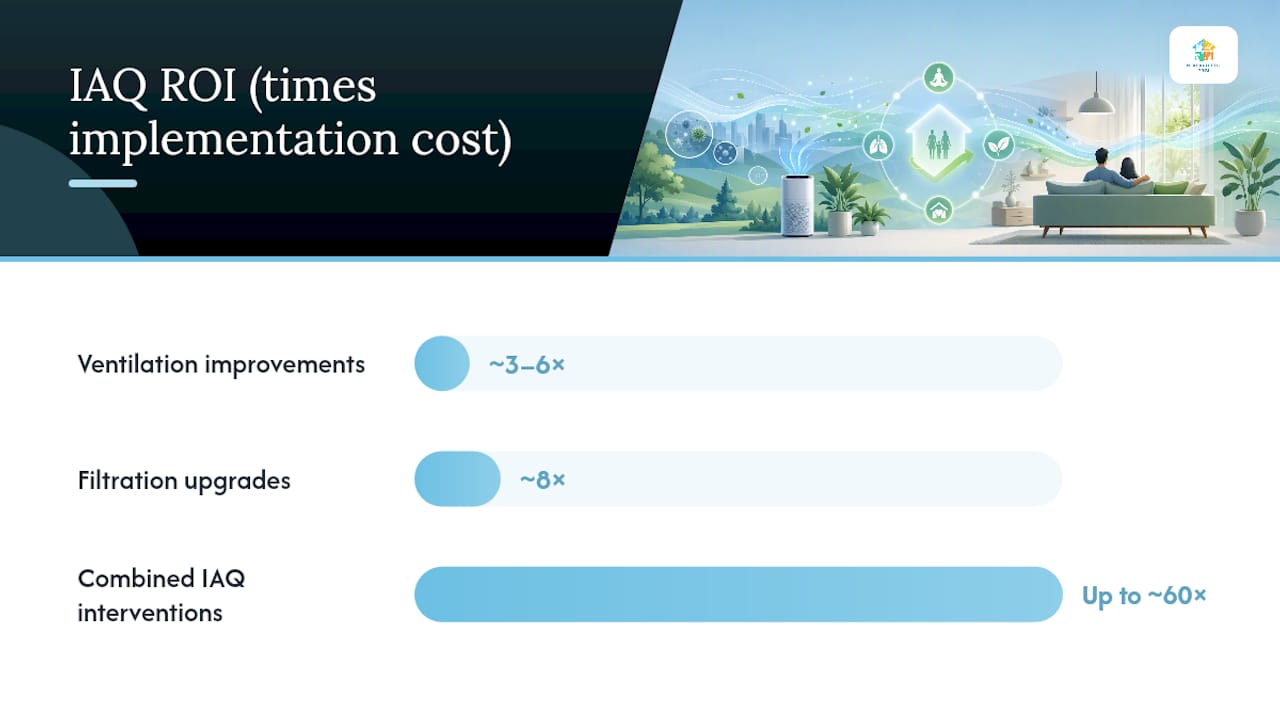
Source: The Value of IAQ: A Review of the Scientific Evidence
For office managers and building owners, those numbers reframe IAQ from a maintenance cost to a performance investment. OSHA’s workplace IAQ guidance notes that poor IAQ causes headaches, fatigue, trouble concentrating, and eye and throat irritation, all of which directly reduce output. Ventilation and building maintenance are OSHA’s central prevention tools.
Pro Tip: Source control is almost always the most cost-effective first step. Removing or reducing the pollutant at its origin costs less and works better than trying to dilute or filter your way out of a problem. Fix the gas stove venting before buying an air purifier.
Why indoor air problems develop in the first place
Understanding the root causes helps you avoid creating new problems while solving old ones.
- Inadequate ventilation: Buildings that do not bring in enough outdoor air allow contaminants to build up. This is the single most common driver of IAQ complaints.
- Tight building envelopes: Energy-efficiency upgrades like weatherstripping, spray foam insulation, and double-pane windows reduce air leakage, which is good for energy bills but can trap pollutants if mechanical ventilation is not added to compensate.
- Combustion appliances: Gas stoves, furnaces, water heaters, fireplaces, and attached garages all produce CO, NO2, and particulates. Incomplete combustion or poor venting makes these sources far more dangerous.
- Occupant activities: Cooking, smoking indoors, using aerosol sprays, painting, and hobby activities (woodworking, soldering) all introduce pollutants directly into the breathing zone.
- Moisture and leaks: Roof leaks, plumbing failures, condensation on cold surfaces, and high indoor humidity above 60% create conditions for mold and dust mite growth.
- HVAC design and maintenance failures: Undersized systems, clogged filters, dirty coils, and poorly balanced ductwork all reduce ventilation effectiveness and can distribute contaminants throughout a building.
The energy-efficiency trap is worth a specific note. A homeowner who seals every gap in their 1970s house to cut heating costs has done something smart for their utility bill and potentially harmful for their air. Without a mechanical ventilation strategy, that newly tight house now traps cooking fumes, VOCs from furnishings, and moisture. The fix is not to stop weatherizing. It is to add controlled ventilation, like a heat recovery ventilator (HRV) or energy recovery ventilator (ERV), alongside the air-sealing work.
How to assess your indoor air: signs and tests
You do not need expensive equipment to start. Most IAQ problems leave observable clues before they become serious.
- Check for persistent odors. Musty smells suggest mold or moisture. Chemical odors after a renovation point to VOC off-gassing. A faint rotten-egg smell near gas appliances warrants an immediate call to your gas utility.
- Look for condensation and visible mold. Condensation on windows, walls, or pipes signals humidity problems. Any visible mold growth, even small patches, should be taken seriously and cleaned with appropriate precautions or professionally remediated if the area exceeds 10 square feet.
- Track symptom patterns. Keep a simple log: when do symptoms appear, where are you, and do they resolve when you leave? A consistent time-and-place pattern is a strong indicator of an indoor source.
- Install carbon monoxide alarms. CO alarms are required by law in many U.S. states and should be placed on every level of the home and near sleeping areas. Test them monthly.
- Test for radon. Short-term test kits are available at hardware stores and online for under $30. Place one in the lowest livable level of your home for 48–96 hours, then mail it to the lab. If results come back at or above 4 picocuries per liter (pCi/L), the EPA recommends mitigation.
- Consider a PM2.5 monitor. Consumer-grade monitors like those from IQAir or Airthings give real-time particulate readings. They are useful for identifying cooking spikes and outdoor infiltration events, though they do not replace professional sampling for regulatory or remediation decisions.
- Test for formaldehyde or VOCs when renovating. If you have installed new flooring, cabinets, or insulation recently, a passive VOC test badge (available online) can confirm whether off-gassing is at concerning levels.
- Know when to call a professional. Hire a certified industrial hygienist or IAQ consultant when you suspect asbestos, have confirmed elevated radon, see mold covering more than 10 square feet, or have recurring symptoms with no identifiable source. Professional sampling uses calibrated equipment and provides legally defensible results.
Portable consumer monitors are useful for trend-spotting and real-time feedback. Professional sampling is what you need when the stakes are high, when a landlord or employer disputes a problem, or when remediation decisions require documentation.
How to improve your indoor air: a prioritized plan
The EPA’s three-strategy framework is the right starting point: source control first, then ventilation, then filtration. Skipping to filtration without addressing the source is like mopping around a running faucet.
- Source control. Eliminate or reduce the pollutant at its origin. Switch to low-VOC paints and finishes. Use the range hood every time you cook, even for short tasks. Ban indoor smoking. Store chemicals in sealed containers in ventilated spaces. Fix leaks within 24–48 hours to prevent mold. The EPA confirms that source control is usually the most effective and cost-efficient first approach.
- Improved ventilation. Open windows when outdoor air quality permits. Run bathroom and kitchen exhaust fans during and after activities that generate moisture or fumes. If your home is tightly sealed, consider an HRV or ERV. In offices, verify that HVAC systems meet ASHRAE 62.1 ventilation rates for the occupancy level.
- Filtration and air cleaning. Upgrade your HVAC filter to MERV 11–13 for meaningful particulate capture without excessive airflow restriction. For portable air cleaners, choose units with true HEPA filters and a Clean Air Delivery Rate (CADR) appropriate for the room size. Avoid any device that generates ozone as a byproduct.
Humidity control runs alongside all three strategies. Keep indoor relative humidity within a range that limits mold growth and dust mite activity without drying out airways. A basic hygrometer costs under $15 and tells you where you stand.
Maintain filters on schedule. A MERV 13 filter clogged with six months of dust performs worse than a fresh MERV 8. Check your HVAC filter monthly and replace it every 60–90 days in average households, more often if you have pets or live near a high-traffic road.
Room-by-room steps you can take today
General IAQ advice is easy to ignore. Specific, room-level actions are harder to put off.
Kitchen
- Run the range hood on high every time you cook, and vent it to the outside (recirculating hoods filter grease but do not remove combustion gases).
- Install a CO alarm within 10 feet of the stove.
- Wipe down surfaces regularly to prevent grease buildup, which can off-gas when heated.
Bedroom
- Wash bedding regularly in hot water to help control dust mites.
- Choose low-VOC or no-VOC finishes if repainting.
- Keep the room at a comfortable temperature and humidity below 50% to discourage mite and mold growth.
- Avoid plug-in air fresheners and scented candles, which add VOCs without improving air quality.
Bathroom
- Run the exhaust fan during showers and for at least 15 minutes after.
- Fix dripping faucets and any grout or caulk failures promptly to prevent mold colonization.
- Check under sinks monthly for slow leaks.
Living room and common areas
- Vacuum with a HEPA-filter vacuum at least weekly. Proper vacuuming technique matters: slow, overlapping passes capture more settled dust than quick sweeps.
- Professional carpet cleaning removes allergen reservoirs that vacuuming alone cannot reach, particularly in high-traffic areas.
- Open windows on low-pollution days to flush accumulated indoor contaminants.
Home office or cubicle
- Position your desk away from printers, which emit fine particles and VOCs during operation.
- Request that building management verify HVAC ventilation rates meet ASHRAE 62.1 for your occupancy level. OSHA’s workplace IAQ resources give you the language to make that request credibly.
- Use a small HEPA air cleaner if you share space with many people or if the HVAC system is aging.
For building and office managers: schedule HVAC filter changes, coil cleaning, and duct inspections on a documented maintenance calendar. Reactive maintenance costs more and leaves occupants exposed longer than a simple preventive schedule.
Common IAQ myths that can make things worse
A few widely repeated ideas about indoor air are not just wrong. Some are actively harmful.
Myth: Houseplants clean your indoor air. A handful of plants in a living room have no meaningful effect on VOC concentrations in a real building. The NASA study that launched this idea used sealed chambers with a single plant and a single pollutant. In a normally ventilated home, you would need hundreds of plants per square foot to replicate those conditions. Plants are pleasant. They are not air purifiers.
Myth: More ventilation is always better. Bringing in large amounts of outdoor air during wildfire smoke events, high-ozone days, or pollen peaks can make indoor air significantly worse. Ventilation decisions need to account for outdoor air quality, not just indoor concentrations.
Myth: Scented air fresheners improve air quality. They mask odors while adding VOCs, including some compounds classified as irritants. Plug-in fresheners, aerosol sprays, and scented candles are net negatives for IAQ.
Ozone generators are the most dangerous myth in this category. Marketed as powerful air purifiers, they produce ozone at concentrations that can irritate the lungs, worsen asthma, and react with other indoor chemicals to form formaldehyde and ultrafine particles. The EPA’s position is unambiguous: do not use them in occupied spaces. The same caution applies to any air cleaner that lists “ionizer” or “plasma” as a primary mechanism without independent third-party testing confirming it does not produce harmful byproducts.
When to get medical care or call a professional
Some IAQ situations require immediate action, not a weekend project.
Call 911 or leave immediately if:
- Your CO alarm sounds and anyone in the building has symptoms (headache, nausea, confusion, loss of consciousness).
- You smell gas and cannot immediately identify and stop the source.
- Anyone loses consciousness or has severe difficulty breathing in a building.
See a doctor or urgent care if:
- Symptoms like chest tightness, shortness of breath, or severe dizziness follow a consistent time-and-place pattern tied to a specific building.
- A child or elderly person develops unexplained respiratory symptoms that worsen over days.
- You have confirmed CO or radon exposure and want baseline health documentation.
Hire a certified IAQ or remediation professional if:
- Radon tests return at or above 4 pCi/L. The EPA recommends mitigation at this level, and certified radon mitigators can install sub-slab depressurization systems that reliably reduce levels. Mitigation typically costs $800–$2,500.
- Visible mold covers more than 10 square feet, or you suspect mold behind walls or under flooring.
- You have a structural water intrusion (flooding, roof failure) that has been wet for more than 24–48 hours.
- You suspect asbestos-containing materials in a pre-1980 building before any renovation work.
The EPA’s radon action level of 4 pCi/L is the threshold at which the agency recommends mitigation. Levels between 2 and 4 pCi/L are in a gray zone where mitigation is worth considering, particularly for homes with children or smokers.
A cleaning professional’s perspective on IAQ
Professional cleaning is not a substitute for source control or ventilation, but it plays a real and underappreciated role in IAQ management. Dust reservoirs in carpets, upholstery, and HVAC registers hold allergens, fine particles, and biological material that re-enter the breathing zone every time someone walks through the room or the system cycles on.
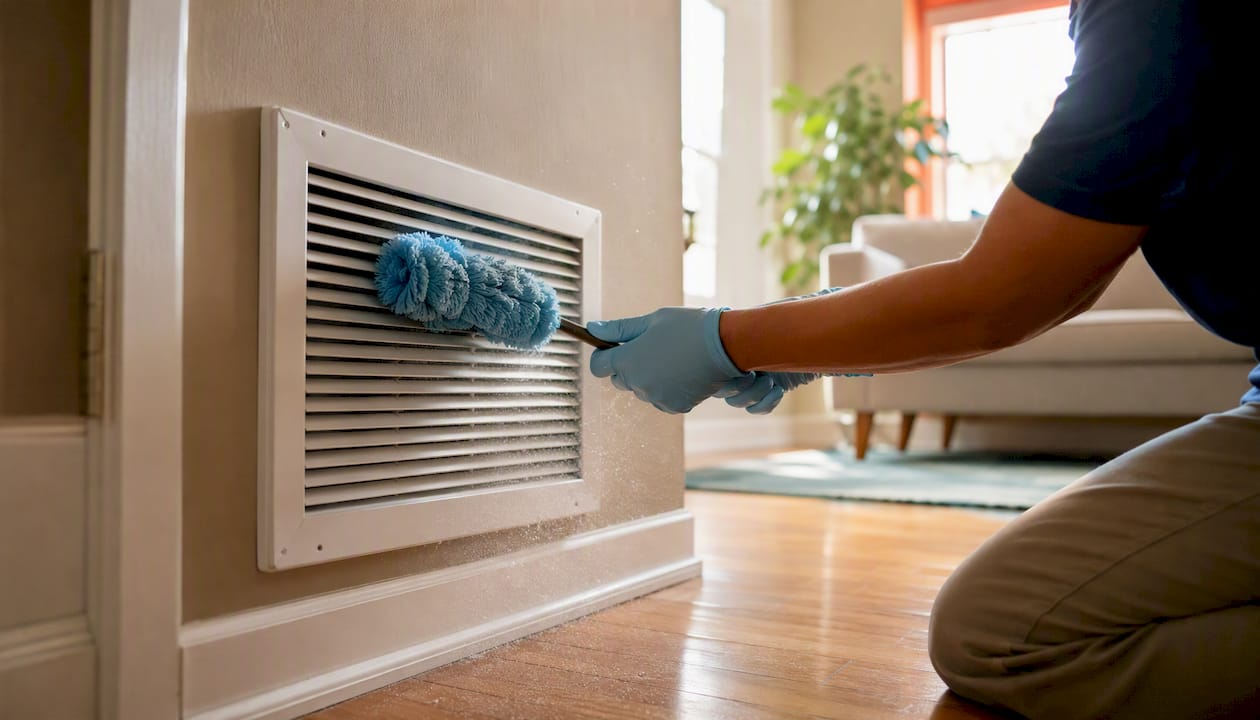
A thorough deep clean removes those reservoirs in a way that routine surface cleaning does not. Post-construction cleaning is especially critical: drywall dust, adhesive fumes, and construction debris settle into every surface and gap, and the particulate load in a freshly finished space can be substantial. Move-in cleaning addresses the same problem from the previous occupant’s perspective, clearing allergen loads and chemical residues before a new family settles in.
Where cleaning fits clearly: removing dust and allergen reservoirs, preparing a space for mold remediation, clearing post-construction debris, and maintaining the cleanliness of HVAC registers and return vents. Where it does not: structural moisture problems, active mold behind walls, elevated radon, and asbestos all require specialists. A professional cleaner who tells you otherwise is overstepping. The right answer in those cases is to coordinate with a certified remediation contractor or industrial hygienist.
Clean air starts with a clean space
Dust, allergens, and particulate residue do not stay on surfaces. They cycle back into the air every time someone moves through a room, runs the HVAC, or opens a door. That is why a residential deep clean is one of the most direct steps homeowners and property managers can take to reduce the pollutant load their family breathes every day.

Neatandtidypros serves homeowners, tenants, property managers, and office managers in Orange County and Corona, California with deep cleaning, post-construction cleaning, move-in/move-out cleaning, and commercial cleaning designed to remove the dust reservoirs and surface contaminants that standard maintenance misses. Every service uses eco-friendly products that do not add VOCs to the spaces being cleaned. If you want to know what a deep clean covers room by room and what it costs for your space, get a quote directly at Neatandtidypros.
Sources
Prioritize government agencies and professional societies for health-related IAQ decisions. Marketing materials from product manufacturers are not a reliable substitute.
- ASHRAE Position Document on Indoor Air Quality
- Indoor air | National Institute of Environmental Health Sciences
- The Value of IAQ: A Review of the Scientific Evidence Supporting the Benefits of Investing in Better Indoor Air Quality
This article provides general information about indoor air quality and is not a substitute for professional medical, remediation, or engineering advice. For persistent symptoms, suspected contamination, or major IAQ concerns, consult a qualified healthcare provider or certified IAQ professional.
One Response