
For a fresh spill, cover it with cat litter or baking soda immediately and do not add water. For stains that are days or months old, apply an alkaline degreaser like Oil Eater or Simple Green, let it dwell 5–20 minutes, scrub hard, and rinse with hot water. For deeply embedded oil that has been sitting for months or years, a poultice is your best shot.
Quick-action checklist before you start:
- Absorbent: plain clay cat litter, oil-dry granules, or baking soda
- Stiff-bristle brush or drill brush attachment
- Alkaline degreaser: Oil Eater, Simple Green, or Zep Driveway and Concrete Cleaner
- Neutral pH cleaner (Zep Neutral pH Floor Cleaner) if your floor is sealed or epoxy-coated
- Poultice materials: diatomaceous earth plus acetone, or a ready-made product like Pour-N-Restore
- Hot water source and a bucket
- PPE: rubber gloves, eye protection, and ventilation
Do / Don’t:
- Do absorb first, always, before any other step
- Do use hot water for rinsing — it meaningfully improves degreaser performance
- Don’t scrub a fresh spill; you’ll push oil deeper into the pores
- Don’t rinse before the absorbent has done its job
- Don’t use high-alkalinity degreasers on sealed or epoxy floors
Pro Tip: Dawn dish soap works in a pinch for light, fresh stains on sealed floors. Squeeze it directly onto the spill, let it sit five minutes, then scrub and rinse. It’s not a substitute for a real degreaser on set-in stains, but it buys you time.
Key Takeaways
The most effective approach to cleaning garage floor oil stains is to match your method to stain age: absorb fresh spills immediately, degrease set-in stains with an alkaline cleaner, and use a poultice for deeply embedded oil.
| Point | Details |
|---|---|
| Fresh spills (under 48 hrs) | Absorb with cat litter or baking soda first; never add water before absorbing. |
| Set-in stains (days to months) | Apply Oil Eater, Simple Green, or Zep Driveway Cleaner; dwell 5–20 minutes, scrub, rinse hot. |
| Embedded stains (months to years) | Use a poultice (diatomaceous earth plus acetone or Pour-N-Restore) for 24–48 hours; expect significant reduction per cycle. |
| Sealed vs. unsealed floors | Use neutral pH cleaners on sealed or epoxy floors; high-alkalinity degreasers on raw concrete only. |
| Neatandtidypros | Handles on-site degreasing, poultice treatment, and compliant disposal for garages in Orange County and Corona, CA. |
Table of Contents
- How do you treat a fresh oil spill on a garage floor?
- What works on set-in oil stains that are days or months old?
- How do poultice and bioremediation methods compare for old, embedded stains?
- How do you choose the right cleaner for your garage floor?
- What aftercare and prevention steps protect your garage floor?
- When should you hire a professional instead of doing it yourself?
- A professional’s honest take on garage oil stain removal
- Neatandtidypros handles garage oil stains when DIY isn’t enough
- Sources
How do you treat a fresh oil spill on a garage floor?
Fresh spills treated promptly can usually be removed near-completely on unsealed concrete — but only if you skip the water and go straight for an absorbent.
Step-by-step:
- Pour a generous layer of plain clay cat litter, oil-dry granules, or baking soda directly over the spill. Cover the entire wet area.
- Let it sit for at least 15–30 minutes. For a large spill, leave it an hour. The granules need time to wick oil up from the surface.
- Sweep up the saturated absorbent and bag it for disposal. Do not hose it away.
- Apply a light degreaser or a few drops of Dawn dish soap directly to the residual stain. For a stronger result, use Oil Eater or Simple Green diluted per label instructions.
- Scrub with a stiff-bristle brush using circular strokes. A drill brush attachment cuts the effort significantly on wider stains.
- Rinse with hot water. Hot water dissolves oil residue more effectively than cold and helps flush it out of surface pores.
- Repeat once if a faint shadow remains.
Materials and quick substitutes:
- Cat litter: plain clay type only, not clumping or scented
- Oil-dry: the same granules sold at auto parts stores
- Baking soda: works well on small spills; less effective on large ones
- Dawn: for light stains or sealed floors when you have nothing else on hand
Dwell times: leave the absorbent down at least 15 minutes for small spills, up to an hour for large ones. For the degreaser step, 5–10 minutes is enough on a fresh stain.
Pro Tip: On a wide spill, work from the outside edge inward when applying your absorbent. Starting in the center pushes oil outward and widens the stain.
What works on set-in oil stains that are days or months old?
A set-in stain looks darker than the surrounding concrete, often with a defined edge, and won’t lift with a quick scrub. Oil that has had days or weeks to penetrate the pores needs chemistry, not just elbow grease.
Identifying what you’re dealing with:
- Fresh (under 48 hours): wet or tacky surface, no defined edge
- Set-in (days to months): dry, dark patch, slightly raised edge from dried oil residue
- Embedded (months to years): flat, gray-black discoloration that goes deep into the slab
For set-in stains, matching the right chemical to your floor type and using hot-water rinses materially improves results compared to pressure washing alone.
Recommended degreasers and how to apply them:
- Oil Eater: works at a 10:1 dilution for most spot work; apply undiluted for heavy stains
- Simple Green Industrial Cleaner: apply at label strength for spot treatment on raw concrete
- Zep Driveway and Concrete Cleaner: a concentrate that can be diluted to make up to 20 gallons of cleaning solution; use at higher concentration for set-in stains
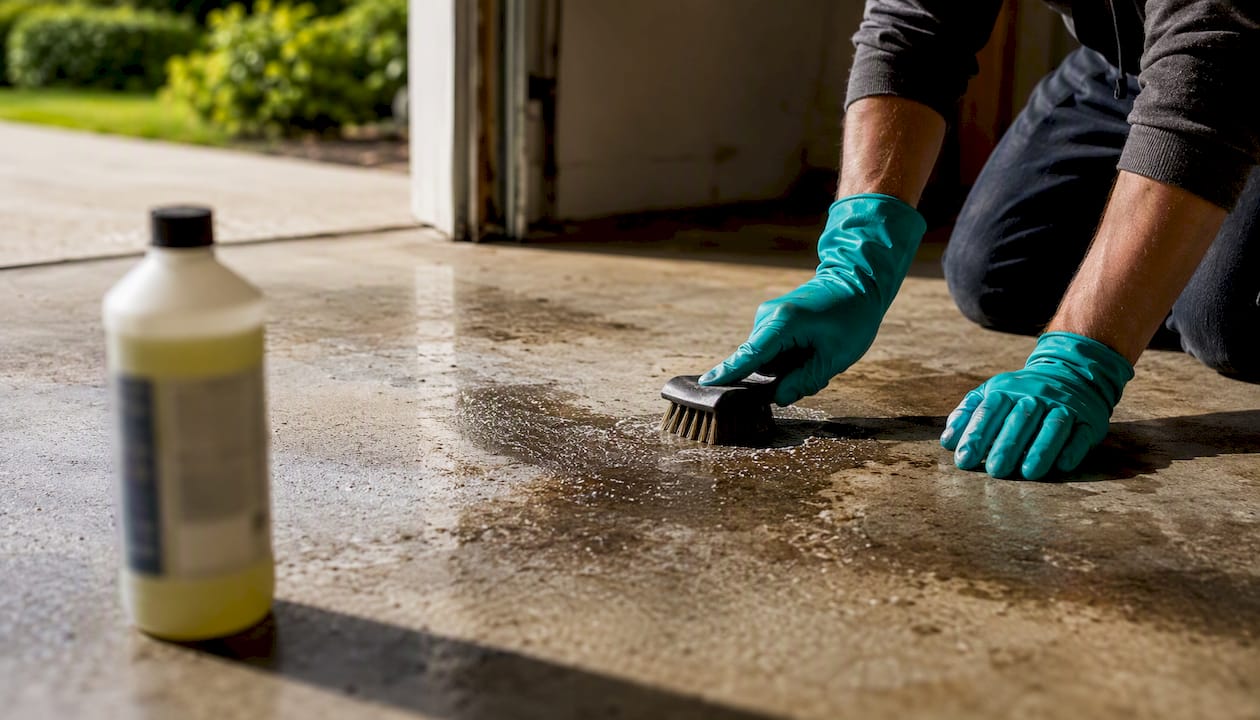
Alkaline degreasers should sit 5–20 minutes and must not be allowed to dry on the surface; reapply if the surface starts to look dry before you scrub.
Mechanical agitation matters. A stiff nylon-bristle brush is the baseline. A drill brush attachment speeds up the work and gets into the surface texture. Avoid wire brushes on concrete — they leave metal fibers that rust and stain. Never use a wire brush on epoxy.
Home remedies that actually help:
- Powdered laundry detergent mixed with just enough water to form a thick paste, spread over the stain, and left to dry. This works on stains up to a few months old. Powdered detergent outperforms liquid dish soap for this method because the powder draws oil as it dries.
- Baking soda paste: less aggressive but useful for lighter set-in stains on sealed floors.
Pouring oil-saturated rinsewater or chemical degreasers down storm drains is illegal under clean-water regulations in the U.S. Collect oily rinse water in a bucket and dispose of it at a local hazardous waste facility or auto parts store that accepts used fluids.
PPE and ventilation: wear rubber gloves and eye protection. Work with the garage door open. Some degreasers produce fumes that build up quickly in an enclosed space.
| Product | Best for | Dilution | Dwell time | Sealed floor safe? |
|---|---|---|---|---|
| Oil Eater | Fresh to set-in stains | 10:1 (spot) or undiluted | 5–15 min | No |
| Simple Green | Set-in stains on raw concrete | Label strength | 10–20 min | No |
| Zep Driveway Cleaner | Set-in to heavy stains | Concentrate (up to 20 gal) | 5–20 min | No |
| Zep Neutral pH Cleaner | Light stains on sealed/epoxy floors | Per label | 5–10 min | Yes |
| Dawn dish soap | Light or emergency use | Undiluted | 5 min | Yes |
How do poultice and bioremediation methods compare for old, embedded stains?
Old oil that has been in concrete for months or years has polymerized — it has chemically bonded to the pore walls. A degreaser alone won’t pull it out. A poultice reverses capillary action by creating an osmotic draw that pulls dissolved oil up into an absorbent medium as it dries slowly under plastic.
How to apply a poultice, step by step:
- Clean the surface first with a degreaser to remove any loose oil on top.
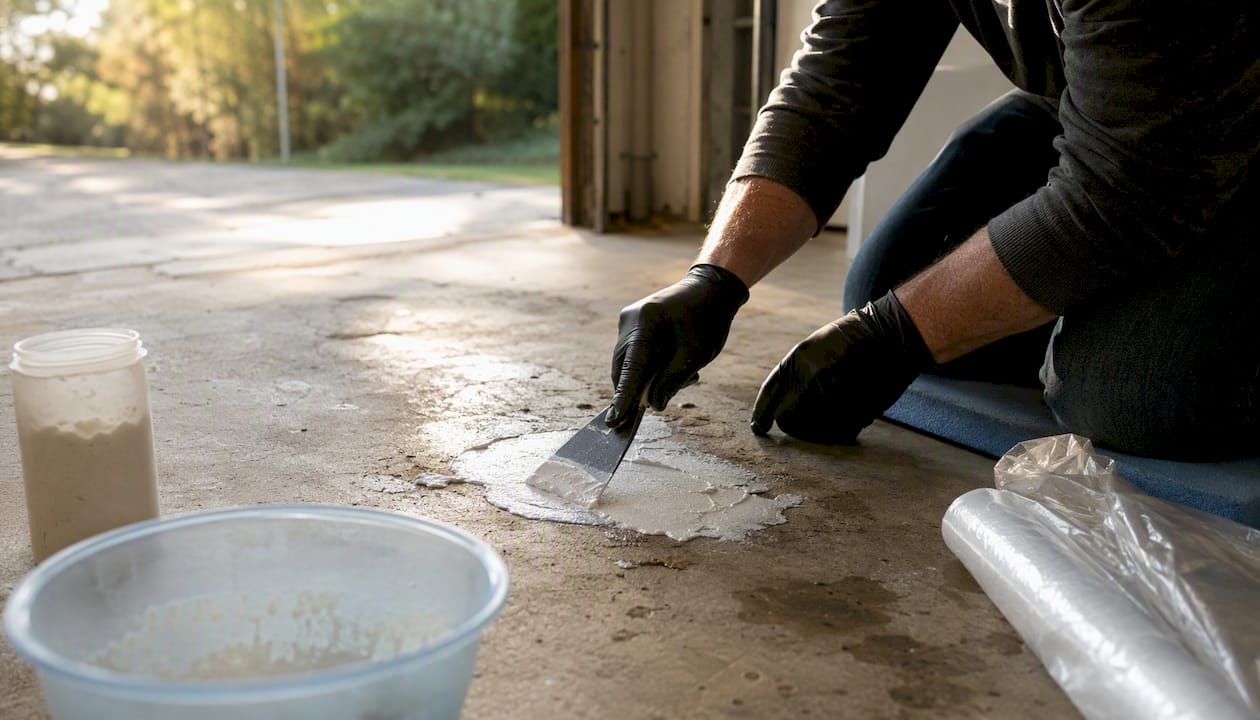
- Mix your poultice: diatomaceous earth plus acetone to a peanut-butter consistency, or use Pour-N-Restore straight from the bottle.
- Spread the mixture about 1/4 to 1/2 inch thick over the stain, extending an inch beyond the stain’s edge.
- Cover immediately with plastic sheeting and tape the edges down. The plastic slows drying and keeps the draw active.
- Leave it for 24–48 hours. Do not lift the plastic early.
- Remove the plastic, let the poultice dry completely, then scrape and sweep it up.
- Rinse the area with hot water and assess. Repeat if needed.
Poultice options:
- Diatomaceous earth plus acetone: inexpensive, effective, requires ventilation and PPE (acetone is flammable)
- Pour-N-Restore: a ready-made poultice that dries to powder in 4–8 hours; easier to use, no mixing
- Powdered laundry detergent paste: works on stains up to a few months old, not deep polymerized stains
Dispose of used poultice material as you would oil-saturated absorbent — bag it and take it to a hazardous waste drop-off.
Bioremediation: the slow-burn option. Enzyme or microbial cleaners like ACT Concrete Cleaner convert petroleum hydrocarbons to water and carbon dioxide and may take 3–4 weeks to show results. They’re a reasonable choice when the stain is old and you’re not in a hurry, or when you want to avoid solvents. Apply, keep the area damp, and repeat weekly.
Complete removal is often not achievable on bare concrete stains more than two years old. Plan for two or three applications before deciding whether to seal over the remaining discoloration or call a professional.
How do you choose the right cleaner for your garage floor?
The single most important question before buying anything: is your floor sealed, epoxy-coated, or bare concrete? Using the wrong product class can strip sealers or damage epoxy.
Compatibility rules:
- Sealed or epoxy floor: use neutral pH cleaners only (Zep Neutral pH Floor Cleaner). High-alkalinity degreasers will dull or lift the coating.
- Unsealed raw concrete: high-alkalinity degreasers (Oil Eater, Simple Green, Zep Driveway and Concrete Cleaner) are appropriate and effective.
- Rust or efflorescence stains (not oil): acid-based cleaners work, but use them cautiously and never on sealed floors.
pH and product types at a glance:
- Neutral pH (6–8): safe for sealed and epoxy floors; lighter cleaning power
- High alkalinity (pH 11–13): for raw concrete; breaks down petroleum-based oils effectively
- Acid cleaners: for mineral deposits only; not for oil stains
PPE and disposal:
- Gloves and eye protection for any degreaser
- Ventilate the garage fully; open doors and windows
- Collect rinse water in a bucket; do not let it run into the driveway or storm drain
- Oil-saturated absorbents go to a hazardous waste facility, not the trash
What to check on a product label before buying:
- pH range or “alkaline/neutral” designation
- Intended surface (concrete, sealed concrete, epoxy)
- Dilution ratio and coverage area
- Dwell time recommendation
- Disposal instructions
Pro Tip: Zep Driveway and Concrete Cleaner concentrate is one of the most cost-effective options for raw concrete. At up to 20 gallons per bottle, the per-use cost drops well below ready-to-use sprays for anyone with more than one stain to tackle.
What aftercare and prevention steps protect your garage floor?
Once the stain is gone or reduced, the work isn’t quite finished. Skipping aftercare is how stains come back faster than they should.
Rinse and dry protocol:
- Rinse the treated area with hot water, scrubbing lightly to lift any remaining degreaser residue
- Collect the rinse water and dispose of it properly
- Let the floor air-dry for at least 24–72 hours before applying any sealer or returning heavy vehicles
Sealing options:
- Penetrating silane/siloxane sealer: soaks into the concrete and repels oil at the pore level; invisible finish; best for raw concrete that sees heavy use
- Epoxy or polyurea coating: bonds to the surface and creates a hard, cleanable shell; best for homeowners who want a showroom look and the easiest future cleanups
Sealed surfaces resist penetration and make future cleanups much faster. A spill on an epoxy floor wipes up in minutes; the same spill on bare concrete becomes a project.
Maintenance routine:
- Sweep or blow out the garage monthly to remove grit that traps oil
- Spot-clean drips within 48 hours using the fresh-spill method above
- Reapply penetrating sealer every 2–3 years; inspect epoxy coatings annually for chips or peeling
Pro Tip: Place an absorbent drip pad under any vehicle that leaks. A $10 pad prevents a $50 cleaning job and protects a fresh seal coat from the start.
When should you hire a professional instead of doing it yourself?
DIY works well for most fresh and set-in stains. A few situations tip the math toward hiring help.
Decision checklist:
- The stained area covers more than 20–30 square feet
- The oil has been sitting for more than a year and multiple poultice attempts haven’t moved it
- The stain is polymerized (shiny, hard surface, doesn’t respond to degreasers)
- You have an epoxy or specialty coating and don’t want to risk damaging it
- You don’t have time for multiple 24–48 hour poultice cycles
- Rinse water disposal is complicated by your local rules or property layout
What a professional service typically delivers:
- On-site assessment to identify stain age, depth, and floor type
- Chemical application matched to the specific oil type and concrete condition
- Mechanical agitation with commercial-grade equipment
- Hot-water extraction to flush pores more thoroughly than a garden hose can
- Poultice application and removal, sometimes with multiple visits
- Resealing or surface prep recommendations after treatment
Questions to ask before booking:
- What chemicals do you use, and are they safe for my floor type?
- How do you handle rinse water and chemical waste disposal?
- How many visits do you estimate, and what’s the realistic outcome?
- Do you offer any follow-up if the stain returns within a set period?
A professional cleaning approach combines correct chemical selection, dwell time, and mechanical agitation in a way that’s hard to replicate with consumer tools alone. For large or deeply embedded stains, the gap in results is real. See the full scope of professional deep cleaning services to understand what a thorough treatment covers.
A professional’s honest take on garage oil stain removal
The most common mistake homeowners make is reaching for a pressure washer first. Pressure alone doesn’t dissolve oil — it spreads it. The second most common mistake is giving up after one degreaser application on a stain that’s been there for six months. Old stains need multiple treatments and realistic expectations.
At Neatandtidypros, we see both ends of this regularly: homeowners who caught a spill early and just need a quick professional rinse, and homeowners who’ve been living with a dark patch for two years and want it gone yesterday. Sealing after treatment is what locks in the result and prevents the next spill from becoming the same problem.
A few shortcuts worth knowing: a drill brush attachment cuts scrubbing time by more than half. Plastic sheeting taped over a poultice overnight is not optional — it’s what makes the method work. And hot water is not a luxury; it’s a meaningful variable in how well any degreaser performs.
Neatandtidypros handles garage oil stains when DIY isn’t enough
When the stain is too large, too old, or too close to a specialty coating to risk a DIY attempt, Neatandtidypros provides on-site degreasing, mechanical agitation, and poultice treatment for residential garages in Orange County and Corona, California. Every job includes an on-site assessment to match the right chemistry to your floor type, and all rinse water and chemical waste is handled in compliance with local and EPA disposal requirements.

No guessing about dilution ratios or whether your sealer can handle a high-alkalinity product. Book a professional deep cleaning or browse the full cleaning services menu to find the right fit for your garage and schedule.
Sources
- How to Clean a Garage Floor: The Complete Guide to Oil Stains, Tire Marks & Concrete Restoration (2026) – Pro Garage Gear
- How to Clean a Concrete Garage Floor in 5 Steps – The Spruce
- How to Fix a Garage Floor Oil Stain: From Fresh Spill to Old Set Stains – FixUpFirst
- Zep Driveway and Concrete Cleaner and Degreaser (product page)
Always read product labels before use and check your municipality’s rules for disposing of oily rinse water and chemical waste. Storm-drain disposal of petroleum-contaminated water is prohibited under the Clean Water Act.