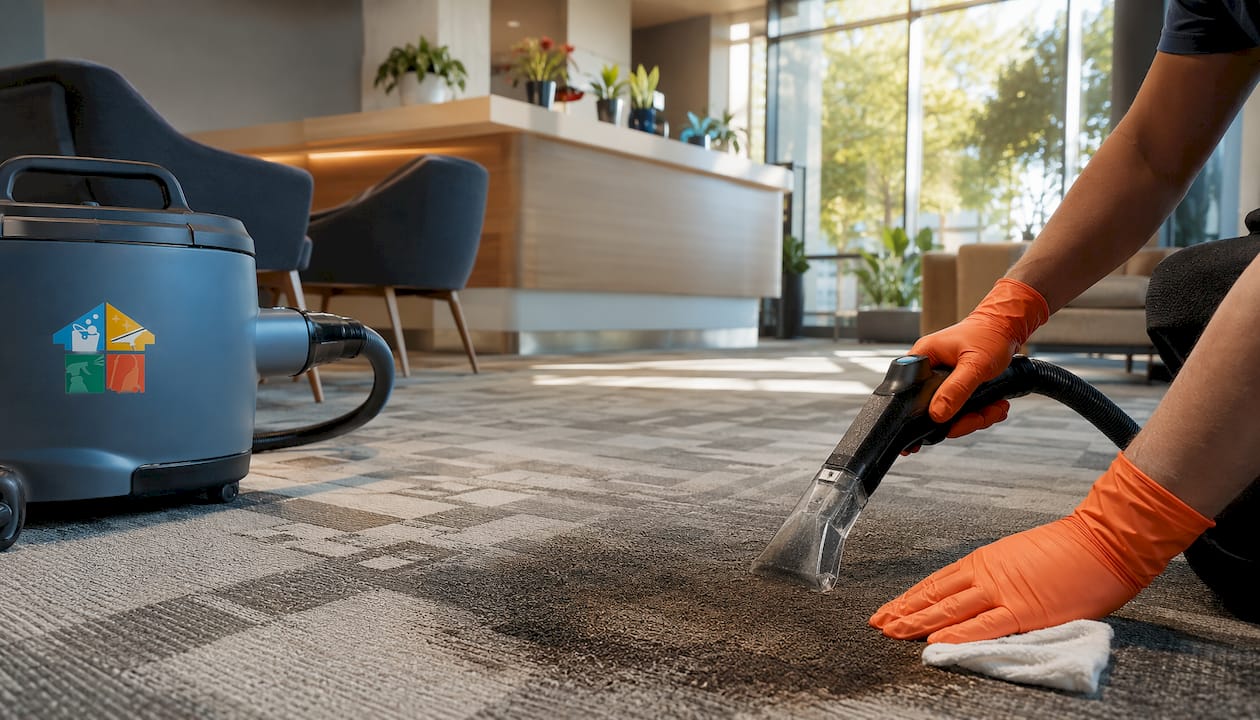
The most effective approach to commercial office carpet maintenance combines daily vacuuming, quarterly interim cleaning for high-traffic zones, and deep cleaning every 6–12 months using hot water extraction. The Carpet and Rug Institute (CRI) and Mannington Commercial both provide frameworks that take the guesswork out of scheduling and method selection. Get this right from day one, and you protect a significant facility investment while keeping your workspace genuinely healthy.
Key priorities at a glance:
-
Entrances and lobbies: vacuum daily; walk-off mats roughly 10 to 15 feet long capture most incoming soil before it reaches carpet
-
Corridors and common areas: daily vacuuming during the work week
-
Private offices and conference rooms: two to three times per week
-
High-traffic zones (breakrooms, elevator lobbies): quarterly interim cleaning at minimum
-
Full facility deep clean: every 6–12 months using CRI Seal of Approval (SOA) certified equipment and solutions
Proactive maintenance before carpet looks dirty is the single most cost-effective strategy. Once soil embeds deeply into fibers, restorative cleaning becomes expensive and results are never as good.
How often should you clean different areas of your office carpet?
Cleaning frequency depends entirely on foot traffic, not on a fixed calendar. A reception area that sees hundreds of visitors daily needs far more attention than a private office used by one person.
- Entry foyers: daily vacuuming; soil not captured by mats migrates directly into interior carpet
- Lobbies and reception areas: daily maintenance, sometimes more frequently for high-volume facilities
- Corridors and open-plan floors: daily during the work week
- Private offices and boardrooms: two to three times per week
- Interim cleaning (low-moisture): quarterly for high-traffic zones, every two to three months for medium-use areas
- Deep cleaning (hot water extraction): every 6–12 months facility-wide; twice yearly for extra-heavy traffic areas
Pro Tip: Spend 80% of your cleaning time and budget on 20% of your carpet: entryways, lobbies, and main traffic lanes. Keeping soil out of these zones stops it from migrating into the rest of the building.
What professional frameworks actually govern effective carpet cleaning?
Two industry frameworks define best practice for commercial carpet care in 2026: the CRI’s five-element maintenance program and Mannington Commercial’s T.A.C.T. system.
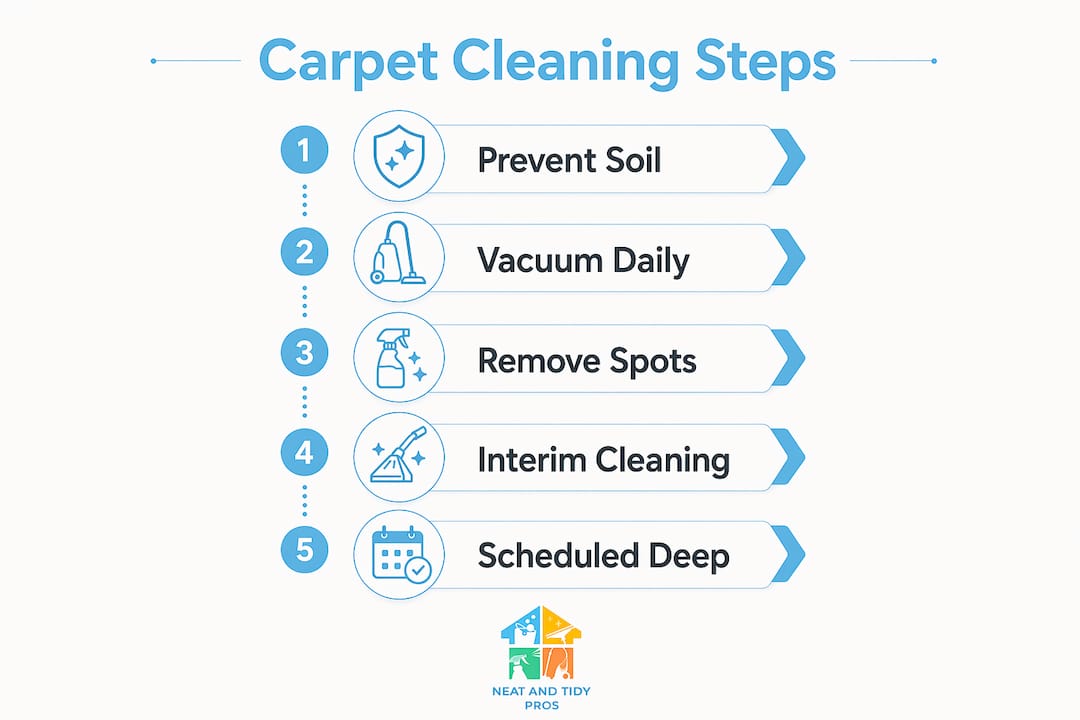
The CRI’s five-element program covers soil prevention, routine vacuuming, spot removal, interim cleaning, and scheduled deep cleaning. Every element depends on the others. Skip interim cleaning and your deep cleans become restorative jobs that cost far more.
Mannington Commercial’s T.A.C.T. framework stands for Time, Agitation, Chemical, and Temperature. Each variable must be balanced: too little dwell time and the chemical can’t emulsify soil; too much agitation and you abrade fibers. The framework applies across routine, interim, and restorative cleaning.
Practical steps within these frameworks:
- Use vacuums with HEPA filters for daily soil removal
- Change vacuum bags at half-full to maintain maximum suction
- Apply liquid crystallizing solution with a counter-rotating brush machine for interim cleaning
- Pre-spray chemicals before hot water extraction so they have time to penetrate fibers
- Use only neutral-pH cleaners (pH 10 or under) and SOA-certified products
Pro Tip: Bonnet cleaning was designed for hard surfaces and is generally not recommended for commercial carpet due to potential fiber abrasion.
Does proactive maintenance actually save money?
Yes, and the gap between proactive and reactive cleaning costs is wider than most office managers expect. Outsourcing commercial carpet cleaning reduces cleaning time and operational expenses while delivering higher disinfection standards and better air quality than in-house programs typically achieve.
Dry soil particles abrade carpet fibers like sandpaper. Daily vacuuming with a HEPA-filtered machine removes up to 80% of that dry soil load before it can grind into the pile. Once fibers are abraded, no amount of deep cleaning restores their original appearance or texture.
Reducing chemical residue also cuts costs indirectly. Excessive cleaning chemicals leave tacky residues that attract dirt, accelerating the resoiling cycle and forcing more frequent cleaning. Using the least amount of SOA-certified, neutral-pH cleaner necessary keeps carpets cleaner between service visits. Professional carpet cleaning also improves workplace air quality by reducing allergens and particulates, which translates to fewer sick days and a healthier team.
Why Neatandtidypros is the right choice for Orange County offices
Orange County offices face specific challenges: high foot traffic year-round, coastal humidity that can trap moisture in carpet fibers, and the professional image expectations that come with a competitive business environment. Neatandtidypros brings local knowledge and a structured commercial cleaning program built around CRI standards and SOA-certified products.
What Neatandtidypros offers for commercial carpet care:
- Scheduled deep cleaning using hot water extraction with SOA-certified equipment
- Low-moisture interim cleaning for minimal business disruption
- Spot and stain treatment using neutral-pH, fiber-safe products
- Customized cleaning programs based on your facility’s traffic patterns
- After-hours and weekend scheduling to keep your team productive
Pro Tip: Ask your cleaning provider to walk your facility before quoting. A proper site survey identifies high-soil zones, carpet types, and traffic patterns that determine the right method and frequency for your specific space.
For a full picture of what professional service covers, see Neatandtidypros’ commercial cleaning services page.
Step-by-step guide to cleaning commercial office carpets
Follow this sequence for consistent, damage-free results across your facility.
- Survey the space. Map traffic zones as light, moderate, or heavy. This determines vacuuming frequency and cleaning method for each area.
- Set up entryway systems. Place walk-off mats at every entrance. Vacuum them daily so they continue capturing soil effectively.
- Vacuum high-traffic areas first. Use a HEPA-filtered, dual-motor vacuum. Work slowly; rushing reduces soil pickup. Change the bag at half-full.
- Address spots immediately. Blot liquid spills with a white cotton towel. Never rub. Clean an area three to four times larger than the visible stain to prevent wicking.
- Apply interim cleaning on schedule. Spray crystallizing solution, scrub with a counter-rotating brush machine, let dry, then vacuum thoroughly.
- Pre-spray before hot water extraction. Allow dwell time so the chemical emulsifies embedded soil. Then extract with plain water to remove all residue.
- Deploy air movers after extraction. Reducing drying time limits moisture exposure and prevents mold or odor development.
- Inspect and document. Note any areas that needed multiple passes. Adjust your maintenance schedule accordingly.
For broader context on office cleaning standards, a structured facility management approach ties carpet care into your overall maintenance program.
Common cleaning mistakes that damage office carpets
Most carpet damage in commercial settings is self-inflicted through well-intentioned but incorrect cleaning practices.
Over-wetting is the most common error. Saturating carpet during extraction without adequate drying time creates conditions for mold, odor, and backing delamination. Proper hot water extraction should leave carpet dry within 2–4 hours when done correctly.
Using too much chemical is the second-biggest problem. Residue left in fibers attracts soil, creating a cycle where the carpet never fully cleans. Always dilute to the manufacturer’s recommended ratio and test for sticky residue before use.
Other frequent mistakes include vacuuming too fast (reducing suction contact time), ignoring corners and wall perimeters where soil accumulates, and waiting until carpet looks visibly dirty before scheduling a deep clean. By then, fiber abrasion is already underway. Reviewing common office cleaning oversights can help you catch these issues before they become costly.
How to handle and remove common office carpet stains
Speed is everything with office stains. The longer a spill sits, the deeper it penetrates and the more soil it attracts as it dries.
Coffee and tea: blot immediately with a white cotton towel, then apply a neutral-pH spotter. Work from the outside of the stain inward to avoid spreading.
Ink: use a solvent-safe specialty spotter. Blot, never rub. Ink spreads aggressively if rubbed.
Grease and food: break up any dry residue first, vacuum, then apply an enzyme cleaner with appropriate dwell time before blotting.
Traffic lane discoloration: this is embedded dry soil, not a stain. It requires interim low-moisture cleaning or hot water extraction, not spot treatment.
Keep a spotting kit stocked with a general-purpose spotter, an enzyme cleaner, and a neutralizing chemical. Offices specifically should anticipate coffee, toner, and food spills as the most frequent incidents.
Safety and health considerations for commercial carpet cleaning
Chemicals used in carpet cleaning require the same respect as any workplace substance. Always read Safety Data Sheets before using any cleaning product, and follow label instructions without improvising dilution ratios.
Ventilation matters during and after cleaning. Open windows or run HVAC systems to accelerate drying and clear any chemical vapors. Wet carpet in a poorly ventilated space can develop mold within 24–48 hours. For commercial property cleaning best practices that address ventilation and chemical handling in detail, that resource covers the operational side thoroughly.
Slip hazards increase significantly on damp carpet. Cordon off freshly cleaned areas and use wet-floor signage until carpet is fully dry. Train cleaning staff to recognize when a product is leaving residue and to adjust dilution accordingly.
Professional vs. DIY commercial carpet cleaning: which makes sense?
DIY cleaning works for daily vacuuming and immediate spot treatment. Beyond that, the gap between consumer-grade and professional equipment is substantial. Truck-mounted extraction systems operate at pressure and temperature levels that portable consumer machines cannot match, and they remove far more moisture, cutting drying time significantly.
Professional services also carry liability coverage, use SOA-certified products that protect manufacturer warranties, and bring trained technicians who can identify fiber types and adjust methods accordingly. For most Orange County offices, the cost of professional cleaning is lower than the cost of premature carpet replacement caused by improper DIY methods.
DIY makes sense for: daily vacuuming, immediate spill blotting, and light spot treatment between professional visits. Leave interim and deep cleaning to certified professionals.
Key Takeaways
Consistent commercial carpet maintenance, guided by CRI standards and the T.A.C.T. framework, protects your carpet investment and keeps your office genuinely healthy year-round.
| Point | Details |
|---|---|
| Clean by traffic zone | Vacuum high-traffic areas daily; private offices require less frequent vacuuming, several times weekly. |
| Deep clean every 6–12 months | Schedule hot water extraction at least twice yearly for heavy-traffic facilities. |
| Walk-off mats capture 80% of soil | Use mats 10–15 feet long at every entrance to cut cleaning frequency and fiber wear. |
| Avoid chemical overuse | Excess residue attracts dirt and accelerates resoiling; always dilute to the recommended ratio. |
| Outsource for better results | Professional cleaning reduces operational costs and delivers higher disinfection standards than in-house programs. |
The case for treating carpet maintenance as a facility priority, not an afterthought
Most offices treat carpet cleaning as something that happens when the carpet looks bad. That’s the wrong trigger. By the time soil is visible, fiber abrasion is already reducing the carpet’s useful life, and restorative cleaning costs significantly more than the preventive maintenance that would have avoided the problem.
The CRI maintenance framework and Mannington Commercial’s T.A.C.T. system exist precisely because carpet manufacturers know this pattern. They designed these guidelines to protect their products and, by extension, your investment. Following them isn’t bureaucratic box-checking. It’s the difference between a carpet that lasts its full expected life and one that needs replacement years early.
Orange County offices that integrate carpet care into their regular facility management, rather than treating it as a reactive expense, consistently maintain better air quality, a more professional appearance, and lower long-term flooring costs. Partnering with a local provider like Neatandtidypros, who understands the regional environment and builds customized programs around your specific traffic patterns, is the most direct path to that outcome.