A green cleaning certification is a third-party verification that a cleaning product or service meets defined health and environmental criteria. In the United States, the seals that matter most are EPA Safer Choice, Green Seal (specifically GS-42 for services), and UL ECOLOGO (UL 2700). Each one relies on independent testing rather than a manufacturer’s own claims, and each ties into procurement systems like LEED’s green cleaning credit.
If you’re vetting a product or a vendor right now, here’s the fast version:
- Look for the actual seal on the label or in the vendor’s proposal, not a vague “eco-friendly” claim.
- Confirm the certification is current by searching the program’s public directory.
- Check that public criteria and an ingredient or product list exist and match what’s in front of you.
Skip any of those three steps and you’re trusting a logo instead of a standard.
Key Takeaways
Green cleaning certification only protects a facility when buyers verify current listings and documentation rather than trusting a logo alone.
| Point | Details |
|---|---|
| Know the three core seals | EPA Safer Choice, Green Seal (GS-42 for services), and UL ECOLOGO (UL 2700) cover the U.S. programs facility managers should recognize. |
| Match the seal to the purchase | Product seals like Safer Choice and UL 2700 differ from service certifications like GS-42, so confirm which one applies to your vendor. |
| Verify before you trust | Check the official directory listing, request ingredient lists and SDS sheets, and confirm the certification hasn’t expired. |
| Build recertification into contracts | Require vendors to notify you of formula changes and to maintain active certification status throughout the contract term. |
| Treat certification as ongoing | A seal reflects a point-in-time audit, so periodic recertification and documentation checks matter more than the initial logo. |
Table of Contents
- Why Green Cleaning Certifications Matter for Facilities
- What Are the Major Green Cleaning Certification Programs?
- How Does the Certification Process Actually Work?
- How Do You Verify Green Cleaning Claims and Spot Greenwashing?
- How Does a Cleaning Company Become Certified?
- What Should You Check When Hiring a Certified Cleaning Service?
- Where Does the Industry Go From Here?
- Our Take: Certification Is a Floor, Not a Finish Line
- Sources
Why Green Cleaning Certifications Matter for Facilities
Certifications exist because “green” used to mean whatever a bottle’s marketing team wanted it to mean. A verified seal changes that by forcing disclosure and testing before a product or service can use it.
For occupant health, this is concrete: certified products go through screening for chemicals linked to respiratory irritation, asthma triggers, and other hazards that show up in poorly ventilated buildings. Custodial staff, who handle these chemicals daily and in concentrated form, benefit even more directly than occasional building occupants.
On the procurement side, certified products and services simplify specification writing. Instead of vetting every ingredient yourself, you can write “GS-42 certified” or “Safer Choice labeled” into a bid document and let the certification do the screening work. That matters for public agencies and any organization pursuing LEED credits for green cleaning, which explicitly reference certified products and equipment as compliance evidence.
Operationally, certification requirements push vendors toward:
- Standardized training programs instead of ad hoc onboarding
- Documented procedures that survive staff turnover
- Equipment standards (vacuum filtration, dilution control) that reduce chemical waste
Both Green Seal and UL ECOLOGO are widely referenced across federal purchasing programs and LEED specifications, which is a large part of why they carry weight in facility contracts rather than just retail shelves.
What Are the Major Green Cleaning Certification Programs?
Not every seal certifies the same thing, and mixing them up leads to buying the wrong assurance for the wrong purpose. Here’s how the main U.S.-relevant programs break down.
- EPA Safer Choice and Design for the Environment (DfE). These are federal ecolabel programs. Safer Choice covers a broad range of cleaning and maintenance products, while DfE focuses on antimicrobial products like disinfectants. Both maintain searchable product directories so buyers can confirm a specific formula is currently listed.
- Green Seal. This program certifies at two levels: GS-42 for commercial and institutional cleaning services, and product-level standards like GS-8, GS-11, and GS-37 for household and industrial cleaners. GS-42 is the one facility managers should recognize when hiring a vendor, since it governs the service itself, not just the bottle.
- UL ECOLOGO (UL 2700). This is a lifecycle-based standard, meaning it evaluates a product from raw material sourcing through disposal, not just the finished formula. Recent updates to UL 2700 add explicit criteria for PFAS, VOCs, and packaging, which makes it especially relevant given California’s growing chemical disclosure rules.
One more program worth knowing: the Environmental Working Group (EWG) publishes product ratings focused on ingredient transparency rather than formal third-party certification. It’s a useful research tool, but it’s not the same tier of verification as Safer Choice, Green Seal, or ECOLOGO, and procurement documents generally shouldn’t treat it as interchangeable with those three.
How Does the Certification Process Actually Work?
A seal on a bottle represents a snapshot, not a permanent guarantee. Understanding what gets evaluated helps you read that snapshot correctly.
Certifiers typically assess:
- Ingredient review, screening for chemicals of concern tied to human health or environmental persistence
- Performance testing, confirming the product actually cleans effectively, since a certification with weak performance just pushes facilities toward more product use
- Lifecycle impacts, covering manufacturing, packaging, and disposal
- Packaging requirements, including recyclability and reduced material use
Testing often references established methods. Auditors reviewing biodegradability claims, for instance, commonly check for citations to standards like OECD 301B, and a missing citation on that kind of claim is itself a warning sign. Certification bodies also conduct third-party audits and on-site verification before certifying a service, then require periodic recertification rather than a one-time approval.
Pro Tip: A certification date matters as much as the seal itself. A product certified three years ago under an older version of a standard may not meet current criteria, especially as programs tighten PFAS and VOC limits year over year.
The limitation to keep in mind: certification confirms compliance at the time of audit. Formulas can change afterward, which is exactly why ingredient disclosure matters as an ongoing check, not a one-time box to tick.
How Do You Verify Green Cleaning Claims and Spot Greenwashing?
Verifying green cleaning claims takes about ten minutes per vendor if you know where to look, and skipping it is how facilities end up with products that technically meet no real standard at all.
- Search the official directory. Confirm the exact product or service name appears in the EPA Safer Choice search tool, the Green Seal database, or the UL ECOLOGO listing.
- Request full documentation. Ask for ingredient lists, Safety Data Sheets (SDS), and the specific test standards cited. In California, check for SB 258 disclosure compliance if the vendor operates in-state.
- Apply the FTC test. The FTC Green Guides warn against broad, unqualified claims like “eco-friendly” with no substantiation behind them. Certification doesn’t excuse a vendor from backing up every other marketing claim they make.
- Watch for pay-to-play seals. Some third-party-sounding logos are simply purchased with no criteria or audit behind them at all.
Document whatever you find in a vendor file. If a seal can’t be verified in an official directory within a few minutes, treat that as a real red flag, not an oversight.
How Does a Cleaning Company Become Certified?
For cleaning companies pursuing certification, or facility managers evaluating whether a vendor’s certification is legitimate, the process follows a fairly consistent sequence.
- Gap assessment. The company compares current products, equipment, and procedures against the target standard’s published criteria.
- Policy and sourcing changes. Products get swapped for certified alternatives; purchasing policies get documented in writing.
- Staff training. For GS-42 specifically, this means documented procedures and employee training covering safe product use, dilution control, and equipment operation.
- Application and evidence submission. The company submits documentation showing compliance across every required category.
- Audit and site visit. A third-party auditor inspects operations directly, checking equipment, training records, and procedures in practice, not just on paper.
- Certification and ongoing monitoring. Once certified, the company faces periodic recertification and must report significant changes to products or procedures.
Timelines and costs vary based on scope. A single-site operation moves faster than a company managing dozens of properties, and remediation work (replacing noncompliant products, retraining staff) adds the most time to the process.
What Should You Check When Hiring a Certified Cleaning Service?
A certification claim is only as good as the paperwork behind it. Before signing a contract, request:
- Current certification documents (not expired ones) and the specific product list used on-site
- SDS sheets accessible to on-site staff at all times
- Training records showing staff completed required safety and procedure training
- Proof of insurance and liability coverage
During a site visit, check that products are properly labeled, that equipment meets standards like HEPA filtration or low sound-level requirements for vacuums (a specific item auditors check under GS-42’s equipment provisions), and that staff can explain their dilution procedures without hesitation.
Your contract should include verification rights (the ability to request updated certification proof), a defined recertification timeline, and a substitution clause requiring notice before the vendor swaps in a different product line. Procurement teams increasingly build these clauses in specifically to prevent quiet formula changes after a contract is signed.
Pro Tip: Ask a prospective vendor to walk you through one cleaning procedure, start to finish, including which certified product they’d use for a specific surface. A vendor with real training answers instantly; a vendor coasting on a logo hesitates.
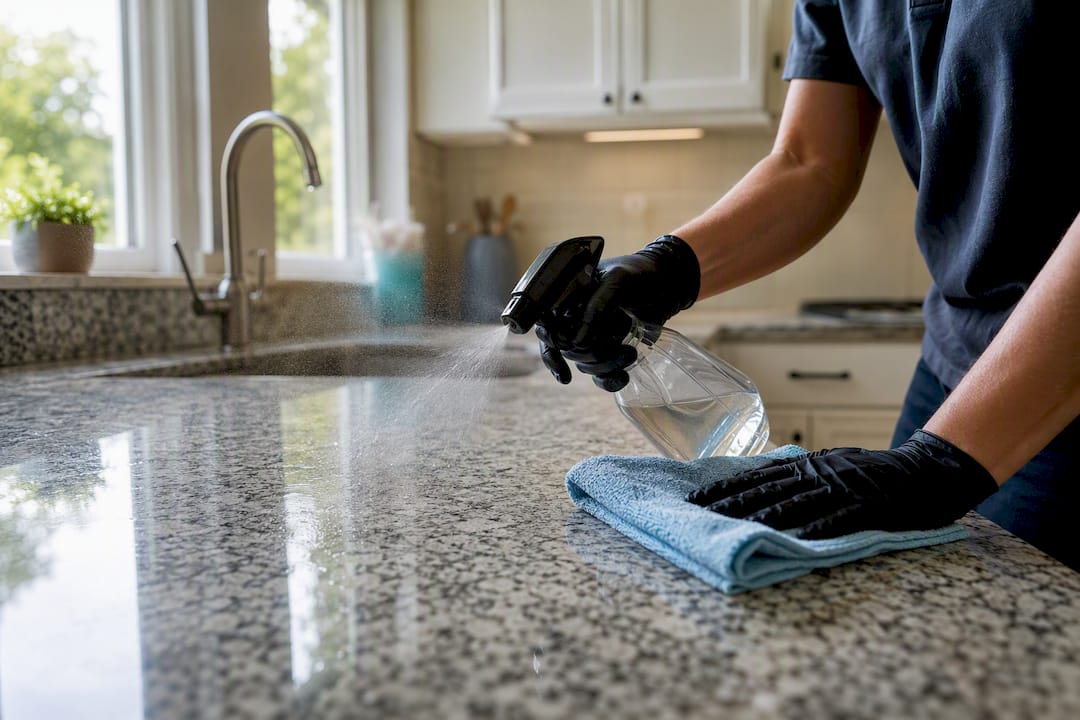
Reviewing this kind of documentation is part of standard practice for commercial cleaning services that build training and safe-product sourcing into their operating procedures rather than treating certification as a marketing afterthought.
Where Does the Industry Go From Here?
Green cleaning certification standards keep tightening rather than loosening. UL 2700’s recent updates addressing PFAS and packaging show where the pressure is coming from: state-level disclosure laws, particularly in California, are pushing certifiers to close gaps that used to let borderline products through. Expect more certifiers to explicitly reference state chemical disclosure requirements in future standard revisions rather than treating them as a separate compliance track.
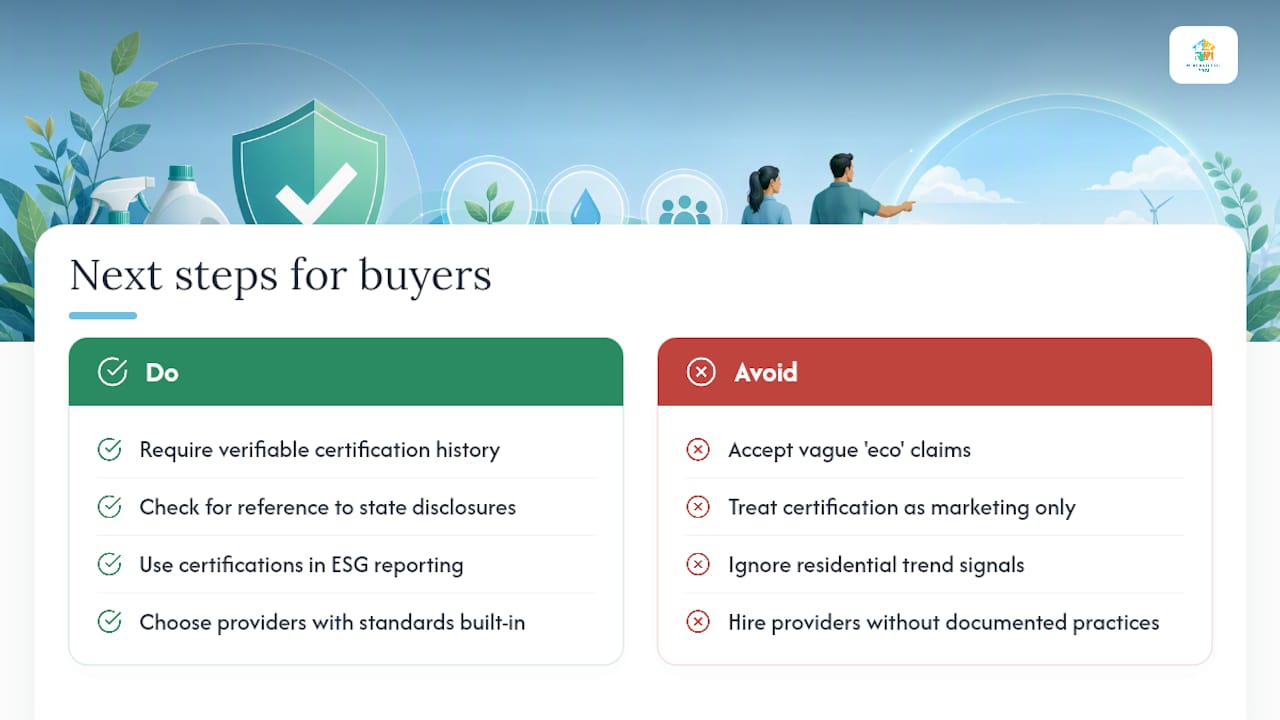
Sustainability reporting is the other driver. As more organizations publish ESG or occupant health disclosures, a documented, verifiable certification history becomes evidence a facility can point to, rather than an internal claim that auditors have to take on faith. That shift is turning certification from a nice-to-have marketing point into a documentation requirement tied directly to compliance reporting.
Buyers who want a broader view of where consumer expectations are heading can look at how eco-friendly cleaning trends are shifting outside the commercial procurement world, since residential demand often signals where commercial standards move next.
If you manage a property or office and want a provider that already builds these standards into daily operations, explore Neat and Tidy Pros’ service offerings or see how commercial cleaning contracts get structured around documented, verifiable practices instead of vague eco claims.
Our Take: Certification Is a Floor, Not a Finish Line
Most guidance on this topic treats a certification seal as the end of the vetting process. It isn’t. It’s the starting point for a conversation about what a vendor or product actually does day to day, and the article’s own evidence backs that up: a seal confirms compliance at audit time, not permanently.
The conventional advice, “just look for the logo”, undersells how much work still sits on the buyer’s side. Facility managers who treat GS-42 or Safer Choice as a checkbox miss the value these standards actually offer, which is a documented, auditable trail they can request and verify themselves. That trail is what protects you if a vendor’s formula changes or a training program lapses.
If you take one thing from this guide, prioritize the verification habit over the seal itself. Check the directory listing. Request the ingredient list. Read the contract language on recertification. A certification earns its value only when someone on your side actually uses it.
— Neat
Sources
- Frequently asked questions | Safer Choice | US EPA
- GS-42 Commercial and Institutional Cleaning Services – Green Seal
- UL ECOLOGO® Certification for Cleaning Products | UL Solutions
- Environmental claims: Summary of the Green Guides | Federal Trade Commission
- Green Cleaning | U.S. Green Building Council