
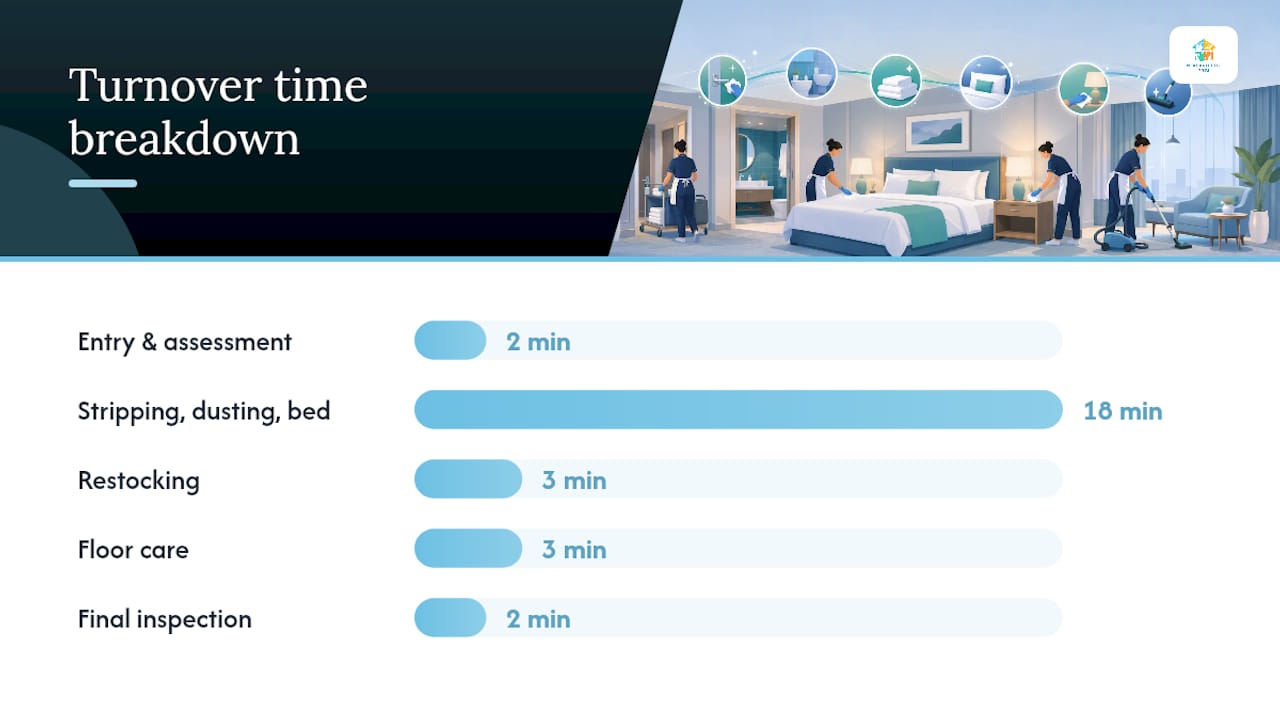
The fastest housekeeping teams follow one sequence, every time: Entry and assessment, strip, dust and wipe, bed-making, restock, floor care, then a final inspection. A standard checkout clean should land around 28 minutes; a stayover should run 15 to 20 minutes. Everything below breaks that sequence into a working hotel room cleaning checklist your team can post on a supply cart today.
TL;DR:
- Housekeeping should follow a strict sequence totaling 28 minutes for checkouts, with each step timed to prevent rushing or lingering and reduce wasted movement.
- The bedroom and bathroom cleaning standards focus on high-visibility surfaces, disinfection of high-touch points, and detailed checks to minimize guest complaints.
- Supervisors must verify each zone during inspection with clear pass/fail criteria, detailed notes, and photos, before marking a room as ready to avoid missed issues.
- Regular deep-cleaning tasks, such as grout scrubbing and mattress rotation, should be scheduled quarterly or monthly to preserve asset value and prevent guest-facing problems.
- Digital tools for real-time status updates, photo evidence, and automatic room assignment improve efficiency, reduce delays, and enable better tracking of cleaning quality.
Table of Contents
- What Is the Best Hotel Room Cleaning Checklist for Turnovers?
- Bedroom Cleaning Standards That Guests Actually Notice
- Bathroom Sanitation: Where Most Guest Complaints Start
- How Do You Inspect and Sign Off on a Cleaned Room?
- Deep-Clean and Maintenance Schedule
- Should You Use Digital Tools for Housekeeping Status Tracking?
- What Housekeeping Supervisors Get Wrong
- Let Neat and Tidy Pros Handle Your Room Turnovers
- Sources
What Is the Best Hotel Room Cleaning Checklist for Turnovers?
A hotel housekeeping checklist only works if it’s timed. Without minute targets, attendants either rush the bathroom or linger on dusting, and your turnaround times swing wildly from room to room. The seven-stage structure below fixes that by assigning a time box to each phase of the clean, based on a standard 28-minute checkout turnover.
- Entry and assessment (2 minutes). Knock, announce, prop the door, open curtains and a window if possible, and scan for maintenance issues or left-behind guest items before touching anything.
- Stripping and removal (5 minutes). Strip linens, pull trash, clear dishes and glassware, and remove used towels in one pass, moving in a single direction around the room.
- Dusting and wiping (8 minutes). Work top to bottom: ceiling fans and vents first, then furniture surfaces, then high-touch points like remotes, light switches, and door handles.
- Bed making (5 minutes). Fresh linens, hospital corners or the brand’s standard fold, pillows fluffed and squared, and a final visual check for stains or wrinkles.
- Restocking (3 minutes). Amenities, coffee service, stationery, and minibar items replaced to par, based on the room’s occupancy type.
- Floor care (3 minutes). Vacuum or mop, working backward out of the room so you never step on a cleaned surface.
- Final inspection (2 minutes). A last walk-through against the checklist before marking the room ready.
That sequence totals 28 minutes for a standard room turnover, and it’s built around a one-directional flow: enter, work the perimeter, exit backward out of the bathroom or entryway. Backtracking is where minutes disappear, and it’s also where attendants retrace steps unnecessarily during shifts that already involve standing for most of the day. A logical room flow reduces that fatigue by cutting wasted movement, not just wasted time.
Stayover cleans skip stripping unless linens are flagged for change, and restocking only covers used items, so they run significantly faster than full checkouts. Mark starred tasks on your printed checklist so attendants know at a glance which steps apply to a stayover versus a full checkout.
Pro Tip: Give new attendants a laminated card with the seven stages and time boxes clipped to their cart. Muscle memory takes about two weeks to build, and a visible reminder gets them there faster than verbal coaching alone.
Bedroom Cleaning Standards That Guests Actually Notice
Guests judge a room’s cleanliness within the first ten seconds of walking in, mostly by what they see on the bed and surfaces. That makes the bedroom section of your guest room cleaning checklist worth more attention per minute than almost any other zone.
- Wipe surfaces in this order: headboard, nightstands, dresser, desk, then chairs, so dust falls forward rather than resettling on cleaned areas.
- Disinfect high-touch points every clean: TV remote, thermostat, light switches, door handles, and the alarm clock or bedside charging station.
- Make the bed to a consistent standard: fresh linens pulled tight, top sheet folded to a set depth, pillows squared, and a visual check for stains, hair, or flattened spots on the mattress topper.
- Check the closet for stray hangers, missing iron or safe instructions, and confirm the in-room safe is empty and reset.
- Handle any guest property left behind according to your property’s lost-and-found procedure, never by discarding it.
Suites need an extended version of this list for sitting areas and extra closets, while accessible rooms require checking grab bars, lowered closet rods, and visual alarm equipment. Treating every room type with the same form is how properties miss the details that actually generate complaints.
Bathroom Sanitation: Where Most Guest Complaints Start
Bathroom cleanliness drives more guest dissatisfaction than any other part of the room, which is why bathroom-specific tasks deserve their own checklist rather than a generic “clean bathroom” line item.
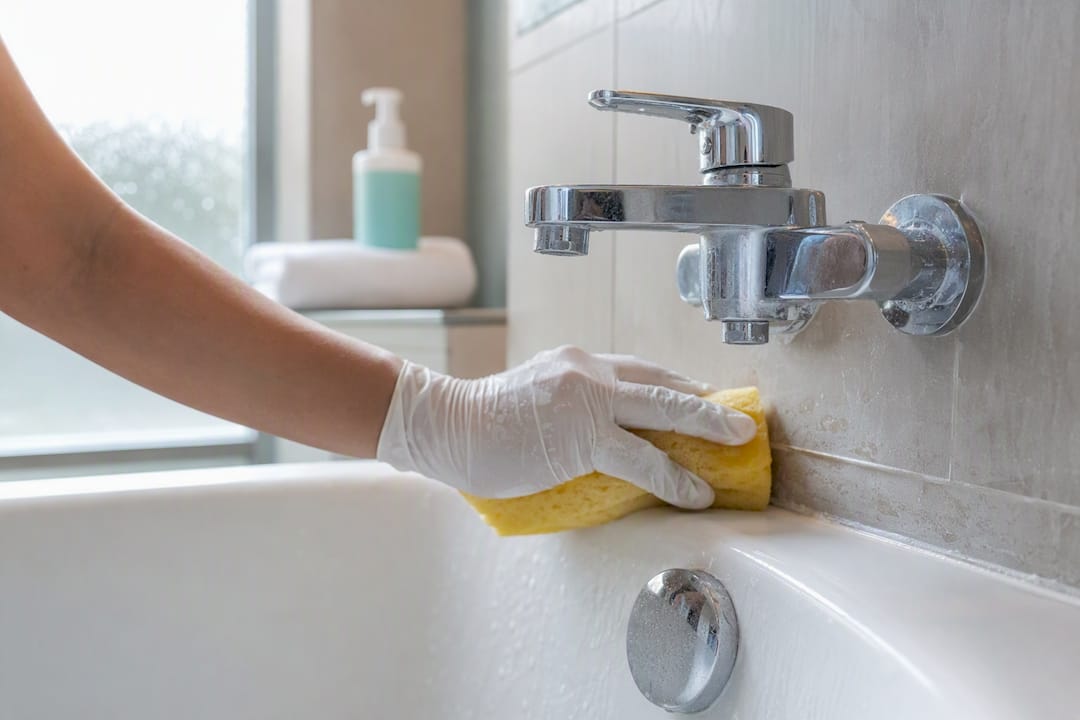
Statistic to remember: Housekeeping guides consistently flag the bathroom as the single most common source of guest complaints, tied directly to grout, drains, and amenity shortages rather than obvious dirt.
Work in this order to avoid cross-contamination and wasted motion:
- Spray and let disinfectant dwell on the toilet, tub, and sink while you address mirrors and fixtures elsewhere.
- Use an EPA-registered disinfectant on all hard surfaces, giving it the manufacturer’s listed contact time before wiping.
- Check grout lines and caulking for mildew, and clear hair from drains, both of which are the top visual triggers for complaints.
- Restock towels and amenities to par, matching occupancy, and confirm bath mats are down and floors are dry before leaving to avoid slip hazards.
A supervisor spot-check on grout and drains, done weekly rather than only during deep cleans, catches buildup before it becomes a guest-facing issue.
How Do You Inspect and Sign Off on a Cleaned Room?
A checklist means nothing without verification. Supervisors need a structure that catches misses before a guest does, and that starts with a zone-by-zone pass/fail inspection rather than a single “room ready” checkbox.
Structure the inspection around these zones, each scored pass or fail with a notes field:
- Entry and closet
- Bedroom surfaces and bed presentation
- Bathroom sanitation and amenities
- Floors and windows
- Final walk-through
Sign-off should capture the inspector’s name, the time of inspection, and a photo when an item fails. Route any maintenance issue, like a flickering lamp or loose grab bar, through a separate maintenance flag rather than burying it in cleaning notes, so it gets dispatched instead of forgotten. Restock only after verification passes, and treat any failed zone as an automatic re-clean trigger before the room status changes to ready.
Deep-Clean and Maintenance Schedule
Daily checklists keep rooms guest-ready, but they don’t touch the tasks that protect your asset value over time. Build a periodic schedule that sits alongside your daily hotel room turnover checklist:
- Weekly: grout and tile deep-scrub, upholstery spot-check, HVAC vent dusting.
- Monthly: mattress rotation, carpet shampoo in high-traffic rooms, curtain and drapery cleaning.
- Quarterly: HVAC filter replacement, full grout and caulking deep-clean, furniture and headboard inspection for wear.
Review the entire checklist itself on a quarterly basis, and update it immediately after a renovation or a pattern of similar guest complaints rather than waiting for the next scheduled review. Log every completed deep clean against the room number so it feeds into your asset-replacement planning. For mattress-specific protocols, an in-room mattress care workflow offers useful detail on rotation frequency and stain handling.
Should You Use Digital Tools for Housekeeping Status Tracking?
Paper checklists work, but they create a lag between when a room is ready and when the front desk knows it. Digital housekeeping tools close that gap with real-time status updates, photo evidence on failed inspection items, and automatic room assignment based on attendant location.
Pro Tip: Adopt a photo-on-fail rule even in a paper system. A phone photo attached to a maintenance ticket resolves disputes faster than a written note ever will.
What Housekeeping Supervisors Get Wrong
The biggest mistake we see is restocking before verification, which hides a failed inspection behind fresh towels. The second is skipping the notes field because “it was fine,” which erases the record a re-clean or a guest complaint later needs. Train supervisors with shadow shifts and photo examples of pass versus fail, not verbal descriptions, and adapt every checklist to your property’s room mix and staffing reality rather than copying a generic template.
— Neat
Let Neat and Tidy Pros Handle Your Room Turnovers
Running a tight checklist is only half the battle. Staffing it consistently, especially during high-occupancy weeks or last-minute call-outs, is where most properties actually lose ground. Neat and Tidy Pros fills that gap as a commercial cleaning partner for hotels, offering trained turnover teams, documented pass/fail inspections, and periodic deep-clean programs that map directly onto the schedule above.
Our teams work from the same zone-by-zone standards outlined here, meaning fewer re-cleans, cleaner inspection records, and guest reviews that reflect it. Whether you need a dedicated turnover crew for daily operations or a quarterly deep-clean program to catch the grout, carpets, and mattresses that daily checklists don’t reach, our commercial cleaning services are built for hospitality properties specifically. Request a walk-through of your property and get a quote for a turnover or deep-clean program that fits your occupancy patterns.
Sources
The timing benchmarks above come from HelloShift’s housekeeping checklist guide, inspection field structure from Roommaster, and bathroom-specific standards from Amadeus Hospitality. For a downloadable turnover format your team can adapt, see our Airbnb cleaning checklist.
- The Ultimate Hotel Housekeeping Cleaning Checklist
- Hotel Housekeeping Checklists for Better Operations | Mews
- Hotel Housekeeping Checklist
- Housekeeping checklist for hotels and vacation rentals | Amadeus Hospitality