A standardized, room-by-room Airbnb cleaning checklist with a pre-clean walkthrough and photo sign-off is the fastest path to consistent five-star turnovers. Cleanliness is the single most-reviewed attribute on major booking platforms, and one low score can push your listing below algorithmic thresholds before you even notice the problem.
Here is the short version of what every turnover requires:
- Strip all linens and start laundry immediately
- Run a pre-clean damage and left-behind-items check
- Sanitize every high-touch surface (handles, remotes, switches)
- Restock consumables to par (toilet paper, soap, coffee, trash bags)
- Complete a room-by-room clean using top-to-bottom, dry-to-wet order
- Take before/after photos for each room and attach to the work order
Professional estimates put a standard 2-bedroom turnover at roughly 2–3 hours, with per-room ballparks of 20–30 minutes for kitchens, 15–20 minutes per bathroom, and 10–15 minutes per bedroom. Add outdoor spaces, a hot tub, or a fireplace and budget another 20–45 minutes.
Key Takeaways
A room-by-room Airbnb cleaning checklist combined with a pre-clean walkthrough, photo sign-off, and stocked supply closet is the operational foundation for consistent five-star turnovers.
| Point | Details |
|---|---|
| Start laundry first | Strip beds and run the washer on arrival so laundry finishes while other rooms are cleaned. |
| Use photo sign-off | Require before/after photos per room attached to the work order to create a timestamped audit trail. |
| Stock to par levels | Keep a supply closet stocked to defined minimums so cleaners never run short mid-turnover. |
| Schedule deep cleans | Plan a deep clean every 3–6 months or every 15–20 turnovers to prevent buildup a standard turnover misses. |
| Neatandtidypros | Provides photo-verified Airbnb turnover cleans and deep cleans in Orange County and Corona, California. |
Table of Contents
- What should you check before cleaners start?
- What are the three cleaning levels, and why does the sequence matter?
- Kitchen checklist: turnover tasks and deep-clean add-ons
- Bathroom checklist: turnover tasks and deep-clean items
- Bedroom checklist: linens, staging, and spot checks
- Living room, dining, and entry checklist
- Laundry room and appliance checklist
- Exterior and outdoor spaces: patios, BBQ, pool, and hot tub
- Final walkthrough, sign-off checklist, and photo verification
- Turnover clean vs. deep clean: when to schedule each
- Supplies every host should stock and how to manage inventory
- How to run a reliable cleaner workflow and keep quality consistent
- Printable checklist templates and how to adapt them to your property
- Waste disposal and recycling best practices during turnover cleaning
- What hosts and cleaners often get wrong about checklists
- Neatandtidypros handles your Airbnb turnovers professionally
- Sources
What should you check before cleaners start?
The pre-clean walkthrough is the step most hosts skip, and it is the one that prevents the most expensive mistakes. Walking the property before a single surface is touched lets you document damage while it is still clearly attributable to the departing guest, find items left behind, and sequence long-dwell tasks so they run in parallel with the rest of the clean.
- Damage and maintenance check: Photograph any new damage (stains, broken items, scuffs) before moving furniture or stripping beds. Timestamps matter for security-deposit claims.
- Left-behind items: Bag them separately, photograph the bag contents, and message the guest through the platform before discarding anything.
- Start laundry first: Stripping beds and starting the washer is the single highest-leverage first move in any turnover. Laundry cycles run while you clean everything else.
- Set up the cleaning station: Confirm all supplies are at par in the supply closet before cleaners begin. A mid-turn supply run kills your schedule.
- Access check: Test the lockbox, smart lock, or key safe. Confirm check-in time for the incoming guest so the team knows their hard deadline.
Pro Tip: Take a short video walkthrough of the property on arrival, not just photos. Video captures odors you want to describe, ambient damage context, and the overall state of the space in a way that still images miss.
What are the three cleaning levels, and why does the sequence matter?
Not every surface needs the same treatment, and mixing up the levels wastes time or leaves guests at risk. The three levels are:
- Cleaning removes visible dirt, debris, and organic matter. It is the baseline for every surface every turnover.
- Sanitizing reduces microbial load to a safe level. Apply it to food-contact surfaces (countertops, cutting boards) and bathroom fixtures after cleaning.
- Disinfecting kills a broader spectrum of pathogens. Reserve it for high-touch surfaces (door handles, light switches, remote controls, toilet flush handles) and any surface a sick guest may have contacted.
The sequence that prevents rework is: top-to-bottom, dry-to-wet, always moving toward the exit. Dust and debris fall downward, so ceiling fans and shelves come before floors. Dry tasks (dusting, wiping dry surfaces) come before wet tasks (mopping, disinfecting) so you are not dragging a wet mop through dust you haven’t picked up yet. Always exit the room from the far corner toward the door so you never step on a freshly mopped floor.
Airbnb’s ground rules require hosts to clean between every stay and provide listings free of extensive dust, pet dander, and dirty dishes. Aligning your SOP to Airbnb’s 5-step enhanced cleaning process (prepare, clean, sanitize, check, reset) keeps you compliant and gives your team a recognizable framework.
For chemical safety: wear nitrile gloves when handling disinfectants, never mix bleach with ammonia-based products, and ventilate rooms during and after wet chemical application. Look for EPA Safer Choice or Green Seal labels when selecting products. These certifications signal that a product is effective without the harsh residues that can irritate guests with sensitivities.
Pro Tip: Label your spray bottles clearly and color-code them by use (bathroom, kitchen, glass). Cleaners working fast under time pressure make fewer errors when the bottle color tells them what they are holding.
Kitchen checklist: turnover tasks and deep-clean add-ons
The kitchen draws more guest complaints per square foot than any other room. Guests open the refrigerator, check the microwave, and run their finger along the countertop. The turnover checklist needs to cover all three.
Turnover tasks (every stay)
- Remove any food left by the departing guest; check the back of shelves and the freezer
- Run or empty the dishwasher; confirm it is empty and clean before staging
- Wipe all countertops and sanitize faucet, handles, and sink basin
- Clean microwave interior (a damp cloth with a splash of white vinegar loosens splatter fast)
- Wipe stovetop and burner grates; check oven window for visible residue
- Empty trash, replace liner, and wipe the bin exterior
- Sweep and mop floor, including under the edge of the stove and refrigerator
- Stage small appliances (coffee maker, toaster, blender) in their designated spots
Restock par levels
| Item | Minimum visible par |
|---|---|
| Dish soap | One full bottle |
| Dishwasher pods | 4 pods minimum |
| Paper towels | One full roll on holder |
| Coffee / tea | 4 servings each |
| Salt and pepper | Shakers at least half full |
| Trash bags | 2 extras under the liner |
Deep-clean add-ons (schedule separately)
- Oven interior: degrease racks and cavity
- Refrigerator coils: vacuum dust from rear or underside
- Cabinet fronts: degrease handles and panel faces
- Grout lines and backsplash: scrub with a stiff brush
- Under and behind appliances: pull out and sweep/mop
Schedule deep-clean kitchen tasks every 3–4 months or whenever you notice buildup that a standard wipe-down cannot address.
Bathroom checklist: turnover tasks and deep-clean items
Guests judge bathroom cleanliness in seconds. Hair in the drain, a cloudy mirror, or a soap scum ring in the tub will show up in your review before anything else does.
Turnover tasks (every stay)
- Disinfect toilet bowl (including under the rim), seat, lid, and base
- Scrub shower or tub; rinse and squeegee glass doors
- Wipe mirrors streak-free (a microfiber cloth with glass cleaner, buffed dry)
- Sanitize faucet handles, towel bars, and light switches
- Empty trash and replace liner
- Replace towels and bathmats with freshly laundered sets
- Restock toilet paper (minimum two visible rolls), hand soap, and any guest toiletries
Staging for a cleanliness signal
| Item | Staging standard |
|---|---|
| Towels | Folded or rolled, hotel-style, on bar or shelf |
| Toilet paper | First sheet folded to a point |
| Hand soap | Full or near-full dispenser |
| Bathmats | Flat, centered in front of tub or shower |
| Toiletries | Aligned, labels forward |
Deep-clean add-ons (schedule separately)
- Grout lines: scrub with a grout brush and mildew remover
- Showerhead: descale with white vinegar soak
- Caulk: inspect for mold or separation; re-caulk as needed
- Exhaust fan: remove cover and vacuum dust from blades
- Behind and under fixtures: wipe baseboards and toilet base
Bedroom checklist: linens, staging, and spot checks
Sleep quality is the one thing guests cannot separate from cleanliness. A stained pillow or a musty mattress overrides everything else you got right.
- Strip all bedding and launder, or swap with a pre-laundered set from your linen rotation
- Inspect the mattress protector for stains; replace if soiled
- Make the bed to a consistent reference photo (hospital corners, pillows centered and stacked)
- Dust all surfaces including nightstands, headboard, ceiling fan blades, and window sills
- Check under the bed for debris, forgotten items, or dust accumulation
- Test bedside lamps and any USB charging ports
- Verify closet hangers are present and organized; confirm luggage rack is clean and accessible
- Vacuum carpet or mop hard floors; pay attention to corners and under furniture
Keeping at least three linen sets per bed prevents laundry bottlenecks during tight turnovers. With three sets, one is on the bed, one is in the wash, and one is clean and ready. You never have to wait on a dryer cycle to make a bed.
Living room, dining, and entry checklist
Common areas are where guests spend most of their waking hours, and the complaints that come from them are almost always about things that take under two minutes to fix: a sticky remote, crumbs under a couch cushion, a dusty TV screen.
- Dust all surfaces: shelves, TV stand, picture frames, ceiling fan
- Sanitize high-touch items: remote controls, light switches, door handles, thermostat
- Vacuum sofa cushions and under them; fluff and arrange throw pillows
- Wipe TV screen with a dry microfiber cloth only (no liquid)
- Vacuum or mop floors, including under furniture edges
- Wipe dining table surface and underside; check chair seats and rungs for crumbs
- Clean and stage table centerpiece or welcome materials in their designated spot
Entryway: Sweep entry floor, wipe the front door and handle, test the smart lock or key safe, and place welcome materials (house manual, WiFi card, local guide) in their standard spot. Guests see the entry first and last. A clean, organized entry sets the tone for the whole stay.
Laundry room and appliance checklist
Laundry is the one task that cannot be rushed, which is why starting it immediately on arrival is the single biggest time-saver in any turnover. While the washer runs, everything else gets done.
- Strip beds and collect all used towels and bathmats on arrival; sort and load the first cycle before touching anything else.
- Clean the lint trap in the dryer before every cycle. A clogged trap is a fire hazard and extends dry time.
- Wipe the washer drum interior and door gasket; check for mildew odor and run a cleaning cycle monthly.
- Wipe dryer exterior and check that the vent hose is not kinked or blocked.
- Verify HVAC filter condition; flag for replacement if visibly dirty. Check thermostat settings and reset to your default guest temperature.
- Wipe the coffee maker exterior and run a water-only brew cycle to flush the carafe. Descale monthly.
- Wipe the toaster crumb tray and exterior; check the blender gasket for residue.
- Confirm the microwave turntable is clean and seated correctly.
Exterior and outdoor spaces: patios, BBQ, pool, and hot tub
Outdoor spaces add time to a turnover, and they are the spaces guests most often photograph for their own reviews. A dirty BBQ grate or a leaf-covered patio table reads as neglect even when the interior is spotless.
- Sweep patio, deck, and entry steps; remove debris from outdoor furniture
- Wipe down patio table and chairs; check cushions for moisture or stains
- Clean BBQ grates after each stay: brush while warm if possible, then wipe the exterior
- Remove trash from outdoor bins and replace liners
- Check outdoor lighting: replace any burned-out bulbs
- Verify gate latches, pool fence locks, and any outdoor safety equipment (life ring, first-aid kit)
- Pool and hot tub chemistry should be checked by a certified pool technician on a scheduled cadence; flag any visible cloudiness or foam for specialist service before the next guest arrives
Hot tub turnovers add 20–30 minutes minimum for a visual check, surface wipe, and cover replacement. Full chemistry testing and water treatment should be on a specialist’s schedule, not the cleaner’s.
Final walkthrough, sign-off checklist, and photo verification
Walk the property the way a guest would: open the refrigerator, sit on the sofa, lie on the bed, run the shower for 10 seconds. You are looking for odors, missed stains, and anything that is out of place.

Room-by-room sign-off
A mandatory per-room photo set attached to the completed work order is the strongest single operational control for remote hosts. It creates a timestamped audit trail, reduces disputes with cleaners, and gives you proof of condition if a guest files a damage claim.
Store photos in a shared folder labeled by property, date, and guest booking ID. Flag any maintenance issues discovered during the walkthrough in your property management or work-order platform before marking the turnover complete.
Turnover clean vs. deep clean: when to schedule each
A turnover clean happens after every stay. A deep clean is a scheduled, more thorough reset that addresses the buildup a turnover cannot reach.
Professional guidance recommends scheduling a deep clean every 3–6 months or every 15–20 turnovers, adjusting for pet-friendly listings or high-traffic periods. Deep cleans typically add 2–4 hours beyond a standard turnover.
Deep-clean tasks that go beyond a standard turnover:
- Grout scrubbing (tile floors, shower walls)
- Baseboard and door-frame wiping
- Appliance interiors (oven cavity, refrigerator coils)
- Upholstery shampooing or steam cleaning
- Drain clearing and descaling
- Window tracks and sill cleaning
- Behind and under all furniture
- Exhaust fan disassembly and cleaning
Statistic callout: A deep clean scheduled every 15–20 turnovers keeps a property in guest-ready condition without over-cleaning, which wastes budget, or under-cleaning, which accumulates the kind of buildup that generates one-star reviews.
For grout restoration, oven cavity degreasing, or upholstery steam cleaning, contracting a professional crew is often faster and more effective than adding those tasks to a cleaner’s turnover shift. See the full room list for professional deep cleans to plan what to outsource versus handle in-house.
Supplies every host should stock and how to manage inventory
Running out of toilet paper mid-stay is one of the most common guest complaints, and it is entirely preventable. The fix is par levels: a defined minimum quantity that triggers a reorder before you hit zero.
Stock your on-site supply closet with these essentials:
- Toilet paper (minimum 4 rolls visible per bathroom)
- Paper towels (one full roll per kitchen)
- Hand soap and dish soap (full bottles)
- Dishwasher pods (4 minimum per turnover)
- Trash bags (correct size for each bin, 2 extras per bin)
- Laundry detergent and dryer sheets
- Microfiber cloths (at least 6 per property, color-coded by room)
- Nitrile gloves (for cleaners)
- Cleaning chemicals: all-purpose cleaner, bathroom disinfectant, glass cleaner, toilet bowl cleaner
- Basic condiments: salt, pepper, sugar, coffee, tea (4 servings minimum each)
When the supply closet hits half, order before it empties. A simple shared spreadsheet or a reminder in your property management app works fine for most hosts. Apps like Breezeway and Properly allow you to attach inventory checklists directly to turnover tasks.
For product selection, look for EPA Safer Choice or Green Seal certified products. Eco-conscious guests read listing descriptions, and hosts who use certified products to reduce complaint risk from guests with chemical sensitivities.
Pro Tip: Pre-pack a “turnover kit” bag for each property: a labeled tote with the exact consumables needed for one turnover. Cleaners grab the bag on arrival and restock from the closet when they leave. It eliminates the “I thought there was more” problem entirely.
How to run a reliable cleaner workflow and keep quality consistent
A checklist only works if the cleaner uses it every time. The operational layer around the checklist is what turns a document into a repeatable system.
Onboarding a new cleaner
- Walk the property together on the first turn, checklist in hand.
- Show reference staging photos for each room (bed made, towels folded, supplies staged).
- Observe the first turnover and give feedback before the cleaner leaves.
- Confirm they know the escalation path: who to call for damage, low supplies, or a maintenance issue.
Embedding the checklist in your workflow
- Use a property operations app (Breezeway, Properly, or Hostfully) to assign tasks, attach the checklist, and require photo uploads before marking a job complete.
- Set escalation rules: if a photo is not uploaded within 30 minutes of the scheduled completion time, you get a notification.
- Embedding digital checklists in work-order software and requiring before/after photos reduces disputes and enforces consistent quality even when you manage cleaners remotely.
Quality-control cadence
- Run a random spot audit once a month: arrive unannounced after a turnover and walk the property with the checklist.
- Review photo pass rate monthly: what percentage of turnovers have a complete photo set?
- Track time-per-turnover. If it creeps up, the checklist may need a task removed or the property may need a deep clean.
Pro Tip: Give cleaners access to the same reference photos you use for quality checks. When a cleaner knows exactly what “correct” looks like, they self-correct before you ever see the result.
When outsourcing, professional Airbnb cleaning in the U.S. typically runs $20–$90 per hour depending on market and scope. A flat-fee arrangement per turnover is often easier to budget than hourly for predictable property sizes.
For onboarding, a printable room-by-room checklist given to new cleaners at their first turn increases adoption and reduces the need for repeated verbal instructions.
Printable checklist templates and how to adapt them to your property
A checklist that lives only in your head or in a long email thread is not a system. The goal is a single-sheet document a cleaner can hold, check off, and hand back.
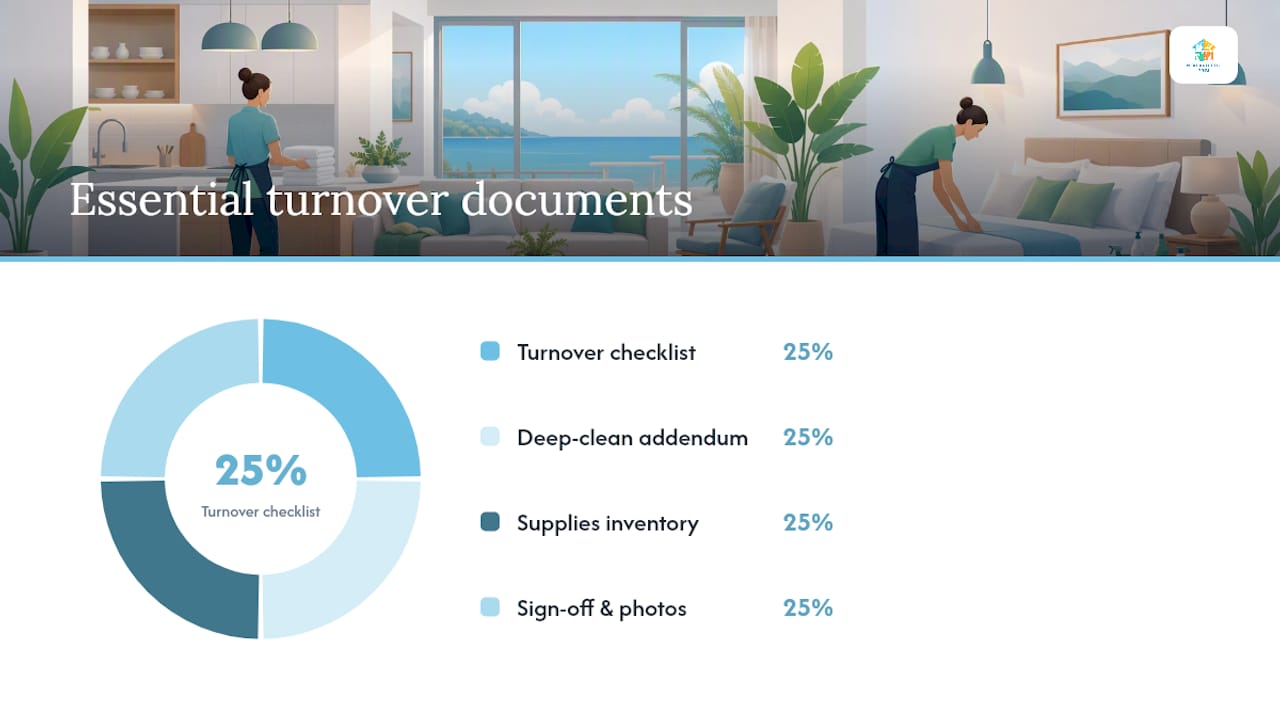
The four documents every host should have:
- Turnover checklist: Room-by-room, fits one or two printed pages. This is the daily-use document.
- Deep-clean addendum: A separate sheet listing the tasks that go beyond a standard turnover, with frequency notes.
- Supplies inventory sheet: A par-level list the cleaner checks on arrival and marks depleted items.
- Sign-off and photo log: A simple form where the cleaner initials each room and notes the photo file names or upload confirmation.
For property-type customization, add a one-page addendum for features your main checklist does not cover: hot tub chemistry check, fireplace ash removal, shared-amenity rules for condos, or fire-pit cleanup for cabins. Keep the main checklist short and universal; put the property-specific items in the addendum so cleaners do not have to read through irrelevant tasks.
File formats that work: PDF for printing (fixed layout, no editing accidents), CSV for the inventory sheet (easy to update and share), and a mobile-friendly checklist format for apps like Breezeway or Properly when cleaners work from their phones.
The Neatandtidypros 47-point California Airbnb Turnover Checklist is a field-tested template you can download, print, and hand directly to a cleaner on their first day.
Waste disposal and recycling best practices during turnover cleaning
Waste handling during a turnover is faster and cleaner when it is built into the room sequence rather than treated as a final step.
Carry a trash bag from room to room and empty every bin as you go. This prevents the back-and-forth of collecting trash at the end when floors may already be mopped. Replace liners immediately after emptying so the bin is guest-ready before you leave the room.
Separate recycling from trash at the point of collection. Keep a dedicated recycling bag in the cleaning kit and sort as you go: glass, cardboard, and plastics from the kitchen; empty toiletry containers from the bathroom. Check local municipal guidelines for what is accepted curbside, since recycling rules vary by city and county.
Hazardous waste (expired cleaning chemicals, used batteries, broken glass) should never go into the regular trash. Bag broken glass separately and label it. Dispose of expired chemicals at a local household hazardous waste facility. Many counties in California hold monthly drop-off events.
Outdoor bins should be checked and emptied every turnover, not just when they look full. A bin that overflows between stays creates a pest problem that is far more expensive to fix than the two minutes it takes to empty it.
What hosts and cleaners often get wrong about checklists
Most hosts who struggle with inconsistent cleanliness are not using the wrong products. They are using the right products in the wrong order, or they are relying on a cleaner’s memory instead of a written system.
The biggest operational mistake is treating the checklist as a training document rather than a live work tool. A checklist handed to a cleaner at onboarding and never referenced again is not a system. It is a formality. The hosts who get the most consistent results are the ones who require the checklist to be physically present during every turnover and require a photo set before the job is marked complete.
There is also a tendency to over-complicate the checklist. A two-page document a cleaner actually uses beats a six-page document that sits in a drawer. The goal is coverage, not comprehensiveness for its own sake. If a task is on the checklist but never gets done, the checklist is too long.
The three-linen-set rotation is another habit that separates high-performing hosts from the rest. Hosts who run on two sets are always one laundry delay away from a missed check-in. Three sets per bed is the minimum that gives you a real buffer.
Neatandtidypros handles your Airbnb turnovers professionally
Hosts who want consistent, photo-verified turnovers without managing the process themselves use Neatandtidypros. The team handles Airbnb turnover cleans, scheduled deep cleaning, and move-in/move-out cleans across Orange County and Corona, California, using eco-friendly products and a structured photo-verification workflow on every job.
Every turnover follows the same room-by-room SOP, with before/after photos attached to the completed work order so you have an audit trail without being on-site. Staff are trained on the top-to-bottom, dry-to-wet methodology and Airbnb’s enhanced cleaning alignment. Products are selected for EPA Safer Choice compliance where available.
For hosts who want a deeper reset, the Neatandtidypros services page covers the full range of options, from standard turnovers to full deep cleans. Book directly or request a quote for your property size and turnover frequency.
Sources
- Vacation Rental Cleaning Checklist Template (2026) | Lodgify
- Airbnb Cleaning Checklist: Room-by-Room Turnover Guide With Time Estimates (2026) | RapidEye
- The Complete Airbnb Cleaning Checklist (Room-by-Room) | PrepBnB
- Ground rules for home guests – Airbnb Help Center
- Airbnb cleaning checklist — Awning
3 Responses