A working restaurant kitchen cleaning checklist splits every task into daily, weekly, and monthly frequencies, then assigns each one to a specific role with a signature line. The system below covers back of house, front of house, hood and grease trap schedules, and sanitizer verification, with a printable structure you can adapt to your own layout. Professional cleaning companies also handle the deep-clean side of this work for kitchens that would rather hand it off.
TL;DR:
- Proper verification tools like sanitizer strips and calibrated thermometers are essential to confirm cleaning effectiveness and prevent inspection failures.
- Assigning specific responsible staff members and requiring signatures for each task significantly improves accountability and compliance.
- External professional deep-clean services should handle complex tasks such as hood and duct cleaning, with logs kept for inspector and insurance review.
- Frequency guidelines based on FDA and local codes must be strictly followed, with attention to contact times and proper sequence in sanitizing processes.
- Regular training, visible checklists, and digital access help maintain consistency, especially during busy service periods.
Table of Contents
- The Back-of-House Cleaning Checklist: Daily, Weekly, Monthly
- Front-of-House Cleaning Checklist: Daily, Weekly, Monthly
- Monthly Deep Cleans: Hoods, Vents, Ice Machines, and Behind Equipment
- Chemical Safety, Sanitizer Contact Times, and How to Verify Them
- Records, Sign-Off Logs, and Who Owns Each Task
- Supplies, Tools, and PPE You Need on Hand
- Building Your Printable Checklist Template
- How Neatandtidypros Approaches Restaurant Cleaning
- What Actually Matters More Than the Checklist Itself
- Get Professional Help With the Parts That Are Hard to Keep Consistent
- Sources
The Back-of-House Cleaning Checklist: Daily, Weekly, Monthly
Most kitchens fail health inspections not because nobody cleans, but because nobody assigns who cleans what and when. A commercial kitchen cleaning schedule fixes that by turning vague habits into named tasks with a paper trail.
Daily tasks
- Sanitize food-contact surfaces after every use. The FDA Food Code requires surfaces touching time/temperature-control-for-safety foods to be cleaned and sanitized at least every 4 hours during continuous use, not just at closing.
- Rotate sanitizer buckets regularly during use and test concentration with strips before refilling, not after.
- Check dish machine temperatures at the start of service and again mid-shift, then run a final sanitizing cycle before shutdown.
- Sweep and mop all kitchen floors, including under low equipment where grease pools first.
- Empty trash and recycling before bins overflow, and wipe down the cans themselves, not just the liners.
- Clean and restock hand sinks with soap, paper towels, and a visible reminder sign each closing shift.
Weekly tasks
- Delime the dish machine to strip mineral buildup that blocks proper sanitizing temperatures.
- Clean ovens and run a fryer boil-out using the manufacturer-recommended degreaser and cycle time.
- Wash walk-in cooler interiors and fan guards, where dust buildup restricts airflow and drives up compressor strain.
- Clean floor drains with a brush and drain cleaner to stop slow drainage and odor buildup before it starts.
Monthly tasks
- Pull movable equipment away from walls and clean behind and underneath it, where grease and food debris hide for months.
- Clean hood filters in-house and log the date of the last professional hood service separately, since these are two different obligations.
- Schedule grease trap pumping based on your local code and cooking volume, not on a generic calendar guess.
- Service the ice machine, including the bin and dispensing chute, which harbor mold faster than most managers expect.
Every one of these tasks needs a verification method attached to it. Sanitizer strips confirm concentration; a calibrated thermometer confirms dish machine and cooler temperatures. When something gets skipped, log the exception in writing rather than pretending it happened. Reference material like the Webstaurant Store’s restaurant cleaning checklist confirms this daily/weekly/monthly split is the industry standard structure, and inspectors expect to see it reflected in your paperwork, not just your kitchen.
Front-of-House Cleaning Checklist: Daily, Weekly, Monthly
Guests judge your kitchen by what they see in the dining room, not by what happens behind the line. A restaurant cleaning guide that only covers BOH misses half of the health department’s actual checklist.
Daily:
- Sanitize tables, chairs, and condiment stations between every seating, not just at the end of the shift.
- Check restrooms on an hourly schedule and log the check with a timestamp.
- Sweep, mop, or vacuum dining floors depending on flooring type.
- Wipe down entry glass, door handles, and host stand surfaces, which collect more hand contact than almost anything else in the building.
- Launder cloth napkins and linens according to your supplier’s schedule.
Weekly:
- Dust light fixtures, vents, and ceiling fans where grease and dust settle unnoticed.
- Wash windows inside and out, especially street-facing glass that shows every smudge.
- Spot-clean upholstery and carpet stains before they set permanently.
Monthly:
- Wash walls near booths and entryways where hands and food residue build up over weeks.
- Check ceiling corners for cobwebs and dust, particularly above booths and near HVAC vents.
- Rotate and deep-clean decor items like menus, planters, and light fixtures.
A quick mid-shift hygiene pass, ideally a five-minute walkthrough between the lunch and dinner rush, catches spills and messes before a guest does. If your restrooms take on heavy traffic, a dedicated restaurant bathroom cleaning checklist with its own sign-off column keeps that high-risk area from falling through the cracks of a general FOH log.
Monthly Deep Cleans: Hoods, Vents, Ice Machines, and Behind Equipment
Some monthly tasks belong to your staff. Others legally belong to a certified contractor, and mixing up the two is how kitchens end up with a fire code violation they didn’t see coming.
- Manager-led deep cleans include pulling equipment fully out, degreasing walls behind the line, cleaning ceiling tiles above cooking areas, and replacing cracked or yellowed light shields.
- Certified-professional tasks include full hood and duct cleaning and grease trap pumping. Hood filter wiping can happen weekly in-house, but the interior ductwork requires a licensed service tied to your local fire code, and cooking volume drives that frequency more than the calendar does.
- Log every service certificate the moment it arrives. Inspectors and insurance adjusters both ask for these, and “the vendor probably has a copy” is not an answer that holds up.
- Set your cadence by volume, not habit: a high-volume fryer line needs hood service more often than a low-volume sandwich shop, even if both opened the same year.
- Run a quick pre- and post-service check. Before the crew arrives, clear the area and pull anything blocking access. After they leave, photograph the completed work and file it with the invoice.
Deep-clean projects go faster on your slowest business day of the week, with one named manager owning the walkthrough from start to finish. For equipment-specific procedures like oven interiors and fryer boil-outs, a detailed appliance deep-clean guide fills in the steps this checklist only summarizes.
Chemical Safety, Sanitizer Contact Times, and How to Verify Them
Cleaning and sanitizing are two separate steps, and skipping the order between them is one of the most common reasons a surface fails an inspector’s swab test. You clean first to remove visible debris, then sanitize to kill what’s left, and the sanitizer only works if it stays wet on the surface for its full contact time.
Manufacturer labels specify that contact time, and it varies by chemical. Chlorine-based sanitizers, quaternary ammonium (quats), and iodine solutions each require different concentrations and dwell times, so the label on your specific product is the only accurate source. Extension guidance on chlorine bleach sanitizing walks through the concentration ranges typically used in food service settings.
Verification steps that actually work:
- Test sanitizer concentration with strips rated for your specific chemical type, not a generic strip.
- Check dish machine final-rinse temperature with a calibrated thermometer, logged at shift start.
- Label secondary containers clearly, since an unlabeled bottle is a liability even if everyone on shift knows what’s in it.
Safety rules that don’t bend: PPE for anyone mixing or applying concentrated chemicals, chemical storage below and away from food and food-contact surfaces, and a hard rule against mixing chemicals under any circumstance. Keep Safety Data Sheets accessible for every product in the building, and stick to EPA-registered disinfectants so you’re never guessing whether a product is even approved for the surface you’re using it on.
Pro Tip: Contact time is the step almost everyone skips. Spraying a sanitizer and wiping it dry ten seconds later means the surface was never actually sanitized, just wet for a moment.
Records, Sign-Off Logs, and Who Owns Each Task
A checklist with no name attached to it fails quietly, every time. “Someone” doesn’t sanitize the walk-in shelving, and “someone” doesn’t check the hand sinks at close. A specific person does, and that person initials the log.
- Build a daily initials-plus-manager-verification workflow, where staff sign off their own tasks and a manager reviews and signs the sheet before the next shift starts.
- File completed logs somewhere retrievable for at least a full inspection cycle, whether that’s a binder in the office or a digital archive.
- Assign monthly deep-clean projects to a named manager, not a rotating “whoever’s free,” so accountability doesn’t evaporate the one month it matters.
- Run a brief demo during new-hire orientation, then refresh training every few months so the checklist doesn’t quietly drift into a formality nobody reads.
- Post the current checklist somewhere visible on the line. A hidden checklist gets ignored; a posted one gets followed.
Digital tracking apps can replace the paper binder, but the same accountability structure applies either way: a name, a timestamp, and a manager’s review.
Supplies, Tools, and PPE You Need on Hand
A schedule falls apart the moment a station runs out of test strips mid-shift. Stock by station, not by guesswork.
- Prep and line stations: color-coded cutting boards, sanitizer buckets, test strips, and clean side towels.
- Dish pit: delimer, machine-safe detergent, and a backup thermometer.
- FOH and restrooms: glass cleaner, disinfectant wipes, restroom-specific supplies, and hourly-check signage.
- Floor care: degreaser, wet-floor signage, and drain brushes kept where drains actually are, not in a closet three rooms away.
Replace mops when the strands fray or hold odor after washing, and rotate floor mats before the rubber backing cracks and becomes a slip hazard itself. Keep a par level for test strips and sanitizer concentrate so a Friday night rush never runs dry, and check that par level weekly, not when someone notices the shelf is empty.
Building Your Printable Checklist Template
A one-page template beats a ten-page binder nobody opens during a rush. Structure it around four columns and one signature row.
- Daily/service/closing columns for the tasks that repeat every shift, each with a blank for initials.
- A weekly rotation row for the tasks that only need attention two or three times a week, not every day.
- A monthly deep-clean row flagged separately, tied to the manager who owns that project.
- A corrective-action field, so when something gets missed, the fix and the follow-up date get written down instead of forgotten.
- A manager verification row at the bottom of every shift, where a supervisor signs that the sheet was reviewed, not just filled out.
Small kitchens can run this on a single clipboard page. High-volume operations often split it into two sheets, one for BOH and one for FOH, because a single page gets crowded fast once you’re running multiple stations at once. A QR code taped near the line, linking to a digital version of the same template, gives staff quick access without hunting for a clipboard during a rush. For a model of how a detailed sign-off workflow scales across a full property, the structure behind an Airbnb cleaning checklist translates surprisingly well to a kitchen’s daily/weekly/monthly rhythm.
How Neatandtidypros Approaches Restaurant Cleaning
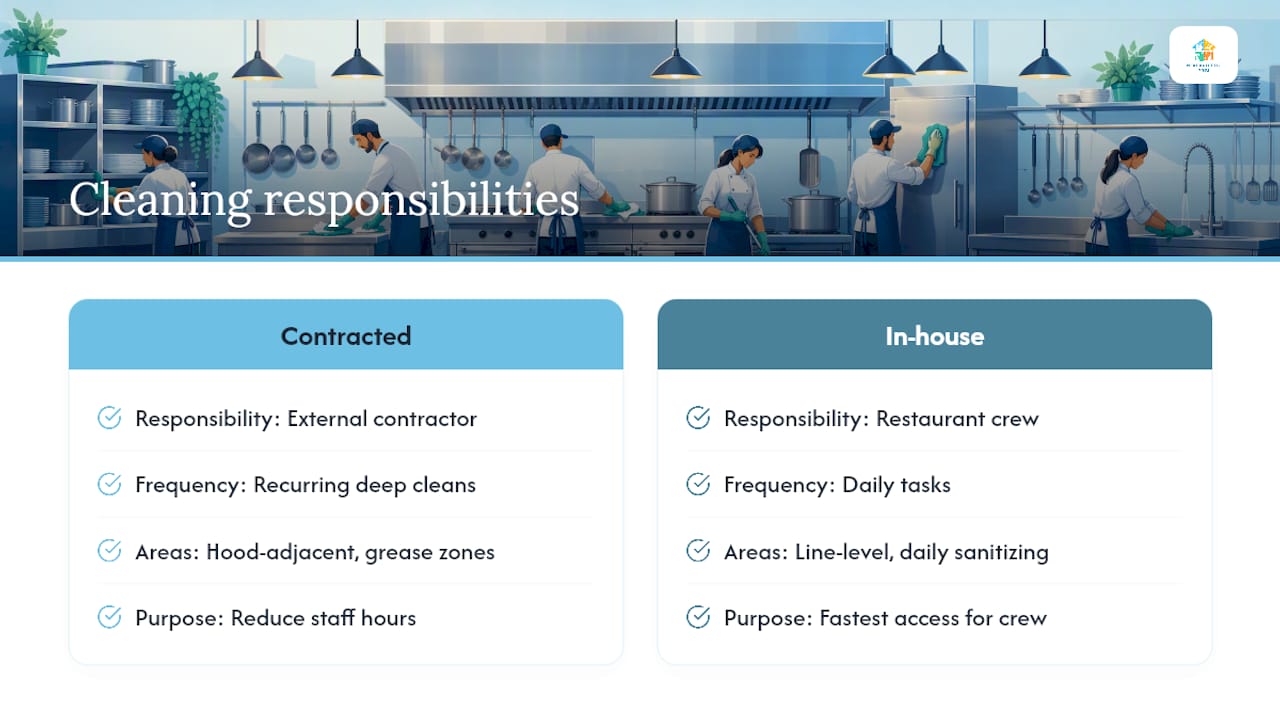
Commercial cleaning engagements build around the same principle this checklist relies on: named responsibility. Every scheduled visit gets logged and verified, so a restaurant’s own sign-off system and a contracted deep-clean schedule reinforce each other instead of working around each other. We generally recommend a recurring contract for hood-adjacent deep cleans and grease-heavy zones that eat staff hours fast, while keeping daily sanitizing and line-level tasks in-house where your own crew already has the fastest access.
What Actually Matters More Than the Checklist Itself
The checklist format gets most of the attention in this industry, but format was never the problem. Kitchens that fail inspections almost always had a checklist. What they lacked was a name attached to each line and a manager who actually reviewed the sheet instead of filing it.
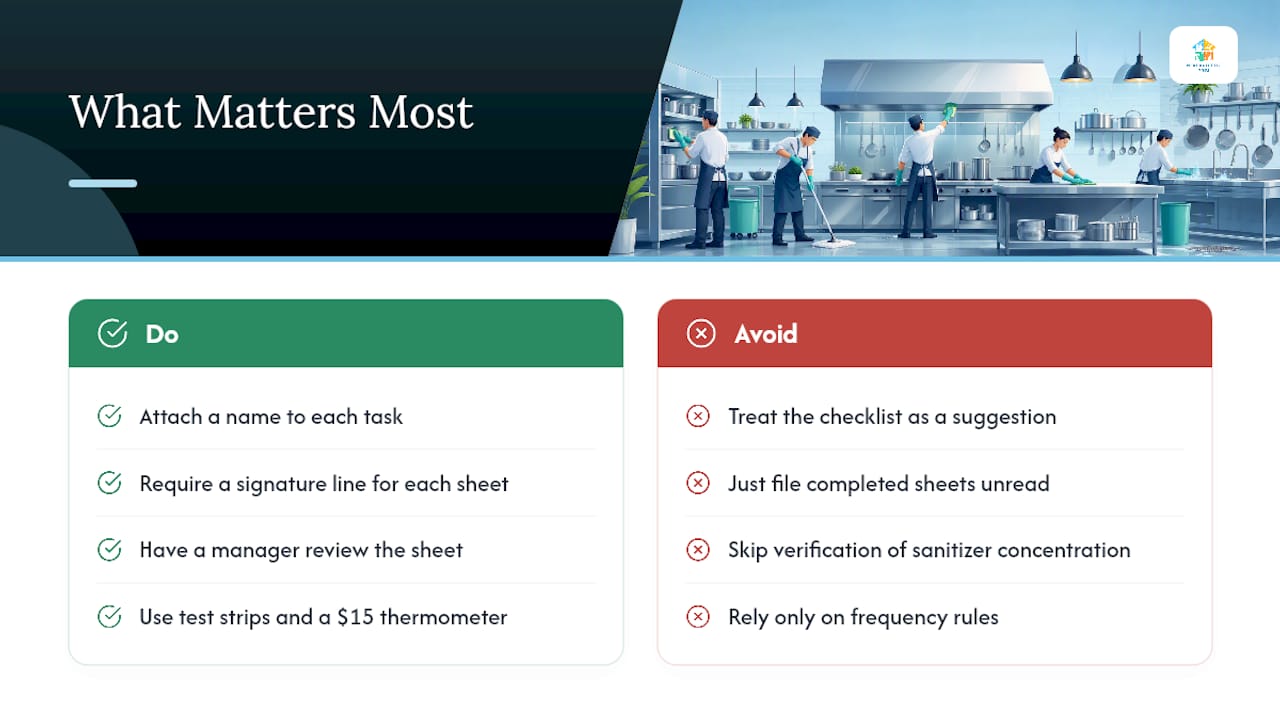
Conventional advice leans hard on frequency: clean this daily, that weekly, this other thing monthly. Frequency matters, but it’s the easy half of the problem. The harder half is verification, proving the sanitizer hit the right concentration, proving the contact time was honored, proving the hood service actually happened on the date the certificate claims. Test strips and a $15 thermometer solve more inspection failures than any laminated poster ever will.
If you take one thing from this system, make it the signature line. A checklist without a name attached to each task is a suggestion, not a system. Fix that first, and the rest of the schedule tends to fall into place.
— Neat
Get Professional Help With the Parts That Are Hard to Keep Consistent
Daily sanitizing is manageable with a good checklist. Hood interiors, grease traps, and behind-equipment buildup are a different problem, the kind that eats staff hours and still gets missed when the dinner rush takes priority. Some professional cleaning services run restaurant deep cleans on a recurring schedule so those monthly tasks never depend on whether your crew had a slow enough day to get to them.
Engagements typically start with a walkthrough audit of your kitchen and FOH space, followed by a proposed cleaning schedule that fits your service volume, then recurring visits logged and verified the same way your own staff logs theirs. That means fewer surprises at inspection time and one less system for a manager to chase down personally. If your kitchen handles heavy grease volume, a commercial cleaning partnership can absorb the deep-clean rows of this checklist entirely, freeing your team to focus on the daily and weekly tasks that need to happen on-site anyway. Reach out for a walkthrough and a quote, and bring your current checklist so we can build the schedule around what you’re already tracking.
Sources
For frequency rules, check the FDA Food Code and your state’s specific retail food code. For disinfectant selection, the EPA’s approved list and extension guidance on chlorine sanitizer dwell times cover the chemistry side. If your floors and drains need attention beyond a mop and bucket, guidance on commercial tile and grout cleaning and avoiding common restaurant plumbing mistakes fill in the gaps this checklist only touches on.
- FDA Food Code 2017
- EPA: List N disinfectants
- Oklahoma State Extension: chlorine bleach sanitizer guidance
- Restaurant cleaning checklist — Webstaurant Store