The best cleaning quality checklist is zone-based and scored, not a simple yes-or-no task list. It covers restrooms, floors, high-touch surfaces, common areas, break rooms, and exterior entries and pairs each zone with a numeric score, a set inspection frequency, and photo-and-timestamp evidence tied to any corrective action. Skip the scoring and you’re left guessing whether “cleaned” actually meant clean.
TL;DR:
- Strict scoring and sampling in high-risk zones like restrooms and food areas are crucial, with daily checks needed for high-risk zones and weekly for lower-risk zones.
- Digital checklists with photo and location evidence speed up corrective actions and ensure accountability across multiple sites, compared to paper forms.
- Consistent training, including shadowing and calibration sessions, is essential to prevent scoring drift among inspectors and maintain standardization across locations.
- Integrating inspection data into existing facility management systems and tying them to contract SLAs enhances transparency, accountability, and operational efficiency.
- Regular tenant or client feedback, weighted by recurrence, helps identify hidden issues not immediately visible during inspections, such as odors or partial cleanings.
Table of Contents
- Cleaning Quality Checklist Template You Can Use Today
- How Should You Score and Sample Cleaning Inspections?
- What’s the Right Order for a Cleaning Inspection?
- Should You Use Digital or Paper Cleaning Checklists?
- How We Apply Checklists in the Field
- Do Cleaning Inspectors Need Formal Training?
- What Defects Do Inspectors Miss Most Often?
- How Do You Keep Standards Consistent Across Locations?
- Where Does This Checklist Fit in Your Facility Systems?
- How Should Tenant or Client Feedback Factor In?
- What Most Cleaning Checklists Get Backwards
- Get Checklist-Driven Cleaning Without Building the Program Yourself
- Sources
- FAQ
Cleaning Quality Checklist Template You Can Use Today
A checklist only works if the header captures accountability before a single task gets checked. Start every inspection with: site name, date and time, inspector name, visit type (daily spot check, weekly review, monthly audit), and crew or vendor on record. Without that, your corrective-action log becomes untraceable within a month.
Below is a working zone-by-zone structure. Score each item 1 to 4 (more on that scale in the next section), or mark pass/fail for lower-risk items.
Restrooms
- Toilets, urinals, and sinks free of residue and odor
- Floors dry, no standing water or grime buildup
- Soap, paper towels, and toilet paper stocked
- Mirrors and fixtures streak-free
- Trash emptied, liners replaced
- Partitions and doors free of graffiti or marks
Lobbies and entrances
- Glass doors and windows free of smudges
- Entry mats clean and flat, no tripping hazard
- Floors free of salt, mud, or debris tracked in
- Directory and signage dust-free
Office areas
- Desks and shared surfaces wiped and disinfected
- Trash and recycling emptied
- Carpets vacuumed, no visible stains
- Light switches and door handles disinfected
Common areas
- Floors swept, mopped, or vacuumed per surface type
- Furniture and upholstery free of stains and dust
- Windows and sills clean
- Air vents free of visible dust buildup
Break rooms and kitchens
- Countertops and tables sanitized
- Sinks free of standing water and food residue
- Refrigerator and microwave interiors checked
- Floors degreased where needed
Exterior entry points
- Walkways clear of debris and standing water
- Door glass and handles clean
- Trash receptacles emptied and free of overflow
For commercial accounts, add a chemical storage and SDS-access check per CDC disinfection guidance, since high-touch surfaces carry the highest risk. Residential accounts can drop the SDS line but should expand bedroom and bathroom detail using a room-by-room checklist built for turnover-level detail.
How Should You Score and Sample Cleaning Inspections?
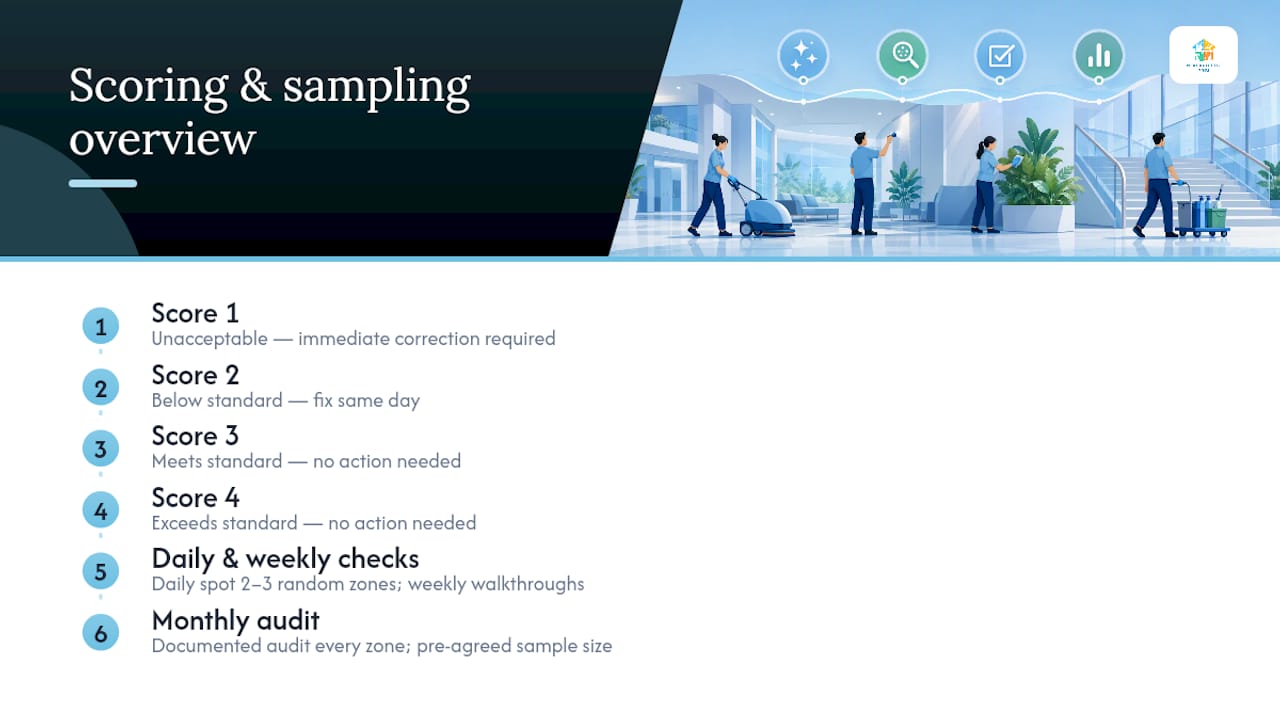
A completed checklist tells you tasks got touched. A scored checklist tells you whether the work actually held up. Use a 4-point scale: 1 means unacceptable and requires immediate correction, 2 means below standard with a fix needed same day, 3 means meet standard, and 4 means exceeds standard with no action needed.
Commercial inspection frameworks typically apply this scale by zone average rather than by individual item, since one dirty item shouldn’t tank an otherwise solid zone score, but a pattern of low scores across a zone should trigger action fast, according to Oxmaint’s commercial inspection framework. High-risk zones like restrooms and food-service areas need tighter thresholds than office space, because failure there carries higher health and liability exposure.
Zones have recommended inspection frequencies and pass score thresholds that trigger corrective actions; higher-risk zones like restrooms and break rooms require daily checks with stricter quality thresholds and immediate fixes, while lower-risk zones like office areas and exterior entries can be inspected weekly with somewhat more lenient corrective timelines.
For sampling, supervisors should run daily spot checks on two to three zones chosen at random, full walkthroughs weekly, and a documented monthly audit covering every zone with a pre-agreed sample size, a practice CleanLog’s audit guidance recommends to keep scores comparable month over month. Weighting restrooms and food-service zones more heavily in the monthly rollup keeps the scorecard honest about where risk actually lives.
What’s the Right Order for a Cleaning Inspection?
Before an inspector ever touches a clipboard or tablet, three things need to be in place: written permission to access the space, appropriate PPE, and access to Safety Data Sheets for any chemicals stored on-site, a requirement tied directly to OSHA’s HazCom standard. Skipping this step is the most common reason inspections get challenged later.
From there, follow a consistent sequence:
- Fill out the site header completely before walking the floor.
- Move zone by zone in a fixed order (restrooms first, since they carry the highest risk) rather than wandering.
- Photograph every failure scoring below 3, plus a wide shot of the zone for context.
- Log each issue with severity, the corrective action needed, who’s assigned, and a due date.
- Route the issue to a work order system or supervisor immediately, not at the end of the shift.
- Re-inspect flagged items on the next visit and require a sign-off before closing the ticket.
Pro Tip: Photograph the timestamp on your phone or tablet screen next to the issue, not just the issue itself. It’s a five-second habit that eliminates any dispute about when a defect was found.
Monthly, roll every closed and open ticket into a trend report. A restroom that fails the same way three months running isn’t a cleaning problem, it’s a training or staffing problem.
Should You Use Digital or Paper Cleaning Checklists?
Paper checklists still work for small residential jobs. For anything with multiple zones, multiple shifts, or multiple locations, digital wins on accountability alone.
The features that matter most:
- Photo upload attached directly to the flagged item, not stored separately
- GPS and timestamp stamped automatically, removing any “when was this actually checked” argument
- Reusable templates so every inspector scores the same items the same way
- Automated alerts when a zone score drops below threshold
- Analytics that surface recurring failures by zone, shift, or crew
Digital checklists speed up corrective action by generating a work order the moment an item fails, and they build a paper trail that holds up if a client questions service quality, a point CleansyAI’s checklist guidance backs directly. Start small: pilot one digital checklist on your highest-traffic account, require photos only on critical-failure items to avoid overwhelming crews, and expand once the workflow proves itself.
How We Apply Checklists in the Field
A version of this checklist can be adapted to different account types. A restaurant account gets a food-service zone weighting closer to the restaurant cleaning checklist standard, with tighter thresholds on prep surfaces and floor drains. A residential turnover gets a checklist closer to a full room-by-room deep clean, because the client is judging the whole unit, not a sampled zone.
Every visit generates a signed log, photo evidence for anything below standard, and a corrective-action ticket if something needs a return visit. Supervisors run unannounced spot checks against the same scorecard the crew already uses, so there’s no separate “inspection standard” crews are guessing at.
Do Cleaning Inspectors Need Formal Training?
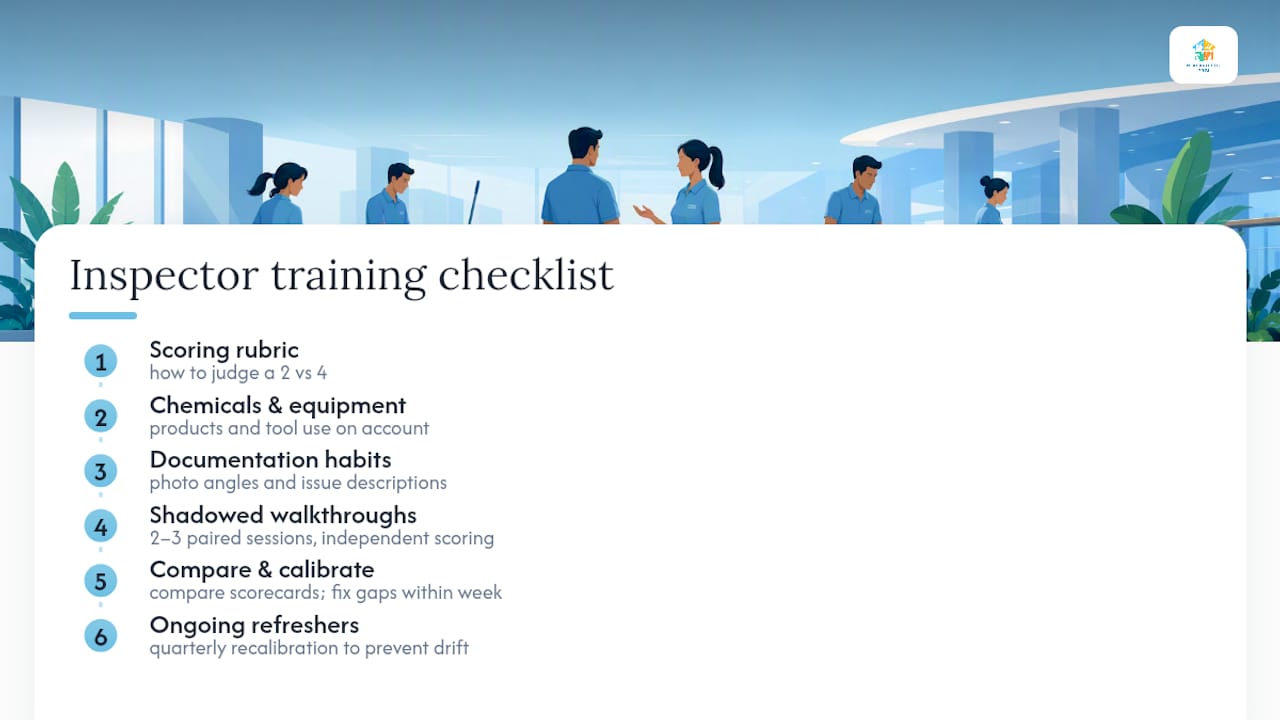
Nothing in a checklist matters if the person filling it out doesn’t know what a 2 looks like versus a 4. Inspector training should cover three things before anyone scores a live account: the scoring rubric itself, the chemicals and equipment used on that account, and basic documentation habits like photo angles and issue descriptions that hold up later.
Most operators build this through shadowing, not classroom training. A new inspector runs a walkthrough alongside a supervisor for two or three sessions, scoring independently while the supervisor scores the same zones separately. Comparing the two scorecards afterward exposes calibration gaps fast, usually within the first week.
Formal credentials help but aren’t the whole picture. Certifications through organizations like APPA or OSHA-focused safety training cover chemical handling, bloodborne pathogen exposure, and general facility standards, and they matter most for accounts with regulatory exposure, like medical offices or food service. For a standard office or residential account, the more valuable qualification is simple consistency: can this inspector score the same defect the same way, twice, a week apart?
Refresher sessions matter more than initial training. Scoring drift happens gradually, not all at once, so a quarterly calibration session where two inspectors independently score the same zone catches drift before it shows up in a client complaint.
What Defects Do Inspectors Miss Most Often?
Some failures jump out immediately. Others hide until a client points them out, and by then it’s a trust problem, not just a cleaning problem.
The most commonly missed issues:
- Grout and tile lines: surfaces look clean at a glance but grout holds discoloration and buildup that only shows under closer inspection.
- Underneath and behind fixtures: toilets, urinals, and vending machines get wiped on top but rarely moved or checked underneath.
- Vent covers and light fixtures: dust accumulates for months before it’s visible from floor level.
- Baseboards and corners: mops and vacuums both tend to skip tight corners, leaving a visible buildup line over time.
- Trash can interiors: liners get changed, but the can itself rarely gets wiped down, leading to odor buildup.
- Door handles and light switches: high-touch surfaces that get skipped because they’re not visibly dirty, even though CDC guidance flags them as priority disinfection points.
- Streaking on glass and mirrors: often caused by using a damp cloth without a proper dry pass afterward.
None of these show up on a basic pass/fail checklist that only asks “was the restroom cleaned.” A scored checklist that requires the inspector to physically check behind and underneath fixtures catches these before a tenant or client does.
How Do You Keep Standards Consistent Across Locations?
The hardest part of running checklist-based QA across more than one site isn’t writing the checklist. It’s making sure every inspector at every location scores a 3 the same way.
Standardize the template first. Every location should use the identical zone list, the identical 4-point scale, and identical corrective-action fields. Letting one site manager customize scoring criteria “for their building” is how a multi-location program falls apart within two quarters.
Second, centralize the data. If each location keeps its own paper log or its own spreadsheet, you can’t compare performance across sites or catch a manager who’s inflating scores. A shared digital system, even a basic one, lets a regional supervisor pull every site’s monthly average side by side.
Third, run cross-location calibration periodically. Have an inspector from one site score a walkthrough at another, then compare their scores against the resident inspector’s. Gaps larger than half a point on the 4-point scale usually mean one of the two needs recalibration, not that one site is genuinely cleaner.
Finally, keep the corrective-action escalation rules identical everywhere. If restrooms trigger a same-day fix at one location and a next-week fix at another, you don’t have one quality standard, you have several, and clients notice the difference fast when they operate at more than one site.
Where Does This Checklist Fit in Your Facility Systems?
A cleaning quality checklist that lives on its own, disconnected from everything else in your facility management stack, becomes a filing exercise instead of a management tool.
The stronger approach ties it into your existing work-order and maintenance system. When an inspection flags a broken dispenser or a stained ceiling tile that’s not a cleaning issue but a maintenance one, that ticket should route into the same system your facilities team already uses, not sit in a separate cleaning log nobody else checks.
Vendor and contract accountability benefits too. If you’re managing a third-party janitorial contract, tying the scorecard to the contract’s SLA terms turns a subjective “the cleaning seems fine” conversation into a documented, numbers-based renewal or penalty discussion. That’s the difference between a checklist that’s just paperwork and one that actually protects the budget.
Finally, feed inspection data into your broader facility reporting cadence. A monthly cleaning score sitting next to your energy usage, maintenance ticket volume, and occupancy data gives leadership a fuller picture of building health in one place, instead of scattered across five disconnected systems.
How Should Tenant or Client Feedback Factor In?
Inspection scores measure what a trained eye catches. They don’t always catch what actually bothers the people using the space every day.
A tenant might not notice a slightly under-threshold floor score, but they’ll absolutely notice a recurring smell in a break room or a restroom that’s out of paper towels by mid-afternoon. Building a short feedback channel, even a simple digital form or a QR code in common areas, surfaces these gaps fast.
The smarter operators treat tenant feedback as a second data stream, not a replacement for scored inspection. Cross-reference complaint patterns against your zone scores monthly. If tenants keep flagging a break room that’s scoring a 3 on your internal checklist, your checklist’s break room criteria probably needs a harder look, not the tenants’ complaints.
Weight recurring, specific feedback heavier than one-off comments. A single complaint about smell might be someone’s sensitive nose. Five separate tenants over a month flagging the same restroom is a scoring gap you need to fix before it becomes a lease-renewal conversation.
What Most Cleaning Checklists Get Backwards
Most checklist templates treat completion as the goal: every box checked, every task marked done. That’s the wrong target. A checked box tells you a task was attempted, not that it met any standard, and that gap is exactly where client complaints and failed audits come from.
The conventional advice to “just use a checklist” undersells how much the scoring and sampling design actually matters. A 15 to 20 item checklist scored consistently beats a 60-item checklist nobody scores honestly. Where most operators fall short isn’t the template, it’s the follow-through: logging a low score without a due date, a photo, or an assigned owner is functionally the same as not inspecting at all.
If you’re building or fixing a checklist program, prioritize the scoring rubric and the corrective-action loop before you worry about how many items are on the list. A short, consistently scored checklist with real accountability will outperform an exhaustive one that’s filled out on autopilot every time.
— Neat
Get Checklist-Driven Cleaning Without Building the Program Yourself
This service offers a scored, photo-documented QA process to support inspection programs without requiring you to hire, train, or manage inspectors yourself. We run inspector audits with the same zone-based scorecard structure covered above, require photo evidence on any item scoring below standard, and track corrective actions until they’re closed, not just logged.
That structure applies across commercial cleaning accounts, recurring basic cleaning contracts, periodic deep cleaning, move-in/move-out cleaning, and post-construction cleaning. Whether you’re managing one office or several properties, the same scorecard and corrective-action process travels with the account.
If you’re evaluating a new cleaning provider or want to see how a QA-backed contract would work for your facility, request a quote through our commercial cleaning page and we’ll walk through how the inspection process would apply to your specific zones and traffic patterns.
Sources
For deeper reading on the standards and methods referenced above, the CDC’s household cleaning and disinfection guidance covers high-touch surface priorities, while its environmental cleaning evaluation guidance explains structured verification methods for facilities. For scorecard structure specifics, see Oxmaint’s commercial inspection framework and CleansyAI’s checklist and template guidance, plus CleanLog’s monthly audit and scorecard guidance for sampling and weighting rules.
- CDC — Cleaning and disinfection for households
- Monthly cleaning audit checklist and scorecard — CleanLog
FAQ
What should be on a cleaning checklist?
A solid checklist covers every zone in the space (restrooms, floors, high-touch surfaces, common areas, break rooms, and exterior entries) with specific, checkable items per zone rather than vague tasks like “clean the office.” Pair each item with a scoring option so a supervisor can measure quality, not just task completion.
Is $50 an hour good for house cleaning?
Rates for house cleaning vary widely by region, home size, and whether the job is a standard clean or a deep clean, so there’s no single “good” rate that applies everywhere. Current pricing for services like basic and deep cleaning is available directly on the Neat and Tidy Pros site since rates depend on the specific job scope.
How do you make a QC checklist?
Start by listing every zone the space contains, then break each zone into four to eight specific, observable tasks rather than broad categories. Add a scoring scale (a 4-point scale is standard for commercial inspections), set pass thresholds per zone, and build in a corrective-action field with an assigned owner and due date.
What are the 7 stages of cleaning?
Definitions vary by industry, but a common commercial sequence runs: pre-inspection and prep, dry cleaning tasks like sweeping and dusting, wet cleaning of surfaces, disinfection of high-touch points, restroom-specific sanitation, waste removal, and a final inspection pass. Not every operator uses exactly seven stages, so treat this as a general framework rather than a fixed standard.
How often should cleaning inspections happen?
High-risk zones like restrooms and food-service areas need daily spot checks at minimum, while lower-risk zones like office areas can run on a weekly cycle. A full documented audit across every zone should happen monthly, with an agreed sample size set in advance so scores stay comparable month to month.