
A recurring cleaning contract for a standard self-storage facility typically runs a few hundred dollars a month, and a single unit turn adds roughly $15 to $50 on top. Those are national benchmarks. A firm quote for a Corona property depends on your office, restrooms, corridors, and how often units turn over. Below are the numbers, how they are built, and what to send a cleaner so the quote is accurate.
TL;DR
- Benchmark monthly janitorial cost for a comparable self-storage facility is $325 to $375, though contracts can drift well above that over the years.
- Facility cleaning is usually priced as a flat monthly rate, driven by the office, restrooms, and corridors rather than total leasable area.
- Cleaning a vacated unit is a separate per-event charge, commonly $15 to $50 per unit.
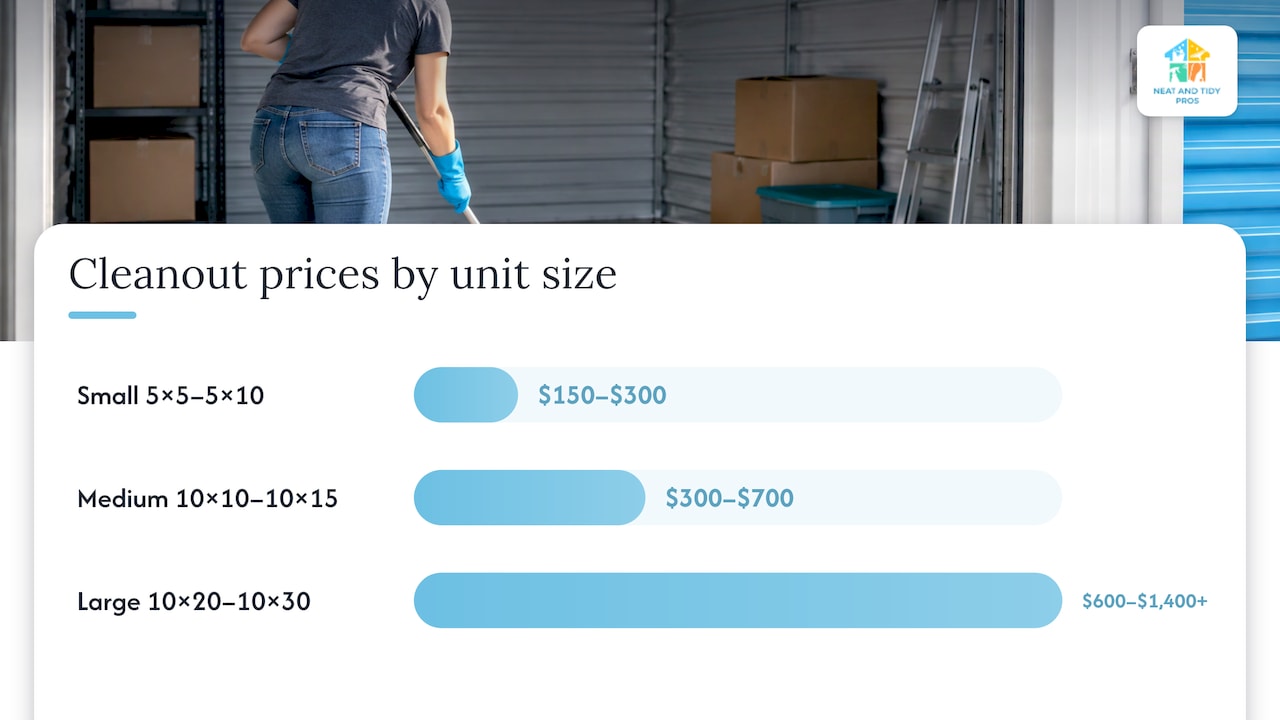
- Clearing out a unit full of belongings is a different job and a different price, from $150 to $1,400 or more depending on size.
- For a Corona quote, send square footage of cleanable areas, visit frequency, and unit count so the number reflects your site.
Table of Contents
- What storage facility cleaning costs
- How self-storage cleaning is priced
- What pushes your price up or down
- Unit-turn cleaning: the cost that adds up quietly
- Facility cleaning versus a storage unit cleanout
- What to send for an accurate quote
- What happens when a unit is not cleaned out
- Our perspective
- Get a storage facility quote in Corona
- Ways to keep the bill predictable
- FAQ
- Sources
What storage facility cleaning costs
The most useful way to think about the cost is as three separate lines: the recurring facility contract, the per-unit turn clean, and occasional one-off work such as a deep clean or a cleanout. Mixing them is the main reason quotes look inconsistent.
| Cost line | Typical range | What it covers |
|---|---|---|
| Recurring facility cleaning, comparable facility | $325 to $375 per month | Office, restrooms, corridors, common areas |
| Standard climate-controlled facility, 100,000 to 200,000 sq ft | $420 to $720 per month, or $5,040 to $8,640 per year | Base monthly rate for the larger building |
| Unit-turn cleaning | $15 to $50 per event | Sweeping and wiping a vacated unit before re-renting |
| Unit cleanout with hauling | $150 to $1,400+ | Labor, loading, hauling, disposal |
None of these is a Corona quote. They are US benchmarks, and the right figure for your property comes from a walkthrough or a detailed scope. Treat the table as a sanity check: if a proposal lands far outside these ranges, ask what is driving it.
Why a warehouse rate is not the right yardstick
You will see per-square-foot pricing for warehouses, such as $0.10 to $0.20 per square foot per month for recurring nightly service. That model fits buildings where most of the floor is cleanable space. A self-storage building is mostly locked units that a janitorial crew never enters, so multiplying total leasable square feet by a warehouse rate overstates the cost badly. The better driver is the space people actually walk through: the leasing office, restrooms, hallways, elevators, and entry areas.
How self-storage cleaning is priced
In the US, self-storage cleaning is most accurately expressed as a monthly flat rate per facility, because needs are set by the office, restrooms, and corridors rather than the total leasable area. Here is what a typical quote contains.
- Scope of recurring tasks. Trash removal, restroom service, floor care in the office and hallways, glass at the entrance, and wiping high-touch surfaces such as kiosks and door handles.
- Visit frequency. Daily, several times a week, weekly, or on call. This is the biggest lever after square footage.
- Supplies and equipment. Whether the cleaner supplies consumables and equipment or you do.
- Add-ons priced separately. Unit-turn cleans, floor scrubbing or buffing, window washing, pressure washing, and post-move-out deep cleans.
- Renewal terms. Annual escalators, fuel surcharges, and what happens when scope is added.
If you manage more than one site, ask about a master agreement. One agreement can cover every facility in a portfolio, with per-facility tiered pricing locked in at signing, which gives a single standard of care and consolidated invoicing, and makes onboarding a new location simpler.
What pushes your price up or down
Labor
Labor is the core of any cleaning bid. Fully loaded rates for self-storage cleaning generally run $22 to $26 per hour in most markets. That is a national figure. Southern California labor costs are a local factor, so expect a Corona quote to reflect local wages and the time a crew needs on site rather than a national average.
Facility layout
Two facilities with the same unit count can need very different cleaning time. Indoor, climate-controlled buildings with long interior corridors, elevators, and several restrooms take more labor than a drive-up site where the cleanable footprint is a small office and one restroom. Outdoor sites bring different tasks, such as sweeping drive aisles and emptying dumpster areas.
Traffic and tenant behavior
A busy site near a major Corona corridor sees more foot traffic, more dust, and more trash in common areas than a quiet one. Facilities that allow moving carts, hand trucks, and deliveries inside will see more floor wear and more frequent mopping.
Frequency
Frequency changes the monthly total more than almost anything else. Recurring common-area service can provide weekly or monthly sweeps for drive-aisle dumping, hallway abandonment, and dumpster overflow at a predictable monthly cost. A site that cleans the office daily but sweeps corridors weekly will pay less than one that wants every area serviced daily. The practical approach is to match each area to its actual traffic instead of applying one schedule to the whole property.
Contract drift
A contract that begins at a fair number can creep. One 2025 spend guide notes that agreements that started at $350 three years earlier may have reached $525 through annual CPI adjustments, fuel surcharges, and scope additions. Its author, Ethan Opdahl, urges operators to benchmark spend against similar facilities rather than accept standard renewals. Good practice is to review the scope and price every year, in writing, with your cleaner.
Unit-turn cleaning: the cost that adds up quietly
When a tenant moves out, the unit needs to be swept, wiped, and checked before it goes back on the market. This is a variable cost, priced separately per event at about $15 to $50 per unit, and not part of the monthly flat rate.
Volume matters. A 500-unit facility at 85 percent occupancy and 15 percent annual turnover generates roughly 75 unit-turn cleaning events a year, and the same source estimates that this can add $1,875 to $4,000 annually depending on turnover. Your own figure depends on your unit count, occupancy, and how much debris tenants leave behind.
To keep this line predictable, agree on a per-unit price in advance, define what counts as a standard turn (sweep, wipe, door and track check, trash out), and define what triggers a higher charge, such as heavy dirt, spills, or pest evidence. If you are weighing a hands-on service model against a professional cleanout versus DIY removal approach for heavier jobs, the same principle applies: set the scope and the price before the work starts.
Facility cleaning versus a storage unit cleanout
These two get confused, and the search results for this topic mix them. Facility cleaning keeps the office, restrooms, and corridors presentable on a schedule. A cleanout removes the contents of a unit, often an abandoned or auctioned one, and hauls them away. Cleanout prices are driven by volume, labor, and disposal, not by cleaning time.
Published 2026 pricing from one hauling company puts small units (5×5 to 5×10) at $150 to $300, medium units (10×10 to 10×15) at $300 to $700, and large units (10×20 to 10×30) at $600 to $1,400 or more, including labor, loading, hauling, and disposal. A Bay Area guide reports cleanouts between $200 and $1,200, with bigger or messier units at the higher end because of extra sorting and recycling labor. California prices are a reasonable reference for Corona, but your actual cost depends on the unit and what is inside.
A cleanout is usually followed by a cleaning pass. Once the contents are gone, the empty unit needs the same sweep and wipe as any turn, and a unit with spills, dust buildup, or residue may need more than a standard turn.
What to send for an accurate quote
A quote is only as good as the information behind it. Before you call a cleaner, gather this.
- Address and building type: single-story drive-up, multi-story indoor, or mixed.
- Cleanable square footage: office, restrooms, corridors, lobby, elevators. Leave out the locked units themselves.
- Restroom count and fixtures: these drive labor time.
- Floor types: sealed concrete, tile, vinyl, carpet in the office.
- Desired schedule: days per week, time of day, and whether staff are on site.
- Unit count and recent turnover: how many units vacate in a typical month.
- Special areas: break room, glass storefront, outdoor drive aisles, trash enclosures.
- Access: keys, gate codes, alarm procedures, and any hours when the building is closed.
- Current contract: what you pay now, what is included, and the renewal date.
Photos or a short walkthrough help the cleaner see the property the way you do. For background on how bids are assembled, our guides on how commercial cleaning is quoted and how professional cleaning is priced walk through the pieces.
Restroom standards
The office restroom is where tenants judge your property. If you want documented service, a signed log is a simple way to show that it was cleaned on schedule. Our restroom cleaning checklist with a signed log is built for office managers and works just as well for a storage leasing office.
What happens when a unit is not cleaned out
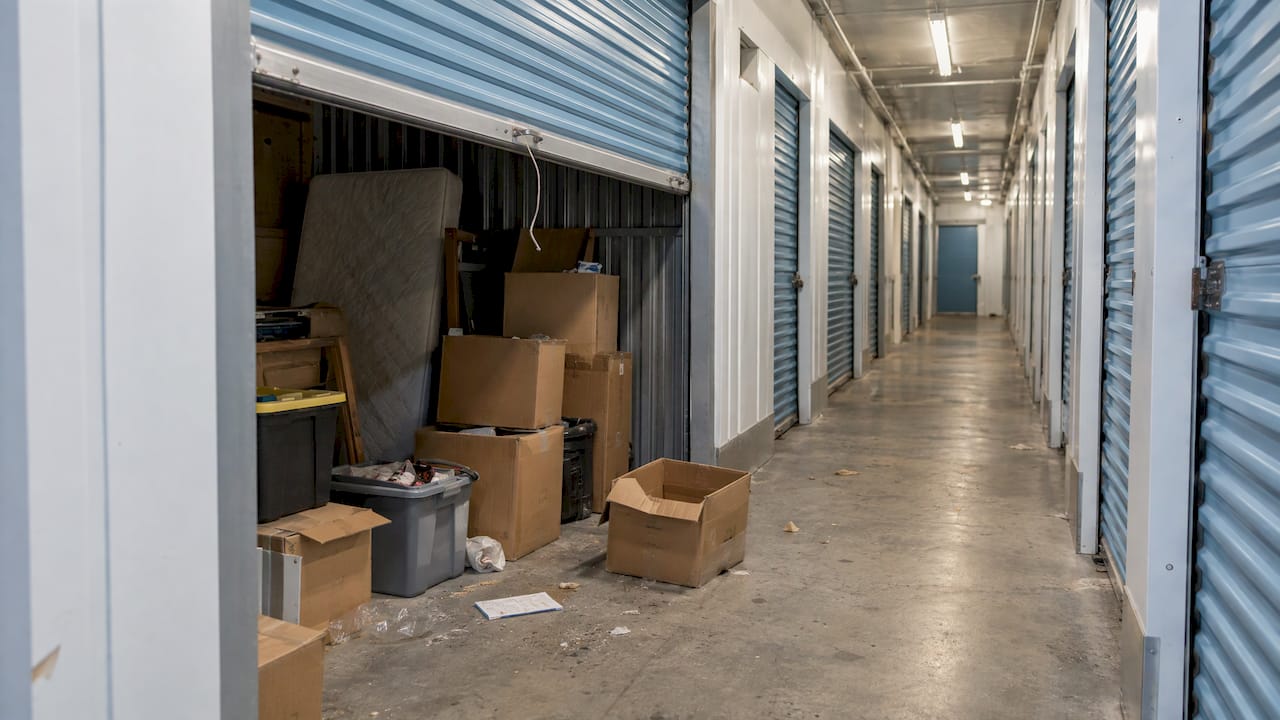
An uncleaned unit costs you money in quiet ways. It cannot be re-rented until it is empty and presentable, so it sits as lost rent while it waits. Leftover items, dust, and spills can also make the next tenant’s first impression a poor one, which affects reviews and move-in satisfaction. Debris left in a unit or in the corridor outside it may also slow down your staff and create trip hazards for other tenants.
For tenants, the rules on abandoned property and lien sales come from your rental agreement and California law, so talk to your attorney or your state’s guidance before disposing of anything a tenant left behind. A cleaning company handles the cleaning after the legal process is complete, not before.
Our perspective
We clean a lot of commercial spaces, and storage facilities are one of the property types we serve. Our view is simple: the office and restrooms are the only parts of the building most customers judge you by, so they deserve a dependable schedule and consistent quality, every visit.
We build our commercial work around the property, not a template. That means walking the space, agreeing a scope for each area, and setting a frequency that matches the traffic. A busy leasing office may need daily service, while corridors may only need a few visits a week.
Our teams arrive fully equipped and use safe, eco-friendly products, which matters in a building where staff, tenants, and visitors share the same air. We draw on 15 years of experience and stand behind our work with a customer satisfaction guarantee.
The best contracts are written down: what is cleaned, how often, and what is priced separately. When that is clear, there are no surprises at renewal, and the facility looks the same on a Tuesday afternoon as it does on opening day.
Neat
Get a storage facility quote in Corona
If you run or manage a storage facility, display center, or office in Corona or elsewhere in Orange County, we can scope the recurring cleaning and the between-tenant turns together. Our commercial cleaning service covers properties like yours, and we tailor the scope to your layout, traffic, and schedule.
If a building project is wrapping up, such as a new unit block or an office expansion, our construction cleaning service handles the final clean before you open. To start, send us the details from the checklist above through our website and we will respond with a scope matched to your property.
Ways to keep the bill predictable
- Price by area, not by building. Ask for a separate line for office, restrooms, corridors, and exterior so you can adjust each independently.
- Fix the unit-turn rate. A single agreed per-unit price avoids debate when volume spikes.
- Put escalators in writing. If the contract rises annually, know the formula and the cap.
- Review scope yearly. Compare what is being cleaned today with what you actually need.
- Benchmark against peers. Operators share cost data through SSA meetings, regional groups, and conferences, which gives them the market intelligence to negotiate at renewal.
- Bundle where it makes sense. Several facilities under one agreement can share one standard and one invoice.
FAQ
How much does it cost to clean a storage facility in Corona?
For a comparable self-storage facility, a monthly benchmark is $325 to $375, while larger climate-controlled buildings of 100,000 to 200,000 square feet run $420 to $720 a month. These are US figures. A Corona price depends on your office, restrooms, corridors, and visit frequency, so request a scope-based quote.
Is storage facility cleaning priced per square foot?
Usually not. It is typically a flat monthly rate per facility, because the cleanable area is the office, restrooms, and corridors rather than the whole leasable footprint. Per-square-foot rates are more common for warehouses where most of the floor is cleanable.
How much does it cost to clean a vacated storage unit?
A unit-turn clean is commonly $15 to $50 per event, priced separately from the monthly contract. If the unit still holds belongings, you need a cleanout, which costs $150 to $1,400 or more depending on the unit size.
What should I give a cleaner to get an accurate estimate?
Share the address, cleanable square footage, restroom count, floor types, desired schedule, and unit count with recent turnover. Add photos of the office and corridors, plus your current contract terms if you have one. With that, a cleaner can scope each area and price it clearly.
Sources
- Mind Your Money: A Strategic Guide to Self-Storage Spend Optimization
- Self-Storage Facility Cleaning Cost: ISSA 447 Labor
- Warehouse Cleaning Cost: 2026 Price Per Sq Ft and Rates
- Self Storage Junk Removal and Abandoned Unit Cleanouts
- Storage Unit Cleanout Cost: All Options Compared
- How Much Do Storage Cleanouts Cost in the Bay Area?
- Professional Estate Cleanout vs. DIY Container Removal