
The fastest safe way to choose a cleaning service is to lock in the exact job you need, shortlist vetted providers, confirm insurance and background checks in writing, get an itemized quote, and run a paid trial before committing to anything recurring. Skip any of those five steps and you’re gambling with who holds a key to your house. Neat and Tidy Pros, along with any legitimate competitor, should clear all three non-negotiables without hesitation: proof of insurance and bonding, documented employee screening, and a written scope of work.
TL;DR:
- Confirm insurance, bonding, and background checks with written documentation before hiring to protect your property and wallet.
- Match the cleaning service type precisely to your needs, such as deep cleaning for a move or regular upkeep for ongoing household maintenance.
- Verify reviews on independent platforms and seek personal referrals to ensure consistent quality and accountability from the provider.
- Expect costs between $120 to $235 per visit, with price depending on home size, region, and scope; request an itemized quote to compare options.
- Conduct a paid trial, focusing on timeliness, task completion, careful handling of belongings, and communication to assess long-term reliability.
Table of Contents
- What Type Of Cleaning Service Do You Actually Need?
- Where Should You Look For Referrals And Reviews?
- How Do You Verify Insurance, Bonding, And Background Checks?
- How Much Should A Cleaning Service Cost?
- How Do You Run A Fair Trial Before Committing?
- How Do You Prepare Your Home For The First Visit?
- What Should You Actually Watch For During The Trial Period?
- How Do Satisfaction Guarantees And Redo Policies Actually Work?
- Neat and Tidy Pros: Meeting Every Vetting Standard
- Ready For A Quote? Here’s How Booking Works
- Sources
- FAQ
What Type Of Cleaning Service Do You Actually Need?
Most people call the wrong kind of cleaner because they’ve never separated “cleaning” into its actual categories. A standard cleaning covers kitchens, bathrooms, floors, and surfaces on a recurring schedule. Deep cleaning goes further, tackling baseboards, inside appliances, grout, and areas skipped in routine visits. Move-in and move-out cleaning strips a property to bare walls and cabinets for a lease turnover or closing. Post-construction cleaning removes drywall dust and debris after a renovation, and Airbnb cleaning is built around fast turnaround between guests rather than depth.
Matching the service to your situation determines both the quote you get and how satisfied you’ll be with the result.
- One-time deep clean: best before a big event, after illness, or when starting fresh with a new provider.
- Weekly or biweekly standard cleaning: fits households wanting consistent upkeep without a full deep clean each time.
- Move-out cleaning: often required by landlords or property managers to return a security deposit.
- Post-construction cleaning: needs crews comfortable with fine dust and debris, not just surface wiping.
- Office or commercial cleaning: scheduled around business hours and often bid per square foot.
Estimate scope by counting rooms, noting pets or allergy concerns, and flagging any specialty work like HVAC vents or dryer ducts, which often require separately licensed technicians rather than a general cleaning crew. A standard cleaning service handles the basics, while a deep clean resets a home that hasn’t had professional attention in months.
Where Should You Look For Referrals And Reviews?
Personal referrals beat cold search results almost every time, because a neighbor or coworker has already lived with the consequences of a bad hire. Ask specifically what they liked and what went wrong, not just whether they’d recommend the company.
Once you have two or three names, cross-check them against independent review platforms rather than trusting testimonials on a company’s own site. Search platforms like Thumbtack let you compare quotes and reviews side by side, but understand that some listings are paid placements rather than pure rankings based on performance. Angi recommends deciding your cleaning frequency before you even start browsing, since that filters out companies that don’t handle your specific need.
- Ask two or three people you trust for a direct referral, including what surprised them, good or bad.
- Check BBB.org for accreditation status and how the business responds to complaints.
- Read the most recent reviews first, not just the overall star average, to catch trends.
- Note how a company replies to a one-star review; a defensive or absent response tells you more than five glowing ones.
- Interview at least three candidates before deciding, comparing scope of work and pricing side by side.
A company that goes silent after a bad review, or has no reviews at all despite claiming years in business, deserves a second look before you hand over a key.
How Do You Verify Insurance, Bonding, And Background Checks?
This is the step people skip, and it’s the one that actually protects your home and your wallet. General liability insurance covers damage to your property during a cleaning visit. Bonding protects you financially if something goes missing. Workers’ compensation covers an injury on your property, which matters more than most homeowners realize, since a slip-and-fall claim without workers’ comp can become the homeowner’s liability.
Follow this sequence before you sign anything:
- Request a certificate of insurance (COI) directly from the company, not a verbal assurance, and confirm the policy is active by calling the listed insurer.
- Ask whether employees are W-2 staff or subcontractors, since screening standards often differ between the two.
- Ask what background check process they use for new hires, how often it’s repeated, and whether it covers criminal history and identity verification.
- Confirm bonding coverage amount and what triggers a claim if something is damaged or stolen.
- Check business registration with your state’s Secretary of State site to confirm the company legally exists where it claims to operate.
- Search BBB.org for complaints and read how the company resolved them, not just whether complaints exist.
The BBB recommends interviewing at least three companies and confirming insurance, bonding, and registration before signing anything, which lines up with what Amenify’s hiring guide calls the baseline for any legitimate cleaning business. A company that hesitates, dodges the question, or says “we’ve never had a problem” instead of producing paperwork is a red flag, full stop.
Pro Tip: Ask for the COI to be emailed to you, not just shown on a phone screen. A real certificate lists policy numbers and an expiration date you can verify with the insurer directly.
If you’re vetting a specialty add-on like duct cleaning or hard-surface floor restoration, the same interview logic applies. This homeowner checklist for floor restoration pros walks through the kind of licensing and experience questions worth asking before letting anyone touch specialized surfaces.
How Much Should A Cleaning Service Cost?
Pricing generally falls into three models: hourly, flat-rate, and per-square-foot. Hourly pricing is common for smaller or irregular jobs where scope is hard to predict in advance. Flat-rate pricing is typical for recurring standard cleanings once a company has seen your home and knows what it involves. Per-square-foot pricing shows up most often in commercial contracts and large post-construction jobs.
Angi’s cost data puts typical US cleaning visits in the range of $120 to $235 per visit, or $30 to $50 per hour, though your actual number depends heavily on region, home size, and condition. A studio apartment in a low cost-of-living area and a five-bedroom home in a major metro will land on opposite ends of that range.
- Ask what counts as an add-on (inside oven, inside fridge, interior windows) since these often cost extra beyond the base quote.
- Confirm how frequency affects price; weekly service is usually cheaper per visit than a one-time deep clean.
- Request an itemized quote in writing, not a verbal ballpark, so you can compare apples to apples across candidates.
- Ask about cancellation and rescheduling fees upfront, before you need to use them.
Understanding what drives cleaning costs before you request quotes puts you in a much stronger position to spot a lowball bid that’s missing something, or a padded one that’s overcharging for basics.
How Do You Run A Fair Trial Before Committing?
Many experienced hires recommend a short paid trial period before committing to a long-term contract. Ask the company to put the trial scope in writing, including which rooms and tasks are covered, so there’s no ambiguity about what “clean” means to either side.
During those first visits, track a short list of measurable items:
- Timeliness: did they arrive within the agreed window and stay for the time quoted?
- Task completion: were the priority items you listed actually finished, not just the easy ones?
- Care with belongings: were fragile or valuable items handled carefully, and were things put back where they belonged?
- Communication: did they flag issues (a broken item, an area needing extra attention) proactively?
If something falls short, ask for a redo before writing off the company entirely. Most legitimate services will fix a missed spot within 24 to 48 hours at no charge. If problems repeat after a redo, that’s your signal to end the relationship and move to your next shortlisted candidate.
How Do You Prepare Your Home For The First Visit?
A little prep work upfront saves confusion and protects what matters most to you. Put away cash, jewelry, prescription medications, and anything irreplaceable before the first visit, regardless of how much you trust the company. Note fragile or sentimental items that need extra care, and decide where pets will be during the visit, whether that’s a crate, a yard, or a friend’s house.
- Write a short priority list for each visit (three items that matter most) and hand it to the cleaner directly.
- Confirm access details: a lockbox code, a key location, or whether someone needs to be home.
- Flag allergy or chemical sensitivities so the crew uses appropriate products.
- Note any off-limits rooms or items before, not after, the visit.
Once a routine is established, it’s easy to request occasional upgrades, like a seasonal deep clean before the holidays or a full move-out cleaning when you’re closing out a lease. Most recurring clients build these into their calendar rather than scrambling at the last minute.
What Should You Actually Watch For During The Trial Period?
The trial period is where theory meets reality. A company can look perfect on paper, with clean insurance documents and glowing reviews, and still be a mismatch for how your home actually needs to be cleaned.
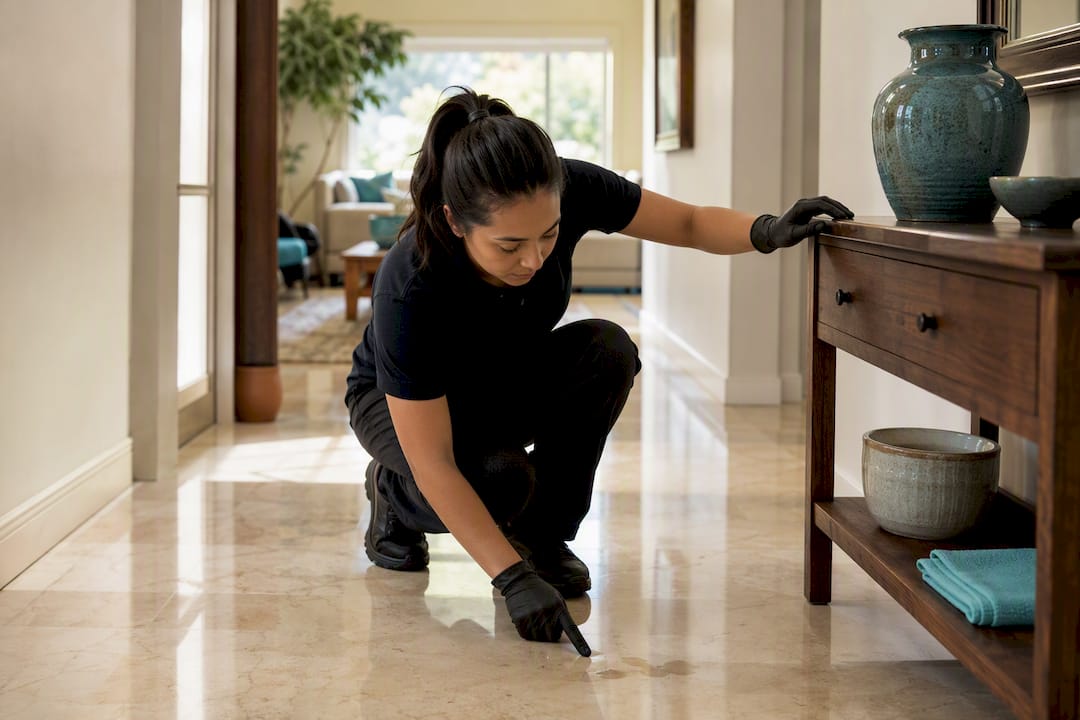
Pay attention to consistency across the two to four trial visits, not just the first one. A strong first visit followed by a rushed second visit is a pattern worth flagging immediately, not waiting out. Ask directly whether you’ll get the same cleaner or team each time. Consistent team assignment improves quality over time because a cleaner who returns to your home repeatedly learns your specific priorities, your pets’ habits, and which surfaces need gentler products.
Watch how the company handles a hiccup during the trial. Did they leave a note about a stain they couldn’t fully remove? Did they ask before moving fragile items? Small moments like these reveal more about long-term reliability than the initial sales pitch ever will.
If you’re comparing an independent solo cleaner against a company, factor in backup coverage. A single independent cleaner might cost less, but if they’re sick or on vacation, you may have no cleaning that week at all. A company with a larger staff can usually send a substitute, which matters if you depend on a predictable schedule.
Use the trial to test communication as much as cleaning quality. A company that responds quickly to a text about rescheduling, or that calls to confirm before a holiday week, is signaling how they’ll treat you once you’re a regular client rather than a new lead.
How Do Satisfaction Guarantees And Redo Policies Actually Work?
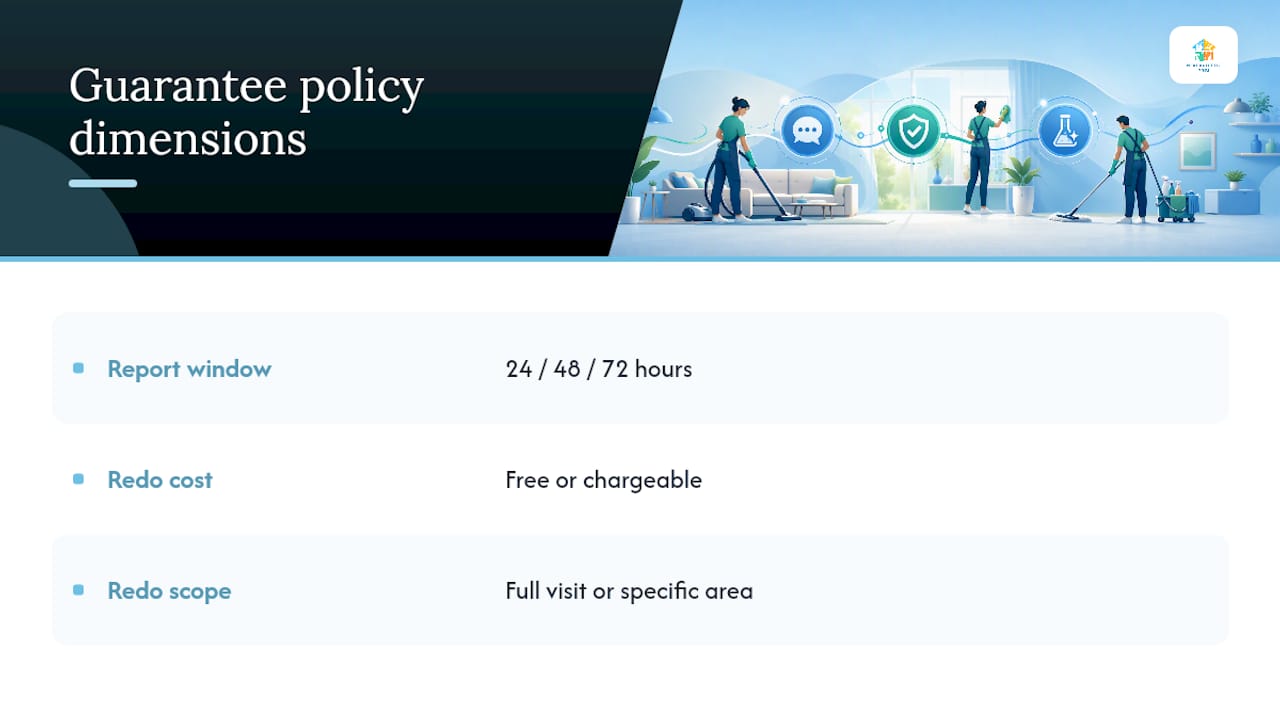
A satisfaction guarantee is only as good as its specifics. “We guarantee our work” means nothing without a defined process: how many hours you have to report an issue, whether a redo is free, and whether it applies to the whole visit or just the missed spot.
Ask each candidate three direct questions: What happens if I’m not satisfied? How long do I have to report it? Is the redo free, or does it apply only to certain services? A company confident in its work will answer without hedging.
Compare guarantee policies the same way you’d compare pricing, side by side. Some companies offer a 24-hour window to report issues; others extend it to 48 or 72 hours. Some redo the entire visit at no cost, while others only fix the specific area you flagged. Neither approach is automatically better, but you need to know which one you’re getting before a problem happens, not after.
Cancellation and rescheduling policies deserve the same scrutiny. Ask what notice is required to reschedule without a fee, and whether a missed appointment on the company’s end (a no-show) comes with any compensation or credit. A written scope of work that spells out these terms, rather than a verbal promise, protects both sides when something inevitably needs adjusting down the line.
Neat and Tidy Pros: Meeting Every Vetting Standard
The company offers various cleaning services, each built around a checklist including insurance, trained staff, and a written scope before any crew steps inside. Case studies and client performance metrics for specific properties are being compiled and will be added here as they become available. Booking typically starts with an assessment, followed by a written scope to approve before scheduling.
— Neat
Ready For A Quote? Here’s How Booking Works
If you want a straightforward next step, requesting an estimate follows a thorough process including an assessment, a written scope of work, and verification of insurance before service begins.
Whether you need a recurring standard cleaning, a one-time deep clean before hosting family, or a full move-out cleaning tied to a lease deadline, the intake process stays the same: tell us the scope, get an itemized quote, and see the work before committing to anything recurring. Homeowners weighing DIY against hiring out can also compare budget-friendly cleaning approaches to see where a professional visit actually saves time versus money.
Visit the services page to see the full list of offerings and request a quote for your specific property today.
Sources
- BBB tips: 7 tips for hiring a house cleaning service
- How to Find a House Cleaning Service
- What to Look for in a Maid Service: Full Hiring Guide (2026) — Amenify
- First-Time Guide to Hiring a Home Cleaning Service
FAQ
What Is The 5-5-5 Rule For Cleaning?
The 5-5-5 rule is a decluttering method where you spend 5 minutes clearing 5 items from 5 areas of your home, often used before a professional cleaning visit to reduce clutter the crew has to work around.
How Much Do Most Cleaning Services Charge?
Typical US cleaning visits run between $120 and $235 per visit, or $30 to $50 per hour, though actual pricing depends on your region, home size, and condition, according to Angi.
How Much Is A One-Hour Clean?
A one-hour clean typically falls within the $30 to $50 hourly rate range, though it covers less ground than a full standard visit and works best for small apartments or quick touch-ups between deeper cleanings.
Does Neat And Tidy Pros Offer A Trial Or Written Quote?
Yes. A written scope of work and an itemized estimate are provided before scheduling, following a walkthrough-and-quote process.