
Cleaning crew management is the process of organizing, supervising, and optimizing cleaning staff through standardized procedures, technology-driven workflows, and quality assurance systems to deliver consistent service across multiple sites. The industry term for this practice is workforce operations management, though most facility managers and cleaning business owners simply call it crew supervision. How cleaning crews are managed determines whether a cleaning operation scales profitably or collapses under coordination overhead. The core components are digital scheduling, GPS-verified attendance, photo-based quality control, structured onboarding, and standard operating procedures (SOPs) built by site type rather than individual account.
How cleaning crews are managed with digital tools
Coordinating cleaning teams across multiple sites without digital infrastructure is the fastest path to scheduling conflicts, missed shifts, and client complaints. Centralized scheduling software solves this by displaying all crew assignments, site requirements, and shift conflicts in one view. Managers can spot gaps before they become problems, reassign staff in real time, and keep labor costs visible at every decision point.
GPS-verified mobile clock-in replaces handwritten timesheets with accurate location and time data. MyTraining recommends replacing paper timesheets with GPS-tracked mobile clocking for remote cleaning teams, because handwritten records are unverifiable and easy to manipulate. This single change removes one of the most common sources of payroll disputes and attendance fraud in field-based workforces.
Photo documentation takes accountability a step further. CleanerHQ’s quality assurance software uses before, during, and after photos with GPS data linked to each job record, creating indisputable proof of service delivery. Clients who question whether work was completed get a timestamped photo log. Managers who suspect corners are being cut get objective evidence either way.
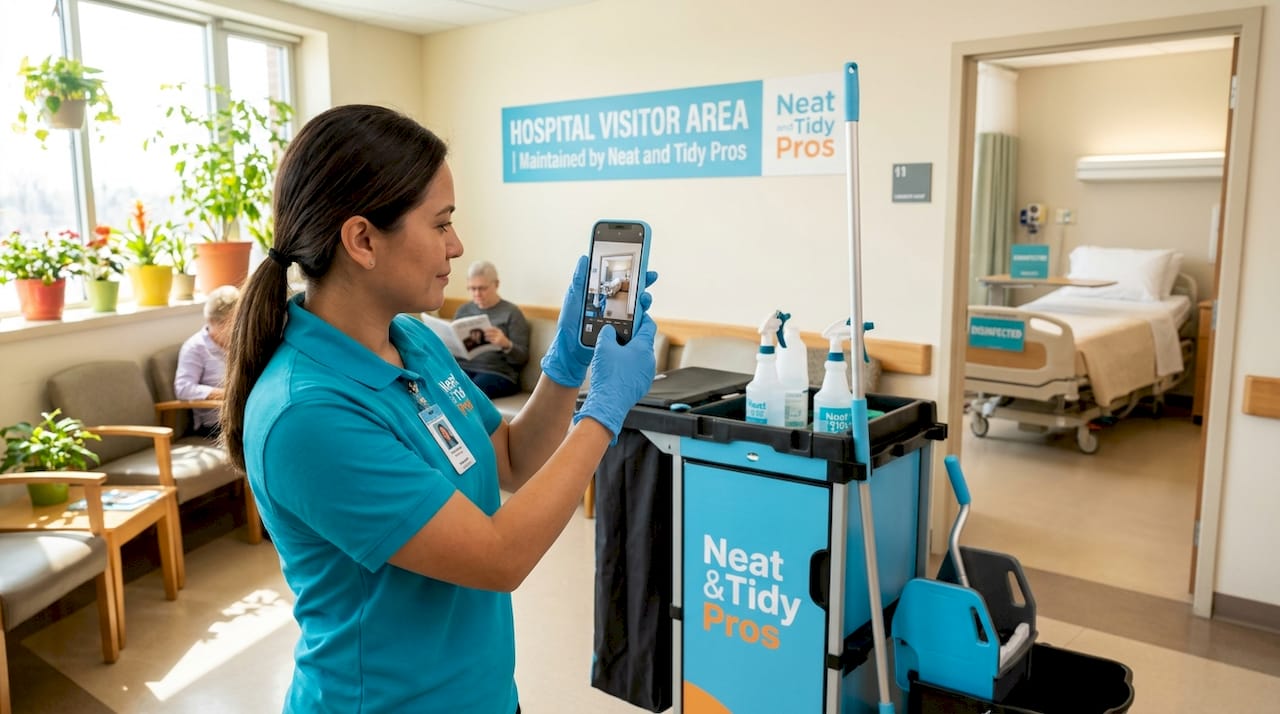
The table below shows how these three tools compare on the problems they solve:
| Tool | Primary problem solved | Key output |
|---|---|---|
| Centralized scheduling software | Shift conflicts and labor cost visibility | Real-time crew assignment dashboard |
| GPS mobile clock-in | Attendance fraud and payroll disputes | Verified timestamps with location data |
| Photo documentation system | Service quality disputes and QC gaps | Timestamped before/after photo records |
Pro Tip: Store digital SOPs inside the scheduling platform so crew members can access site-specific instructions directly from their mobile device before each shift. This eliminates the “I didn’t know” excuse and reduces supervisor call volume.
How does team cleaning methodology improve efficiency?
Team cleaning divides tasks among crew members by function rather than by zone. One person handles all vacuuming across the entire floor. Another handles all restrooms. A third handles trash removal and surface wiping. ISSA explains that this task division enables standardized production benchmarks and easier supervision, because each worker becomes highly proficient at one repeatable task rather than moderately skilled at many.
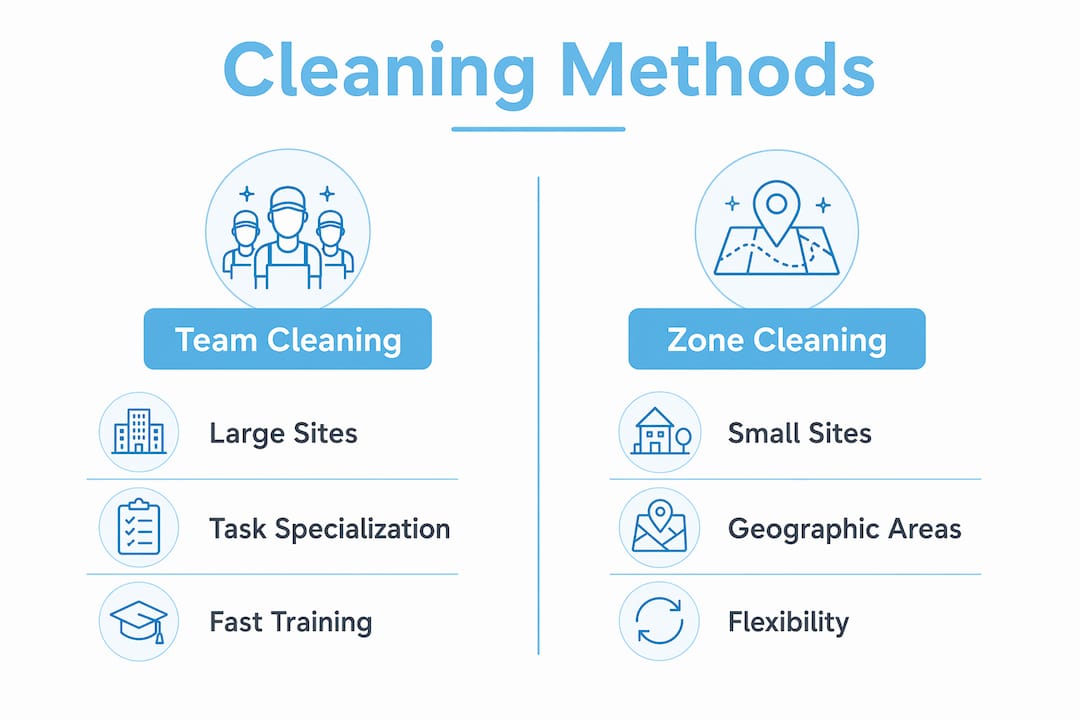
Zone cleaning, by contrast, assigns each worker a geographic area to clean completely. Zone cleaning works well for small crews or residential settings where one person can manage a defined space. Team cleaning outperforms zone cleaning in commercial environments with large square footage, high traffic, and tight time windows.
Here is a direct comparison:
| Method | Best environment | Key advantage | Key limitation |
|---|---|---|---|
| Team cleaning | Large commercial sites | Speed, specialization, easier QC | Requires coordination between roles |
| Zone cleaning | Residential or small offices | Worker autonomy, simple oversight | Inconsistent quality across zones |
The efficiency gains from team cleaning go beyond speed. Training becomes faster because each new hire learns one task deeply rather than an entire cleaning sequence. Physical strain decreases because workers are not switching between heavy equipment and detail work repeatedly. Supervision becomes cleaner because a manager can evaluate one person’s vacuuming output against a clear benchmark rather than judging an entire zone.
For commercial cleaning environments like office buildings, medical facilities, and retail spaces, team cleaning is the method that scales. The consistency it produces also simplifies client communication, because managers can point to defined roles and production rates rather than vague assurances about quality.
What are best practices for onboarding and retaining cleaning staff?
Structured onboarding is the single highest-leverage investment a cleaning operation can make. Housecall Pro advises combining written standards, checklists, and shadowing with reinforcement through the first 30 days. A new hire who shadows an experienced crew member for two full shifts before working independently makes fewer errors, asks fewer questions, and stays longer than one thrown into a site with a verbal briefing.
The onboarding structure that works in practice follows this sequence:
- Day one: Site walkthrough with a supervisor, covering layout, client preferences, chemical storage, and emergency procedures.
- Days two and three: Shadow an experienced crew member through a full shift, following the site-specific checklist in real time.
- Week two: Supervised solo shift with a supervisor present for the first hour and available by phone.
- 30-day check-in: Structured conversation focused on the employee’s feedback, not just performance evaluation. Ask what is unclear, what feels unmanageable, and what tools they need.
- 60 and 90-day check-ins: Review inspection scores, address any recurring errors, and recognize specific improvements.
Recognition is not a soft management concept. It is a retention tool with direct financial impact. Replacing a single cleaning employee costs between one-third and one-half of their annual salary when you account for recruiting, onboarding, and the productivity gap during training. Positive, specific feedback delivered consistently reduces voluntary turnover.
Staff assignment stability fosters ownership and improves both cleaning quality and retention compared to random floating assignments. When a crew member owns a site, they notice when something is wrong, they take pride in the result, and clients notice the consistency. A hybrid model works well at scale: dedicated assignments for most staff, with a small specialized floating group for coverage and surge demand.
Pro Tip: Build a site-specific “first day” document for every account. Include the client’s top three priorities, the access code, the supply location, and one common mistake to avoid. New hires read it before their first shift. Supervisors update it quarterly.
How do managers implement quality control in cleaning crews?
Quality control in cleaning operations is evidence-based or it is not real. Physical observation is impossible at scale, so the system must generate its own proof. US Tech Automations describes mandatory in-app photo capture that blocks job completion until evidence is collected. This design removes the option to skip documentation, making compliance the path of least resistance rather than an extra step.
The core QC framework for managing cleaning teams at any scale includes:
- Digital checklists with mandatory completion controls: Tasks cannot be marked complete without photo evidence or a supervisor override.
- GPS-verified photo logs: Timestamps and location data confirm the photo was taken at the correct site during the correct shift.
- Rotating supervisor spot checks: Unannounced audits at different sites on different days prevent crews from performing only when they expect observation.
- Client feedback channels: A direct line for clients to report issues creates a second data stream that catches problems the internal system misses.
- Performance metrics tracked weekly: Inspection scores, complaints per 100 shifts, and productivity per labor hour give managers objective data to act on.
ISSA cleaning times and CMMS mobile routes translate appearance standards into defensible labor times, removing guesswork from workload planning. When a manager knows a 10,000-square-foot office floor takes 2.4 labor hours to clean to a defined standard, scheduling becomes precise rather than approximate. Overstaffing and understaffing both become visible before they affect service.
Futuramo’s approach with 300-plus field employees confirms that checklists combined with consistent spot checks build accountability into workflows, making standards real even without direct supervision. The cultural shift happens when crews understand that the system sees everything, not just the supervisor.
What challenges arise in multi-site cleaning operations?
CleanLog states that companies handling 25 or more sites require automated scheduling with labor cost visibility and tiered communication layers. The coordination complexity does not grow linearly. At five sites, a manager can track everything mentally. At fifteen sites, that same mental model breaks down, and at twenty-five sites, manual systems produce daily failures.
The specific problems that surface in multi-site operations include:
- Scheduling conflicts that go undetected until a crew arrives at a site already covered or finds no coverage at all.
- Inconsistent SOPs where each site has evolved its own informal procedures, making quality unpredictable and training impossible to standardize.
- Communication fragmentation where instructions travel through text messages, phone calls, and verbal handoffs, creating gaps and contradictions.
- Labor cost opacity where managers cannot see which sites are profitable and which are consuming excess hours without a clear reason.
- Turnover cascade where losing one key crew member disrupts three sites simultaneously because coverage was never systematized.
CleanLog recommends SOP templates adaptable by building type rather than account-specific procedures. A medical office SOP, a retail SOP, and a warehouse SOP each cover the relevant variables for that building category. New accounts in the same category get a working procedure on day one rather than a blank page. This approach also makes cross-training faster, because staff moving between similar sites already know the framework.
For operations managing move-in and move-out cleaning or post-construction cleaning across multiple properties, the same principle applies. Specialized SOPs by job type, combined with digital scheduling and GPS verification, convert what feels like chaos into a repeatable system. The lawn care workflow frameworks used in facilities management offer a parallel model for how multi-site service businesses structure coordination at scale.
Key takeaways
Effective cleaning crew management requires digital scheduling, evidence-based quality control, and structured onboarding working together as a system rather than as isolated practices.
| Point | Details |
|---|---|
| Digital tools are non-negotiable | GPS clock-in, photo documentation, and centralized scheduling remove the most common sources of error and dispute. |
| Team cleaning scales better | Task specialization in team cleaning produces faster training, more consistent output, and cleaner supervision than zone methods. |
| Onboarding drives retention | Structured shadowing and 30/60/90-day check-ins reduce turnover, which is the highest hidden cost in cleaning operations. |
| QC must be evidence-based | Mandatory photo capture with GPS timestamps makes quality control real at scale without requiring constant physical supervision. |
| Multi-site systems need SOP templates | Building-type SOPs rather than account-specific procedures make new site onboarding fast and cross-training practical. |
What I’ve learned from managing cleaning operations at scale
The biggest mistake I see in cleaning operations is treating supervision as the quality control system. When a manager is the only thing standing between a crew and a missed task, the operation cannot grow beyond what one person can physically observe. The moment you accept that documentation and digital evidence must replace personal oversight, the entire management model changes.
Positive feedback is underused in this industry. Most communication between supervisors and crews is corrective. Crews that receive specific, genuine recognition for consistent performance stay longer and perform more reliably. This is not a theory. It shows up directly in retention numbers and in the attitude clients notice when they interact with the same crew week after week.
The floating staff question comes up constantly. My experience is clear: dedicated assignments produce better results. When a crew member owns a site, the quality of attention is different. The hybrid model works because it gives you coverage flexibility without sacrificing the ownership dynamic for your core accounts.
Technology does not replace judgment. It creates the conditions where good judgment can be applied consistently rather than reactively. A manager with a real-time dashboard, photo logs, and inspection scores can make ten good decisions a day. A manager working from memory and phone calls is lucky to make two.
— Neat
See how Neatandtidypros puts these principles into practice
Every management principle in this article is built into how Neatandtidypros operates across residential and commercial accounts. Trained crews follow site-specific SOPs, GPS-verified attendance confirms every shift, and photo documentation backs every job. Whether you need deep cleaning for a demanding commercial space or recurring office maintenance, the same accountability systems apply. Explore the full range of cleaning services Neatandtidypros offers and see how structured crew management translates directly into service you can rely on.
FAQ
How are cleaning crews typically managed on large sites?
Large-site cleaning crew supervision relies on centralized digital scheduling, GPS-verified clock-in, and rotating supervisor spot checks. Digital checklists with mandatory photo completion controls enforce standards without requiring constant physical presence.
What is the difference between team cleaning and zone cleaning?
Team cleaning assigns each crew member one task type across the entire site, while zone cleaning assigns each worker a geographic area to clean completely. Team cleaning produces faster training and more consistent output in large commercial environments.
How do you reduce turnover in cleaning staff?
Structured onboarding with shadowing, dedicated site assignments, and scheduled check-ins at 30, 60, and 90 days are the most effective retention tools. Specific positive recognition for consistent performance also reduces voluntary turnover significantly.
What metrics should managers track for cleaning crew performance?
The core metrics are inspection scores, complaints per 100 shifts, and productivity per labor hour. Aligning labor time targets with ISSA cleaning time standards removes guesswork from workload planning and makes performance gaps visible.
How do you manage cleaning crews across multiple sites?
Operations with 25 or more sites require automated scheduling with labor cost visibility and tiered communication layers. Building-type SOP templates rather than account-specific procedures make new site onboarding fast and cross-training practical across the entire operation.