
There is no single “medical office cleaning standard.” Your cleaning has to satisfy a stack of rules and guidance: bloodborne pathogen rules (federal OSHA and, in California, Cal/OSHA Title 8, Section 5193), CDC infection-control guidance, and the EPA label on every disinfectant used. In practice that means a written plan, the right product for each surface, the full wet contact time, trained staff, safe waste handling and records you can show an inspector.
This guide walks through each layer for a California medical, dental or specialty office, and ends with what to ask a cleaning contractor before you hire one.
TL;DR
- California medical offices with occupational exposure need a written Exposure Control Plan, including written cleaning and decontamination methods and schedules.
- Clean first, then disinfect. Patient-care surfaces need an EPA-registered disinfectant used exactly as labeled, including the full wet contact time.
- Administrative areas usually need only detergent and water, so spend your disinfecting effort where risk is highest.
- Cleaning staff with potential exposure need initial and annual training, PPE and access to hepatitis B vaccination.
- Keep training records, exposure records and logs. They are what turns “we clean well” into proof.
Table of Contents
- Which rules and guidance apply
- Cleaning, sanitizing and disinfecting are not the same
- Choosing disinfectants and honoring contact time
- Cleaning by area and level of risk
- Training, PPE and bloodborne pathogens
- Medical waste and contaminated materials
- Records and quality checks
- Our perspective
- What to ask a cleaning contractor before you hire
- Medical office cleaning with Neat and Tidy Pros
- FAQ
- Sources
Which rules and guidance apply
Three layers apply, and they do different jobs.
Regulation (must follow). In California, Title 8, Section 5193 requires employers with occupational exposure to keep a written Exposure Control Plan and written methods and schedules for cleaning and decontaminating the worksite. Those methods must fit the location, the surface, the type of soil and the task. Federal OSHA sets the same direction nationally: its hospital housekeeping guidance says work surfaces must be cleaned with an appropriate disinfectant, such as a diluted bleach solution or an EPA-registered antimicrobial product effective against the target pathogens.
Guidance (what inspectors and accreditors expect to see). The CDC’s disinfection and sterilization recommendations are the reference for how often to clean, what to use and where. They are guidance rather than law, but they are the yardstick most infection-control programs are measured against.
Product labels (legally binding on use). The EPA regulates disinfectants as pesticides, and the label is the instruction. Using a product outside its label is where offices and contractors get into trouble.
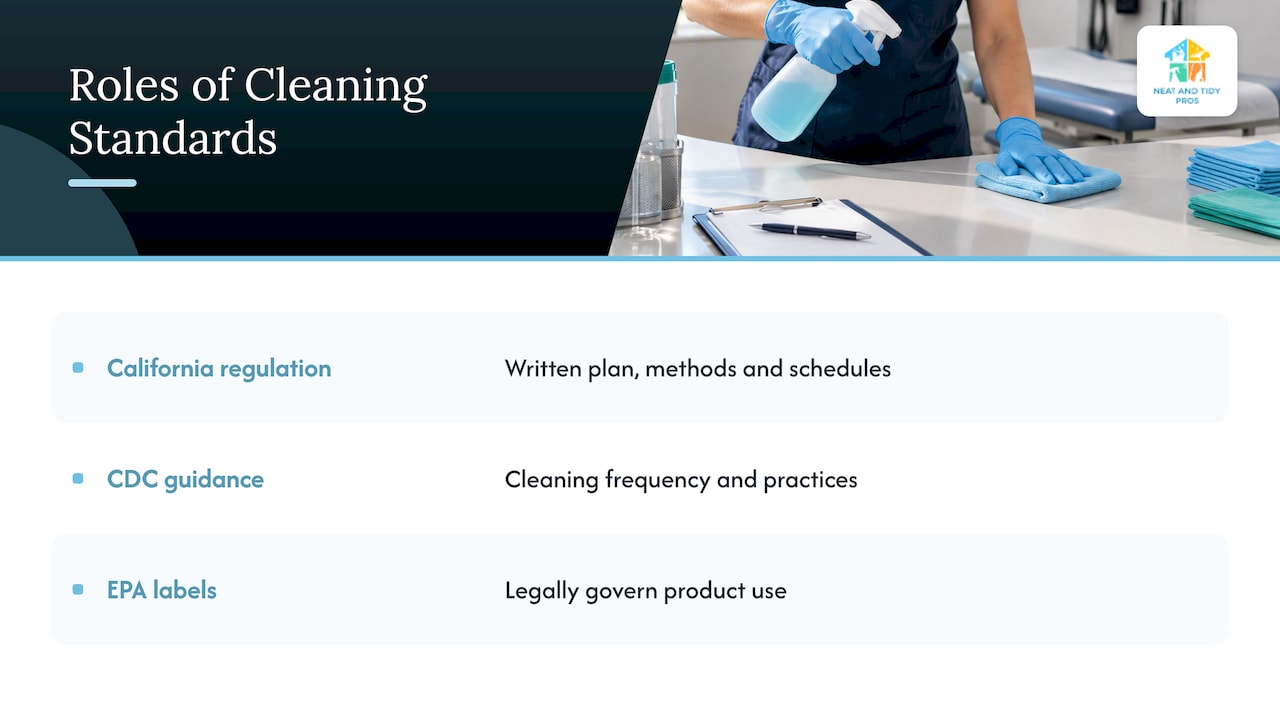
If your office is a small clinic, the practical takeaway is simple: your written plan is the center of the system. Everything else, from product choice to schedules to training, hangs off it.
Cleaning, sanitizing and disinfecting are not the same
The CDC defines cleaning as removing germs, dirt and impurities with water, soap and scrubbing, and disinfecting as using chemicals to kill the germs that remain. Its guidance is to clean a surface before you disinfect it, because dirt can make disinfectants less effective.
| Step | What it does | Typical medical-office use |
|---|---|---|
| Cleaning | Removes soil, dust and some germs | Floors, desks, administrative areas, every surface before disinfecting |
| Sanitizing | Lowers germs to a safer level, as defined on a product label | Less common in clinical areas; check the label for the claim |
| Disinfecting | Kills germs left on a pre-cleaned surface when used as labeled | Exam tables, counters, high-touch points, restrooms, spill response |
The distinction matters for cost and for risk. The CDC notes that detergent and water are generally enough for non-patient-care areas such as administrative offices, while patient-care surfaces may call for an EPA-registered hospital-grade disinfectant depending on risk. A contractor who sprays disinfectant on every desk is not being more careful. They are spending your budget in the wrong place.
CDC experts also point out that contaminated surfaces are rarely a direct source of infection but can act as reservoirs, which is why hand hygiene and surface cleaning work together. Cleaning does not replace handwashing.
Choosing disinfectants and honoring contact time
This is the most commonly failed standard, and the easiest to audit.
- Use an EPA-registered product. The CDC says staff should choose EPA-registered disinfectants suited to the target pathogens and follow the label, including contact time. Off-label use shifts liability to whoever did it.
- Match the claim to the risk. OSHA’s housekeeping guidance refers to products that are tuberculocidal or effective against HIV and HBV when blood or body fluids are involved.
- Keep the surface wet. The EPA explains that contact time is how long the product must stay on the surface, and the surface should stay visibly wet for that whole period. If a label says 10 minutes and the surface is dry at 5, apply more product.
- Do not over-escalate. The CDC cautions that high-level disinfectants and liquid chemical sterilants belong on critical medical devices, not on ordinary environmental surfaces.
A quick test during a walkthrough: ask the cleaner what the contact time is for the product in their hand and where it is written. A trained person answers in seconds.
One more point that is easy to miss. Researchers at the CDC have noted that routine floor disinfection may not always be necessary, and that cutting unneeded chemical exposure can help indoor air quality. Floors in most areas get a good detergent clean; save disinfectant for spills and higher-risk rooms.
Cleaning by area and level of risk
The CDC says housekeeping surfaces in patient-care areas, such as floors and tabletops, should be cleaned regularly and whenever spills occur or surfaces are visibly soiled. Beyond that, the frequency is yours to define in your written plan. Here is a practical way to set it.
Waiting room and reception
High-touch surfaces are the priority: door handles, check-in counters, pens, clipboards, armrests, children’s play items, light switches. Clean them with detergent, then disinfect them on a set round during operating hours. Floors and upholstery get a standard clean. Our clinic waiting room checklist shows how a signed round log works, and the six-zone high-touch disinfection checklist covers the shared touchpoints that every office has.
Exam and procedure rooms
These are the highest-risk rooms. Clean and disinfect the exam table, counters, sinks, chairs, door handles and equipment surfaces between patients (clinical staff) and again in the nightly clean. California’s rule on protective coverings is specific: plastic wrap or similar coverings must be replaced as soon as they are contaminated, or at the end of a shift if they might have been.
Work from cleanest to dirtiest, and from high to low, so you do not carry contamination across the room. Use color-coded cloths and mops by zone so a restroom cloth never touches an exam table. Reusable cloths go to laundering after each use; mop heads are changed rather than reused in the next room.
Privacy curtains and window coverings count as surfaces too. If you are choosing fabrics for exam rooms, healthcare privacy window treatments are worth a look for how they balance daylight and privacy, and your cleaning plan should list how often each treatment is laundered, wiped or replaced.
Restrooms
Restrooms need disinfectant on fixtures, flush handles, taps, door handles and dispensers, plus floors cleaned and disinfected, every day the office is open. Busy practices add a midday check. Our office restroom checklist with a signed log is a ready format.
Administrative areas, break rooms and hallways
Detergent and water, dusting with damp or microfiber cloths (not feather dusters, which just move particles around), trash removal and floor care. Food areas in break rooms stay separate from clinical zones, and staff do not eat where patients are examined.
Sample frequency table
| Area | Surfaces | Method | Suggested minimum |
|---|---|---|---|
| Waiting room | Handles, counters, chairs | Clean, then disinfect high-touch | Daily, plus rounds on busy days |
| Exam rooms | Table, counters, sinks, equipment | Clean, then disinfect | Between patients and nightly |
| Restrooms | Fixtures, floors, dispensers | Clean, then disinfect | Daily, midday check if busy |
| Admin offices | Desks, floors, trash | Detergent and water | Per your schedule |
| Break room | Counters, fridge, microwave | Clean; disinfect touchpoints | Daily |
The frequencies are our suggested starting points, not regulatory minimums. Your Exposure Control Plan and your medical director set the actual standard for your practice.
Training, PPE and bloodborne pathogens
Anyone who may come into contact with blood or other potentially infectious material, cleaners included, falls under the bloodborne pathogen rules. OSHA’s model plan describes initial and annual training on the Exposure Control Plan, PPE selection and use, and post-exposure procedures. Employers must provide required PPE such as gloves and eye protection, and offer hepatitis B vaccination at no cost to exposed employees.
Handwashing is part of the standard too. California requires readily accessible handwashing facilities, and where those are not feasible, antiseptic hand cleanser with clean towels or antiseptic towelettes, followed by soap and running water as soon as feasible.
Practical rules we apply on any healthcare job:
- Gloves go on before a task and come off before touching clean areas, doors or phones.
- Sharps are never handled by cleaners. Containers are sealed by clinical staff and removed by a licensed hauler.
- Blood or body-fluid spills are escalated to staff who are trained for them, using the office’s spill kit and procedure.
- If equipment cannot be fully decontaminated before servicing, it must carry a biohazard label naming the contamination.
Medical waste and contaminated materials
Cleaners should not decide what is regulated waste. In California, medical offices must determine whether their waste is hazardous, and hazardous waste must be labeled and managed under California hazardous-waste rules. That is the practice’s responsibility, set out in its waste plan.
What that means for a cleaning crew:
- Regular trash and red-bag or sharps containers are separate streams. Cleaners empty only what the plan assigns to them.
- Never compact or press down on bags that might contain sharps.
- Chemical containers and disinfectant wipes follow the product label and the office’s waste plan.
- Anything unclear gets asked before it is touched, not after.
Records and quality checks
A standard you cannot show is a standard you cannot prove. OSHA’s model plan lists the retention periods: training records for at least three years, sharps injury logs for five years after the end of the calendar year they cover, and employee medical records for the duration of employment plus 30 years. The medical-record period comes from 29 CFR 1910.1020.
For day-to-day verification, keep:
- Signed cleaning logs by room and by shift.
- Product list with EPA registration numbers and contact times.
- Training sign-ins for every cleaner who works in your space.
- Monthly walkthroughs with a short scoring sheet: floors, touchpoints, restrooms, exam rooms, supply stock.
- Corrective action notes for anything that failed and how it was fixed.
Our medical office cleaning checklist is built around exactly this kind of inspection-ready paper trail.
Our perspective
Most medical offices we talk to are not failing on products. They fail on the handoffs: nobody wrote down which areas the cleaners handle and which belong to clinical staff, nobody checked the contact time, and nobody can find the log. We have been cleaning homes and commercial spaces for 15 years, and the pattern is the same everywhere: a clear scope, a checklist and a signature at the end of the shift fix more problems than a stronger chemical.
We also push back on over-disinfecting. Using eco-friendly products where the risk allows and keeping EPA-registered disinfectants for the places that need them protects your staff’s air and your budget. Our teams show up equipped, and we adapt the scope to your Exposure Control Plan rather than the other way around.
— Neat
What to ask a cleaning contractor before you hire
- Can you show training on bloodborne pathogens for the people who will be in my building?
- Which disinfectants do you use, and what are their contact times?
- How do you separate tools and cloths between restrooms, exam rooms and offices?
- What do your cleaners do, and not do, with sharps and regulated waste?
- How is the work documented, and who signs it?
- What happens when a walkthrough finds a miss?
A contractor who answers these with specifics is worth a trial. One who answers “we use hospital-grade everything” is not. If you manage a mixed building, our guide to how office cleaning works explains how scopes and schedules are set.
Medical office cleaning with Neat and Tidy Pros
We clean medical facilities and offices across Orange County and Corona, with eco-friendly products, fully equipped teams and a customer satisfaction guarantee. We build the scope around your written plan, use checklists and signed logs, and can add deep cleaning to your routine. See our commercial cleaning service to request a walkthrough.
If your clinic is newly built or renovated, our construction cleaning comes first, before you open your doors.
FAQ
Does a medical office need hospital-grade disinfectant everywhere?
No. The CDC says detergent and water are generally enough for non-patient-care areas such as administrative offices. Use EPA-registered disinfectants on patient-care surfaces, restrooms and high-touch points, following the label for the target pathogen and contact time.
Who is responsible for the Exposure Control Plan, the office or the cleaner?
The employer with occupational exposure is responsible for the plan. If a contractor’s staff work in your space, coordinate so their training, PPE and duties match the plan, and so it is clear what they do and do not handle.
How often should exam rooms be cleaned?
Patient-care surfaces should be cleaned regularly and whenever spills occur or surfaces are visibly soiled, according to the CDC. Most practices disinfect between patients and run a full clean nightly, but your written plan sets the exact schedule.
How long do records need to be kept?
OSHA’s model plan lists at least three years for training records and five years for sharps injury logs after the calendar year covered. Employee exposure medical records are kept for employment plus 30 years.
Sources
- California Code of Regulations, Title 8, Section 5193
- OSHA eTool: Hospitals, Housekeeping, Biological Hazards
- CDC: Recommendations for Disinfection and Sterilization in Healthcare Facilities
- CDC: Cleaning and Disinfecting
- CDC: Environmental Services
- EPA: Selected EPA-Registered Disinfectants
- CDC: Cleaning and disinfecting environmental surfaces in health care
- OSHA: Model Exposure Control Plan
- DTSC: Managing Waste in Dental, Medical and Veterinary Offices