
After hours office cleaning means a professional crew cleans your workspace in the evening or overnight, when your team has gone home. The work gets done without noise, wet floors or people shuffling around vacuums. You arrive to clean restrooms, emptied trash and wiped surfaces. For most offices with fixed daytime hours, an evening slot right after closing is the simplest start, and overnight suits larger floors or businesses that run late.
This guide covers what the service includes, how to pick between evening, overnight and daytime, how access and security are handled, what the schedule costs you in practice, and how to set up the first week. We clean offices across Orange County and Corona, California, so the examples lean toward local businesses.
TL;DR
- After hours cleaning covers the same core work as daytime service (restrooms, trash, floors, high-touch surfaces, break rooms), done while the office is empty.
- Evening slots (right after closing) fit most small and mid-size offices. Overnight suits large floors, shared buildings and businesses with late hours.
- Night work usually carries a pay premium of 10 to 15 percent on the base hourly rate, so ask for a written scope before comparing quotes.
- Settle access, alarm codes, supplies storage and who to call before the first visit, and put them in writing.
- Public areas need daily attention; private offices and cubicles can run on a lighter cycle.
Table of Contents
- What after hours office cleaning includes
- Evening, overnight or daytime: choosing the window
- How access, keys and security are arranged
- What to confirm before the first visit
- How often each area needs attention
- What after hours cleaning costs compared with daytime
- Our perspective
- Setting up your first week
- Book after hours office cleaning in Orange County and Corona
- FAQ
- Sources
What after hours office cleaning includes
The scope is the same as for any regular office cleaning contract. Only the clock changes. A typical after-hours visit covers:
- Restrooms: fixtures, mirrors, floors, dispensers refilled, trash removed.
- Trash and recycling: every bin emptied and relined, plus the kitchen and break room.
- Floors: vacuuming carpet, dust mopping and wet mopping hard floors, entry mats.
- Surfaces: desks cleared for wiping where agreed, reception counters, conference tables.
- High-touch points: door handles, light switches, elevator buttons, stair rails, shared equipment.
- Break rooms: counters, sinks, microwave exteriors, table tops.
The CDC advises cleaning high-touch surfaces regularly, naming pens, counters, door handles, stair rails, elevator buttons, touchpads, restroom fixtures and desks, and other surfaces when they are visibly dirty. An empty office makes that easy to do thoroughly, because nobody is sitting at the desk you need to wipe. Our own six-zone high-touch disinfection checklist shows how to split these points into zones.
Deeper tasks, such as carpet extraction, window cleaning or floor refinishing, are usually scheduled as separate periodic jobs. If you are building a scope from scratch, our office cleaning checklist for managers gives you a 15-minute daily list and a statement-of-work template you can adapt.
Evening, overnight or daytime: choosing the window
The three windows suit different offices.
| Window | Typical timing | Best for | Watch for |
|---|---|---|---|
| Evening | Right after closing, often a few hours | Small and mid-size offices with fixed 9 to 5 hours | Late stayers, meetings that run over |
| Overnight | Late evening into early morning | Large floors, multi-tenant buildings, late-running businesses | Alarm and access setup, premium pay rates |
| Daytime | During business hours | Buildings where energy or access favors it | Disruption and confidentiality concerns |
When evening cleaning fits
Choose evening if your staff all leave by a predictable time and the space is small enough to finish in a few hours. The crew is in and out, you keep one clear handover point (the last person out), and the office is ready the next morning. It also suits medical and professional offices that need surfaces refreshed daily but have no overnight activity.
When to schedule overnight
Overnight works when the floor plate is large, when several departments share space, or when your team stays late and you cannot hand over the building until the evening is well along. It also fits businesses that need a deep task, like floor scrubbing, to dry fully before the doors open. A university facilities team shows the pattern at scale: The University of Texas at Austin runs routine cleaning from 5:30 p.m. to 2 a.m., Monday through Friday. A private office will be smaller, but the logic is the same: start after the working day ends and finish before it begins.
Night versus day cleaning
Night cleaning has clear advantages: no disruption, no foot traffic on freshly mopped floors, and less exposure of confidential desks to people moving through. Daytime cleaning has its own case. ISSA’s Value of Cleaning white paper reports that State Farm saw energy savings of 7 to 8 percent per year across 30 buildings moved to daytime cleaning, and that EPA Region 8 headquarters in Denver cut energy costs by 28 percent by scheduling custodial service from 8 a.m. to 5 p.m. Those are large buildings with lighting and HVAC running just for the crew, so a small suite will see far less effect.
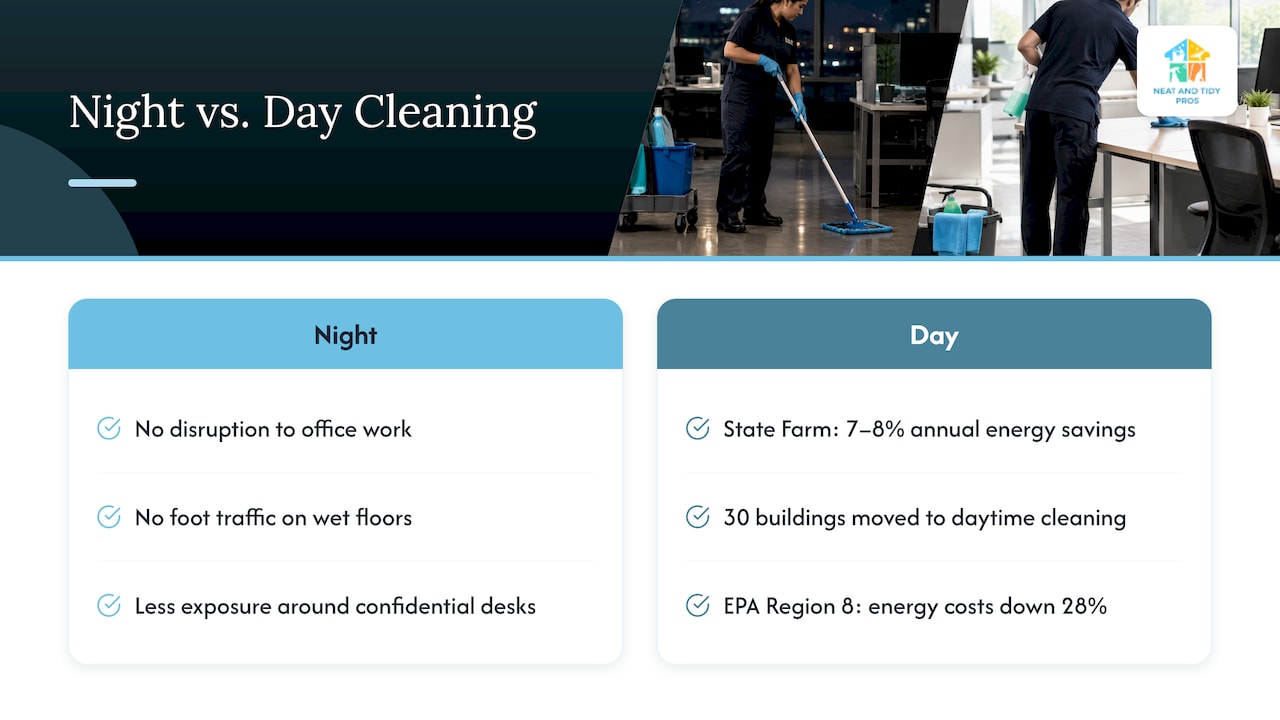
The practical rule: if your building’s lights and air handling shut down at night and your team needs quiet, work after hours. If you run long business hours already or have a large building, ask your cleaner to price both windows so you see the real difference.
How access, keys and security are arranged
The question we hear most from office managers is not about mops. It is who has the keys. A clean handover process covers five points:
- Entry method: key, fob, keypad code or building management let-in. Give each crew member a separate credential where the building allows it, so you can remove one without changing all.
- Alarm procedure: who arms and disarms, what the code process is, and who gets the call if it trips.
- Restricted areas: server rooms, executive offices, file rooms and cash handling areas marked as in or out of scope.
- Supplies storage: a closet or cabinet where the crew’s equipment and your paper goods live.
- Contact chain: a named person to call when something is wrong, day or night.
If you are tightening your own procedures at the same time, a practical walkthrough on securing after-hours property access covers the physical side of who gets in and when. For the wider picture of keeping a workplace protected, there is also a guide on office security for workplace safety.
Two habits prevent most problems. First, ask the crew to sign in and out on a simple log, with the time on and off site. Second, ask for a short end-of-visit note when anything was missed or damaged, so you hear about it before your staff does.
What to confirm before the first visit
A good start is a short walkthrough with the crew lead, ideally in the evening so they see the space in its after-hours state. Confirm:
- Scope in writing, room by room, with frequency for each area.
- Products: the cleaning chemicals the crew will use, and where safety data sheets are kept. The CDC notes that employers must follow OSHA standards, including the hazard communication standard (29 CFR 1910.1200) and PPE standards, so your site should be able to show a chemical list and labels.
- Floors: OSHA’s housekeeping rule, 29 CFR 1910.22(a), requires workplaces to be kept clean, orderly and sanitary, and workroom floors to be clean and, so far as possible, dry. Ask for wet floor signs and enough drying time that your first arrivals walk onto a dry surface. Our guide to OSHA office housekeeping rules explains what managers must do.
- Lone worker safety: how the crew checks in, who they call in an emergency, and where exits and first-aid kits are.
- Quality checks: how you will inspect the first week, and how issues get reported and fixed.
How often each area needs attention
Not every square foot needs the same schedule. Shared and public spaces take the most wear and carry the most germs. The University of Texas at Austin gives a useful split in its own program: offices and cubicles are cleaned about every 20 business days, while bathrooms, hallways, classrooms and break rooms are cleaned daily. That is a university, but the principle carries to a business.
A practical office plan looks like this:
| Area | Suggested rhythm |
|---|---|
| Restrooms | Every visit |
| Break room and kitchenette | Every visit |
| Trash and recycling | Every visit |
| Lobby, reception, entry floors | Every visit |
| High-touch points | Every visit |
| Open workspace carpet | Several times a week |
| Private offices and cubicles | Weekly or on a rolling cycle |
| Windows, vents, baseboards | Monthly or quarterly |
Use our restroom cleaning checklist with signed log for the area that draws the most complaints, and the cubicle cleaning routine for the rolling cycle. If you run a small team, the small business office cleaning schedule shows how to cut the plan down to two or three visits a week.
What after hours cleaning costs compared with daytime
We do not publish set prices for office cleaning, because cost depends on square footage, layout, frequency and scope. What affects your quote:
- Size and layout: more rooms, more restrooms and more floor types mean more time.
- Frequency: daily, three times a week or weekly.
- Scope: basic tidy and trash versus full restroom, kitchen and floor care.
- Time window: night work usually costs more in labor. Opora’s June 2026 field guide says night work in most US markets carries a 10 to 15 percent premium on base hourly rates, and gives an example of a 10-person crew at $18.50 an hour base where a $1.85 shift differential adds about $1,900 a month in payroll before benefits. Your own quote will differ with crew size and California wage rules.
Because pricing is built on the specifics, the fastest way to compare is to give each provider the same written scope and ask for an itemized quote. Our Commercial Cleaning page lists the kinds of spaces we serve, and our guide to how office cleaning works walks through quoting, scope and handover.
Our perspective
We have cleaned homes and commercial spaces for 15 years, and the offices that are happiest with after hours service share one habit: they treat the first week as setup, not as a test of the cleaner.
Our approach is to start with a walkthrough, write a scope the crew lead can follow from a single page, and agree on how access and alarms work before anyone cleans a thing. Our teams arrive fully equipped, and we use safe, eco-friendly products so the office smells like nothing at all when your staff walks in.
We tailor the plan to the space. A dental or medical office, a property management front desk and a three-desk startup do not need the same checklist, and we do not pretend they do. Evening service works for most; overnight is there when your building demands it.
Consistent quality comes from a stable crew who know your layout. That is what we aim to deliver, and it is backed by our customer satisfaction guarantee.
Neat
Setting up your first week
- Day 1: walk the space with the crew lead. Mark restricted rooms, supply storage and the exit route.
- Day 2: hand over access credentials and alarm instructions. Confirm the contact chain.
- Days 3 to 5: run the first visits and read the sign-in log and notes each morning.
- End of week one: do a morning walkthrough. Check restrooms, break room, floors and high-touch points, and list any gaps.
- Week two: adjust the scope. Move tasks between daily and weekly, and decide whether the time window still fits.
If things go wrong, they usually go wrong in the same places. Our piece on common office cleaning oversights lists them, from missed restroom restocking to unclear scope on break rooms.
Book after hours office cleaning in Orange County and Corona
We provide commercial cleaning for offices, property managers, medical facilities, hotels, restaurants and other business spaces across Orange County and Corona, California. We will walk your space, write a scope, and set a schedule that fits your hours, whether that is a quick evening visit or a full overnight program.
See our Commercial Cleaning page to request a quote, or start from neatandtidypros.com to book by phone or online.
FAQ
What time does after hours office cleaning usually happen?
Evening visits typically begin once your last staff member leaves and run a few hours. Overnight programs run late evening into the early morning. A large facility such as a university may run from 5:30 p.m. to 2 a.m., and a private office picks the window that fits its closing time.
Is night cleaning more expensive than daytime cleaning?
Often, yes. Night work in most US markets carries a premium of 10 to 15 percent on the base hourly rate. The exact difference depends on your size, scope and crew. Ask for an itemized quote for the same scope in both windows.
Is it safe to give a cleaning crew keys and alarm codes?
It is routine, and it works best with a process: individual credentials where possible, a sign-in log, restricted rooms marked in the scope, and a named contact for problems. Agree on all of it in writing before the first visit.
Is office cleaning the same as commercial cleaning?
Office cleaning is one type of commercial cleaning. Commercial cleaning also covers spaces like medical facilities, hotels, restaurants and storage facilities, each with its own scope. Offices focus on restrooms, trash, floors, break rooms and high-touch surfaces.
Sources
- Nightly vs Day Cleaning: Office Rules and ASHRAE, Opora
- The Value of Cleaning, ISSA white paper
- Cleaning Services, UT Austin Facilities Services
- Housekeeping: Maintaining a Safe, Clean Workplace, Office for Congressional Workplace Rights
- When and How to Clean and Disinfect a Facility, CDC