
Yes, charge a cleaning fee if it covers your actual turnover cost and stays competitive with your market. The practical benchmark is 25 to 50% of your average daily rate (ADR), a range AirROI’s analysis of over 685,000 listings ties to the highest annual revenue and occupancy. Remember Airbnb’s host fee cuts into that number before it hits your bank account, so model your net, not just the sticker price.
TL;DR:
- Charging a cleaning fee between 25 and 50% of the nightly rate maximizes revenue and occupancy, while higher fees can deter bookings.
- The minimum you should charge covers labor, laundry, supplies, coordination, and a small wear-and-tear buffer, based on actual invoice data.
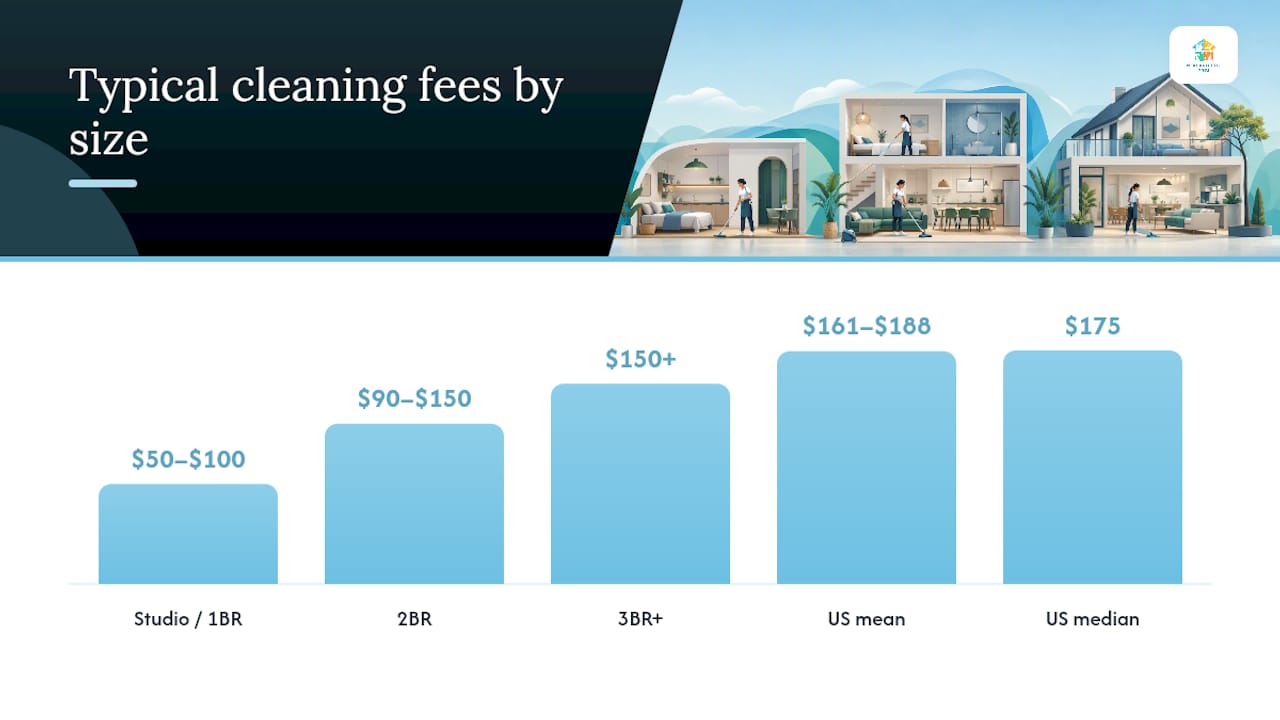
- Cleaning fees for typical properties range from $50 to $100 for studios, $90 to $150 for two-bedroom units, and $150 or more for larger homes.
- Bundling or scaling the cleaning fee with the nightly rate works best when guests stay longer, especially for stays of four nights or more.
- Testing different fee strategies over four to six weeks ensures optimal balance between attracting bookings and covering turnover costs.
Table of Contents
- How Airbnb’s Cleaning Fee Rules Work
- What Does It Actually Cost You to Turn a Unit?
- What’s a Typical Airbnb Cleaning Fee by Property Size?
- Should You Bundle the Cleaning Fee Into Your Nightly Rate?
- A 3-Step Framework for Setting Your Fee
- What a Cleaning Fee Covers, and What It Doesn’t
- Why Testing Your Fee Beats Guessing at It
- Get a Cleaning Quote Built Around Your Actual Turnover Math
- Where This Guide’s Numbers Come From
- Sources
How Airbnb’s Cleaning Fee Rules Work
Airbnb defines the cleaning fee as a one-time, host-set charge folded into the total price a guest sees before booking. It is not negotiable per stay and it is not the same as Airbnb’s Host damage protection, which covers separate incidents. Airbnb’s Help Center spells out the refund logic: cancellations made during your free cancellation window get the cleaning fee back in full, while later cancellations follow your own cancellation policy.
Since Airbnb folds the fee into the total price shown at checkout, guests rarely see it broken out prominently until they review the price breakdown. That total price display matters because a high fee relative to a low nightly rate can look like a bait and switch once a guest scrutinizes the math.
A few compliance basics keep you out of trouble: For hosts modeling fee versus nightly-rate tradeoffs, this rental property calculator can help analyze your cash flow, cap rate, and ROI.
- Set or edit the fee in your listing’s pricing settings, not through direct messages with guests.
- Apply the same fee consistently across booking channels tied to that listing.
- Update the fee before new bookings come in. It won’t retroactively change confirmed reservations.
What Does It Actually Cost You to Turn a Unit?
Your cleaning fee floor is the minimum you can charge without losing money on every turnover. Skip this step and you’re pricing blind.
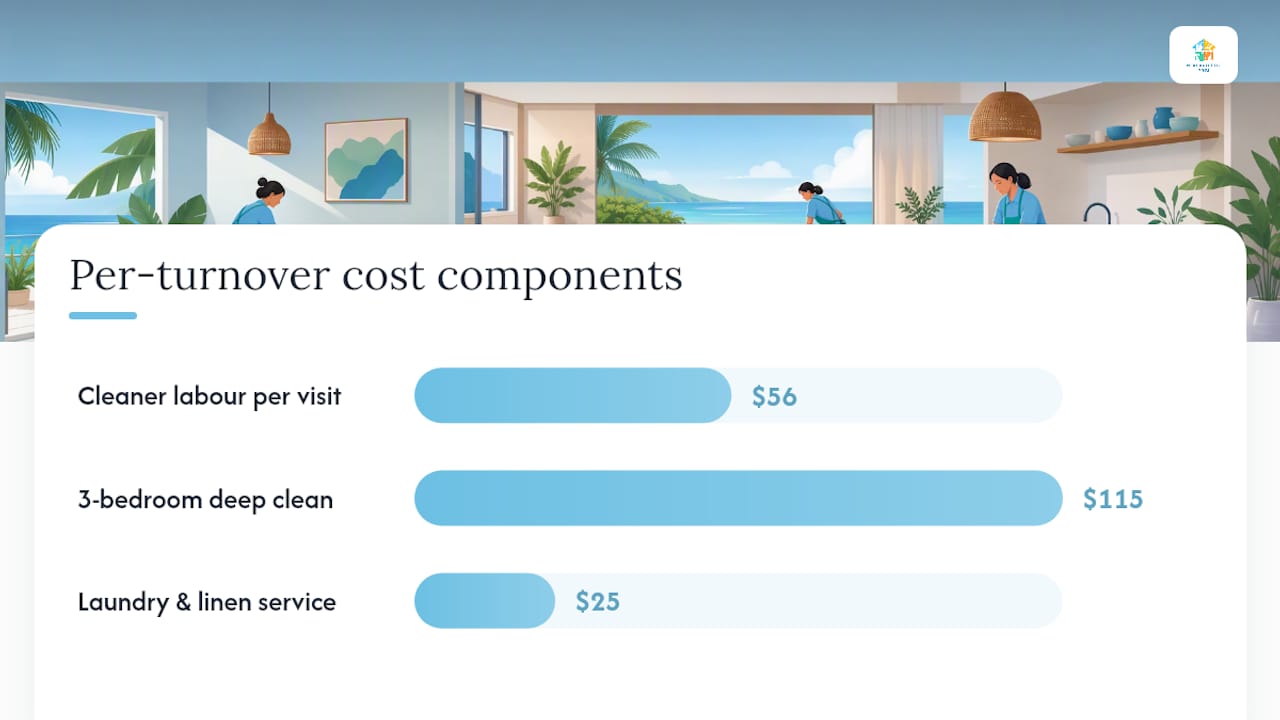
Start with labor. Professional turnover cleaners typically charge $20 to $30 an hour, and a standard one or two bedroom clean runs 1.5 to 3 hours. A three bedroom or larger unit with a full deep clean can run $80 to $150 or more per visit. Add laundry and linen service, often $10 to $40 depending on whether you outsource it or do it yourself, plus consumables like toilet paper, soap, and coffee that need restocking every stay.
Here’s the fastest way to build your floor:
- Multiply cleaner hourly rate by realistic hours on-site for your square footage.
- Add laundry and linen costs, whether that’s an outside service or your own detergent and time.
- Add supplies and restocking costs per visit.
- Add a coordination or admin line for the time you spend scheduling and checking in with cleaners.
- Tack on a small wear-and-tear buffer, then round up to the nearest $5 or $10.
That formula, adapted from AirROI’s cost-modeling approach, gives you a number you should never price below, regardless of what competitors charge.
Pro Tip: Track your actual cleaner invoices for two months before locking in a fee. Estimates almost always run low once you account for the 10 minutes spent restocking a coffee station or hauling out recycling nobody mentioned during the walkthrough.
What’s a Typical Airbnb Cleaning Fee by Property Size?
National averages hide more than they reveal. AirDNA reports a mean US cleaning fee near $161 to $188 depending on the data set and year, while Clean Casa’s 2026 panel puts the median closer to $175. The gap between mean and median exists because a small number of large vacation homes with $400+ fees pull the average upward. Bedroom count is a far more useful benchmark than any single national figure.
| Property size | Typical cleaning fee range |
|---|---|
| Studio / 1BR | $50 to $100 |
| 2BR | $90 to $150 |
| 3BR+ | $150 or more |
AirROI’s large-sample study found listings priced in that band posted the strongest annual revenue and occupancy, while fees exceeding 100% of ADR dragged both metrics down.
Fees set at 25 to 50% of ADR correlate with the highest annual revenue among the 685,000+ listings AirROI analyzed. Go much higher and booking conversion tends to suffer even if the per-stay math looks fine on paper.
Should You Bundle the Cleaning Fee Into Your Nightly Rate?
Your ideal pricing structure depends heavily on how long guests typically stay. A separate line item feels reasonable to a week-long guest amortizing the cost over seven nights. It feels like a rip-off to someone booking one night at a $90 rate with a $90 cleaning fee attached.
Three approaches solve this differently:
- Full bundle: Roll the cleaning cost into your nightly rate entirely. This works best if your average stay runs four nights or longer, since the per-night cost dilutes naturally.
- Length-of-stay scaling: Keep the fee separate but pair it with minimum-stay requirements or weekly discounts, so short-stay guests who feel the fee most are steered toward the stays where you need volume.
- Partial bundle: Split the difference by folding half the fee into the rate and keeping a smaller cleaning line, softening the shock without eliminating flexibility.
Guest sensitivity to unit-price shock is highest among one and two night bookers, so listings that lean heavily on short stays benefit most from bundling or scaling strategies rather than a flat, separate charge.
Pro Tip: If you switch strategies, don’t change your total effective price. Guests notice a nightly rate jump paired with a fee drop far less than they notice a fee that looks disproportionate to a short stay.
A 3-Step Framework for Setting Your Fee
- Calculate your cost floor. Run the itemized labor, laundry, supplies, and coordination formula above. This is the number you never go below.
- Benchmark your ADR. Multiply your current or planned nightly rate by 0.25 and by 0.50 to get your sweet-spot range, then compare it against the bedroom-count benchmarks for your market.
- Pick the overlap, then test. Choose a fee where your cost floor and the ADR sweet spot intersect. To net a target amount after Airbnb’s roughly 15.5% host fee, divide your desired net by 0.845; netting $100 means charging close to $118. Run the new fee for four to six weeks and watch booking conversion before locking it in permanently.
What a Cleaning Fee Covers, and What It Doesn’t
A cleaning fee should fund the routine work between every guest: stripping and remaking beds, laundering linens and towels, restocking toiletries and paper goods, vacuuming, sanitizing bathrooms and kitchens, and hauling out trash. Use our Airbnb cleaning checklist as the working reference for what a thorough turnover should include every time.
What it should not cover:
- Exceptional damage from a guest, which falls under Airbnb’s Host damage protection, not your cleaning fee.
- Periodic deep cleans (carpet shampooing, appliance detailing, grout work) that go beyond standard turnover scope.
- Move-out level cleaning after long-term stays, which behaves more like a move-out clean than a standard turnover.
Guests scrutinize higher fees more closely, expecting a visibly spotless unit in return. A $150 fee on a modest studio invites more complaints than the identical fee on a well-appointed three bedroom home, even when the actual cleaning work is comparable.
Why Testing Your Fee Beats Guessing at It
Guessing a cleaning fee from a competitor’s listing is how hosts end up either bleeding money on every turnover or scaring off short-stay bookers. Run a revenue-neutral test: trim the fee, nudge the nightly rate up slightly to compensate, and watch conversion and occupancy for four to six weeks before deciding.
A 47-point turnover checklist gives you a consistent standard to audit against, whether you clean the unit yourself or hire it out. Once turnover frequency climbs past two or three a week, or guest expectations start outpacing what you can deliver solo, the time-cost math usually favors bringing in a professional crew.
— Neat
Get a Cleaning Quote Built Around Your Actual Turnover Math
We provide Airbnb hosts with a clear cost estimate for turnover cleans, linen service, and deep cleans scheduled around the guest calendar rather than a generic weekly slot.

Quotes typically break down labor, laundry, and restocking separately, so hosts can see what’s driving their per-turnover cost and adjust cleaning fees with real numbers instead of guesses. That kind of clarity matters most for hosts juggling back-to-back bookings where a rushed clean risks a bad review. Check our full services page to see turnover cleaning, linen options, and deep-clean add-ons, and request a quote to see how professional pricing lines up against your current fee.
Where This Guide’s Numbers Come From
- Airbnb Help Center: Cleaning fees for policy and refund rules.
- Airbnb Resource Center on cleaning fees for guest-expectation guidance.
- AirDNA, AirROI, and Clean Casa’s 2026 report for benchmarks and revenue data.
- Neat and Tidy Pros’ turnover checklist for operational standards.
Sources
- Cleaning fees – Airbnb Help Center
- Airbnb cleaning fees: what hosts need to know in 2026
- Airbnb cleaning fees: how much to charge in 2026 | AirROI
- 2026 State of STR Cleaning Fees Report – Clean Casa