
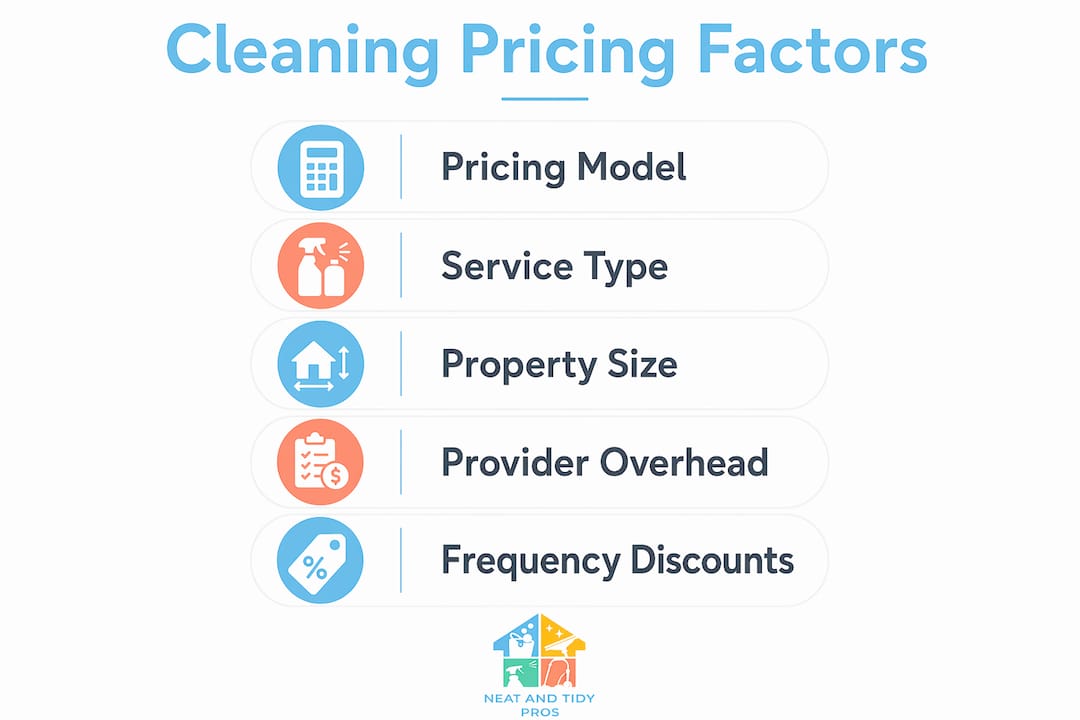
Professional cleaning is priced using three core models: hourly rates, flat rates, and per-square-foot rates, with the final cost shaped by service type, property size, and regional labor costs. For Southern California homeowners and renters, understanding these variables is the difference between overpaying and getting real value. Standard residential cleaning runs $120–$280 per visit for a typical 3-bedroom home, while deep cleaning climbs to $200–$500 or more. This guide breaks down every factor that drives cleaning service pricing so you can read any quote with confidence.
How professional cleaning is priced: the three main models
The industry uses three primary pricing structures, and knowing which one applies to your job tells you immediately whether a quote is fair.
Hourly pricing is the most transparent model. You pay for the actual time spent. Hourly rates range from $20–$30 per hour for a beginner solo cleaner, $30–$50 for an experienced independent, $50–$75 for a professional company, and $75–$90 or more for premium specialty services. That spread matters because a company charging $65 per hour with two cleaners on site may finish faster and cost less total than a solo cleaner at $35 per hour who takes twice as long.
Flat-rate pricing is the standard for recurring residential work. The provider assesses your home once, sets a fixed price per visit, and that number stays consistent unless your home’s condition changes significantly. A flat rate removes billing surprises and makes budgeting simple. Most Southern California cleaning companies prefer this model for weekly and biweekly clients.
Per-square-foot pricing applies mainly to commercial properties and large residential jobs. Per-square-foot rates for standard cleaning typically fall between $0.05 and $0.20, with deep cleaning running 1.5–2.5 times that amount. This model rewards scale: a 4,000-square-foot office at $0.08 per square foot costs $320 per visit, which is competitive compared to hourly billing for the same space.
- Hourly: Best for one-time cleans, irregular schedules, or first-time clients
- Flat rate: Best for recurring residential cleaning with a consistent scope
- Per square foot: Best for commercial spaces, post-construction, and large homes
Pro Tip: Ask any provider whether their quote is based on estimated hours or a fixed scope. If it’s hourly, request a time estimate in writing so you can compare it against flat-rate alternatives.
How does service type affect cleaning costs?
The type of cleaning you book is the single biggest driver of price variation. Each service category carries a different labor requirement, time commitment, and supply cost.

Standard (basic) cleaning covers surface-level tasks: vacuuming, mopping, wiping counters, cleaning bathrooms, and tidying common areas. For a Southern California home, this is the basic cleaning tier most families book on a recurring schedule. Expect $120–$280 per visit for a 3-bedroom home depending on size and provider.
Deep cleaning goes significantly further. It includes baseboards, appliance interiors, grout scrubbing, vents, and windowsills. These are high-effort tasks that take two to three times longer than a standard visit. Deep cleaning costs 1.5–2.5 times a standard clean, which means a $180 standard visit could become a $270–$450 deep clean. Always request a written checklist before booking so you know exactly what is included.
Move-in/move-out cleaning is priced similarly to deep cleaning but often includes additional tasks like cleaning inside cabinets, wiping down all surfaces in an empty unit, and addressing areas that were hidden by furniture. For renters in Southern California trying to recover a security deposit, this service is worth every dollar.
Post-construction cleaning sits at the top of the price range. Post-construction rates typically run $0.15–$0.35 or more per square foot due to specialized equipment, debris disposal, and extended labor time.
| Service Type | Typical Price Range | Notes |
|---|---|---|
| Standard Residential | $120–$280 per visit | Based on 3-bedroom home |
| Deep Cleaning | $200–$500+ | 1.5–2.5x standard clean cost |
| Move-In/Move-Out | $200–$450+ | Includes cabinets, empty unit detail |
| Post-Construction | $0.15–$0.35+ per sq ft | Equipment and disposal included |
| Airbnb Turnover | $80–$200 per turnover | Scope similar to standard clean |
What factors cause professional cleaning costs to vary?
Beyond the base pricing model, several variables push a quote higher or lower. Southern California homeowners face a specific set of regional pressures that are worth understanding.
Location and labor costs are the starting point. Los Angeles, Orange County, and San Diego all carry higher labor costs than the national average. A cleaning company operating in Irvine or Santa Monica pays more for insurance, fuel, and staff wages than one in a lower-cost market. That overhead shows up in your quote.
Cleaning frequency is one of the most reliable ways to reduce your cost per visit. Recurring services save 10–20% compared to one-time visits, with weekly schedules offering the deepest discounts. A home that is cleaned regularly also takes less time per visit, which compounds the savings.
Property condition and special requests add cost in predictable ways. Homes with pets require extra time for hair removal and odor treatment. Homes that have not been cleaned professionally in months require more labor on the first visit. Extra requests like interior oven cleaning, refrigerator cleaning, or window washing each carry an add-on fee.
Provider type shapes the price structure significantly. Franchise cleaning services cost 30–50% more than independent cleaners because of overhead, licensing fees, and royalty payments. That premium does not always mean better cleaning. It means more administrative infrastructure, which may or may not matter to you.
- Pets in the home: add $15–$40 per visit on average
- First-time or catch-up clean: expect 25–50% more than a recurring rate
- Add-on services (oven, fridge, windows): $20–$60 each
Pro Tip: Before getting quotes, write down your home’s square footage, number of bedrooms and bathrooms, pet status, and the last time it was professionally cleaned. Providers who receive this upfront will give you more accurate quotes and fewer surprises on the first visit.
How can you interpret and compare cleaning quotes?
A quote is only useful if you know what it includes. Two quotes for the same home can differ by $100 or more based entirely on scope, not quality.
- Request a written scope of work. Every line item should be listed: which rooms, which tasks, which surfaces. A provider who resists this is a provider to avoid.
- Ask about supplies. Some companies bring their own products; others expect you to supply them. This affects both cost and cleaning quality, especially if you have preferences for non-toxic or fragrance-free products.
- Clarify time estimates for hourly quotes. If a company charges $60 per hour and estimates three hours, ask what happens if the job runs to four. Get the cap in writing.
- Use price per room as a benchmark. Divide the total quote by the number of rooms being cleaned. In Southern California, $30–$60 per room for a standard clean is a reasonable benchmark. Deep cleaning runs $50–$100 per room.
- Check for insurance and bonding. Professional cleaning overhead includes liability insurance ($400–$800 per year), workers’ compensation, and bonding. A provider without these protections is cheaper for a reason. If a cleaner breaks something or gets injured in your home, you want that coverage in place.
The lowest quote is rarely the best value. A company that is licensed, insured, and consistent is worth paying more for, especially if you are booking recurring service or a high-stakes clean like a move-out.
How does commercial cleaning pricing differ from residential?
Commercial cleaning operates on different economics than residential work. The scale is larger, the frequency is higher, and the pricing model reflects both.
Commercial cleaning is priced primarily per square foot, with standard office rates running $0.05–$0.20 per square foot. Specialized facilities like medical offices or industrial spaces reach $0.30 or more per square foot due to compliance requirements and specialized products. A 2,000-square-foot office at $0.10 per square foot costs $200 per visit. At five visits per week, that is $1,000 per week before any add-ons.
Frequency drives significant savings in commercial contracts. Long-term commercial contracts with higher frequency reduce per-visit costs by 15–25%. A business committing to daily cleaning over a 12-month contract will pay meaningfully less per visit than one booking weekly on a month-to-month basis.
| Facility Type | Rate Per Sq Ft | Notes |
|---|---|---|
| Standard Office | $0.05–$0.15 | Daily or weekly frequency |
| Retail Space | $0.07–$0.18 | Higher foot traffic, more frequent |
| Medical Office | $0.15–$0.30 | Compliance and specialized products |
| Industrial/Warehouse | $0.10–$0.25 | Equipment and safety requirements |
| Residential (comparison) | $0.08–$0.20 | Per-visit estimate for large homes |
Add-on services like carpet cleaning, window washing, and floor waxing are billed separately in most commercial contracts. Budget for these as quarterly or annual line items rather than per-visit costs.
Key takeaways
Professional cleaning costs are determined by pricing model, service type, property size, and provider overhead, with Southern California rates running above the national average due to regional labor costs.
| Point | Details |
|---|---|
| Three pricing models | Hourly, flat rate, and per square foot each apply to different job types and sizes. |
| Service type drives cost | Deep cleaning costs 1.5–2.5x a standard clean; move-out and post-construction cost more. |
| Frequency saves money | Recurring service discounts of 10–20% make regular bookings more affordable per visit. |
| Provider type affects price | Franchise services cost 30–50% more than independent cleaners due to overhead and royalties. |
| Insurance matters | Licensed, bonded, and insured providers cost more but protect you from liability and loss. |
What i’ve learned after years of cleaning southern california homes
The most common mistake I see homeowners make is treating a cleaning quote like a commodity purchase. They compare two numbers without comparing what those numbers actually cover. A $150 quote that includes baseboards, appliance interiors, and bathroom grout is a better deal than a $130 quote that covers only surface cleaning.
The second mistake is skipping the written scope of work. Verbal agreements fall apart the moment a cleaner and a homeowner disagree about whether “deep cleaning the kitchen” includes the inside of the oven. A written checklist protects both sides and sets clear expectations before anyone walks through the door.
From my experience, the clients who get the most value from professional cleaning are the ones who book recurring service, communicate clearly about their home’s condition, and treat their cleaning team with respect. Those relationships produce better results and more consistent pricing over time.
One thing I tell every new client: request a trial clean before committing to a recurring contract. One visit tells you more about a provider’s quality and reliability than any online review. If the trial clean impresses you, you have found your team. If it does not, you have spent one visit fee to avoid a long-term mistake.
— Neat
Get transparent cleaning pricing from Neatandtidypros
Neatandtidypros serves homeowners, renters, and businesses across Southern California with clear, upfront pricing on every service we offer.
Whether you need a standard recurring clean, a thorough deep cleaning service, or a move-in/move-out clean before your next lease transition, Neatandtidypros builds every quote around your specific home, not a generic price list. Our full services page covers everything from post-construction cleaning to Airbnb turnovers and commercial office cleaning. Request a customized quote today and get a written scope of work with every estimate, no surprises, no hidden fees.
FAQ
What is the average cost of professional cleaning in southern california?
Standard residential cleaning for a 3-bedroom home runs $120–$280 per visit in 2026, with deep cleaning ranging from $200–$500 or more. Southern California rates sit above the national average due to higher labor and overhead costs.
How much does deep cleaning cost compared to standard cleaning?
Deep cleaning typically costs 1.5–2.5 times the price of a standard clean because it covers high-effort tasks like grout scrubbing, appliance interiors, and baseboards. Always request a written checklist to confirm what is included before booking.
Does booking recurring cleaning save money?
Recurring cleaning services save 10–20% per visit compared to one-time bookings. Weekly schedules offer the deepest discounts, and a consistently maintained home also takes less time per visit, which reduces costs further.
Why do franchise cleaning services cost more than independent cleaners?
Franchise services cost 30–50% more than independent cleaners because of licensing fees, royalty payments, and administrative overhead built into their pricing structure. That premium does not automatically mean higher quality cleaning.
What should i check before accepting a cleaning quote?
Verify that the quote includes a written scope of work, confirms whether supplies are provided, and lists any add-on charges separately. Also confirm the provider carries liability insurance and bonding before allowing anyone into your home.