
A retail floor needs three layers of care: daily dust control and spill response, weekly machine scrubbing, and periodic deep work such as stripping, recoating or extraction. The right mix depends on your floor type and your foot traffic. For store owners and managers in Orange County and Corona, the most reliable way to keep all three layers on schedule is a recurring commercial cleaning service, so floors stay presentable and safe without pulling your sales team off the floor.
This guide covers what to do and how often, which products suit which surfaces, and the safety rules that matter when customers are walking on wet floors. It applies equally to a boutique, a grocery, a showroom or any shop floor.
TL;DR
- Daily: mats at entrances, dust mop or vacuum, and immediate spill response. Weekly: machine scrub hard floors. Periodic: burnish, recoat or extract, depending on the surface.
- Match the product to the floor. Neutral pH cleaners are the safe default when you are unsure, and the manufacturer’s instructions always come first.
- Too much water, too much chemical or the wrong mop leaves residue that makes floors slippery. Post wet floor signs before mopping starts.
- Orange County stores are open long hours, so build a schedule around traffic peaks and do heavy work when the doors are closed.
- A recurring commercial cleaning plan keeps the routine consistent, which is what protects your flooring investment.
Table of Contents
- Why retail floors wear out faster than you expect
- Start with the floor type
- A daily routine that works
- Weekly and periodic floor care
- Products and equipment: what suits a shop floor
- Preventing slips while you clean
- Cleaning during business hours and after closing
- Doing it yourself, or hiring a crew
- Our perspective
- Floor care for your Orange County or Corona store
- FAQ
- Sources
Why retail floors wear out faster than you expect
A store floor takes more abuse than almost any other commercial surface. Grit from the parking lot is carried in on every shoe, and grit works like sandpaper on finish and tile. Add carts, pallets, wet weather tracked in, food and drink spills, and the floor loses its finish long before the material itself fails.
The customer reads the floor before they read the merchandise. A hazy, scuffed or sticky floor tells shoppers the whole store is poorly kept. A floor that is actually slippery also creates injury risk and legal exposure. Good floor care is a mix of prevention (keeping dirt off the floor), routine (removing what gets through) and restoration (renewing the surface before it is damaged).
Start with the floor type
No single schedule fits every shop. Cleaning method, water use and chemicals all depend on what is under your feet. These are the common retail surfaces and the guidance that applies to each.
| Floor type | Daily | Periodic | Avoid |
|---|---|---|---|
| Vinyl composition tile (VCT) | Dust mop, spot-clean spills | Burnish, scrub and recoat, strip and refinish | Harsh abrasives, highly acidic cleaners |
| Luxury vinyl (LVT/LVP) | Dry microfiber dust mop, damp mop with pH-neutral cleaner | Routine damp cleaning only | Bleach, ammonia, vinegar, steam, wax, stripping |
| Ceramic or porcelain tile | Sweep and mop | Machine scrub, deep grout cleaning, sealing | Acidic cleaners on natural stone |
| Polished or sealed concrete | Microfiber dust mop, mop spills at once | Auto-scrubber with neutral cleaner, polishing | Letting spills sit, especially juice or frozen goods areas |
| Hardwood and laminate | Dry mop | Damp mop, periodic resealing | Wet scrubbing, excess water |
| Carpet | Vacuum | Spot treat, hot-water extraction | Soaking and leaving it damp |
Vinyl composition tile
VCT is still common in retail. A floor-care guide for commercial buildings calls for daily maintenance: cleaning matting, sweeping or mopping, and spot cleaning, scaled to traffic and soil levels. One published schedule for high-traffic spaces suggests daily dust mopping, monthly buffing, quarterly scrubbing and recoating, and annual stripping and waxing. Treat those as a starting point. A busy entrance zone may need the cycle more often than a back aisle.
A distributor’s guide advises VCT owners to dust mop high-traffic areas often, clean spills right away, use walk-off mats and avoid harsh abrasive or highly acidic cleaners. Alkaline cleaners also strip the finish off VCT, which is why neutral products are the usual default.
Luxury vinyl plank and tile
Many newer shops use luxury vinyl because it looks like wood or stone and tolerates traffic. It is less forgiving of the wrong chemistry. The same guide says to avoid bleach, ammonia, vinegar and solvent-based cleaners, keep the floor damp rather than wet, and use a pH-neutral cleaner with a microfiber mop. LVP should not be stripped, waxed or steam-mopped. If you are choosing or replacing flooring for a store, waterproof vinyl and SPC flooring options are worth comparing with maintenance in mind, because a floor that tolerates frequent damp mopping makes the daily routine easier.
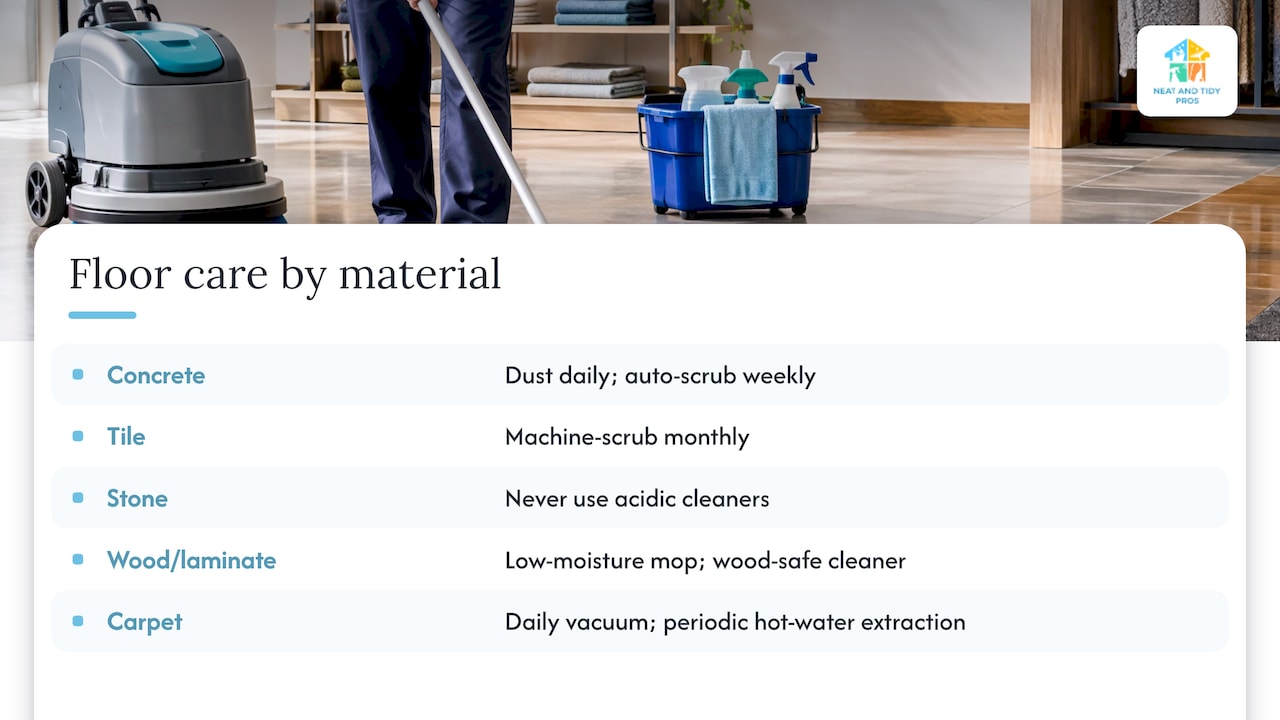
Concrete, tile, wood and carpet
Polished concrete is common in big-box and grocery stores. Retail best-practice guidance from a floor-equipment maker says to place mats at entrances, sweep sand and grit immediately, and mop spills at once, especially near frozen food or juice, where polished concrete can stain. The same guide recommends a microfiber mop for daily dusting and polishing with an automatic scrubber at least weekly.
Tile is routine: sweep and mop daily or weekly, scrub by machine monthly, and plan deep grout cleaning and sealing a few times a year. Natural stone should never see acidic cleaners, which etch the surface and can eat away grout. Hardwood and laminate need low-moisture flat mops and cleaners made for wood. Carpet in fitting rooms and seating areas needs daily vacuuming and periodic hot-water extraction to lift soil that vacuuming cannot reach. Our guide to cleaning commercial carpet covers that process in more detail.
When you do not know what the floor is, say after taking over a lease, start with a neutral pH cleaner and test it in an inconspicuous spot. The manufacturer’s care sheet outranks any general advice here, since the wrong product can void a warranty.
A daily routine that works
The goal of the daily routine is to remove soil before traffic grinds it in. A practical sequence for a retail floor:
- Entrances first. Place water-absorbent mats at every door. Federal workplace-safety guidance for retail recommends water-absorbent mats near entrances and cleaning floors as soon as they become wet. Shake or vacuum mats so they keep working.
- Dust mop or vacuum the whole sales floor. A microfiber dust mop captures fine grit without pushing it around. On high-traffic sales floors, a second pass in the afternoon keeps the floor presentable.
- Spot-clean spills immediately. Small spills need absorbent towels, larger ones need absorbent powder. Removing every trace of residue is what prevents the slippery film that causes falls.
- Mop in sections. Change mop water between areas. A two-bucket method, one for cleaning solution and one for clean rinse water, stops you from spreading dirty water. Insurance loss-control guidance on floor maintenance recommends replacing mop water for each area mopped and following the manufacturer’s dilution and water-temperature directions.
- Finish with the details. Empty trash, clean restrooms and wipe frequently touched surfaces.
If you want the whole-store version of this, with owners and sign-offs for each task, our retail store cleaning checklist turns it into five daily actions. For stores with display areas, the showroom cleaning checklist does the same.
Don’t forget what is outside. Parking lots and walkways are the source of most of the grit on your floor, and keeping them in good repair helps too. Commercial asphalt maintenance can reduce loose debris at your entrance, although every property’s situation differs.
Weekly and periodic floor care
Daily work holds the line. Weekly and periodic work restores the floor.
Weekly: machine-scrub hard floors with an auto-scrubber, with manual edge work along walls and under displays. This is also the time to clean less accessible areas, such as beneath movable fixtures and behind counters. A retail cleaning checklist from an equipment maker separates daily tasks from weekly ones and from periodic deep cleaning in the same way.
Monthly to quarterly: burnish VCT and sealed concrete to restore shine, treat carpet spots and scrub grout. Burnishing daily or weekly is typical in high-gloss stores, while a deep restorative clean, meaning strip and refinish, happens every few months to once a year depending on wear.
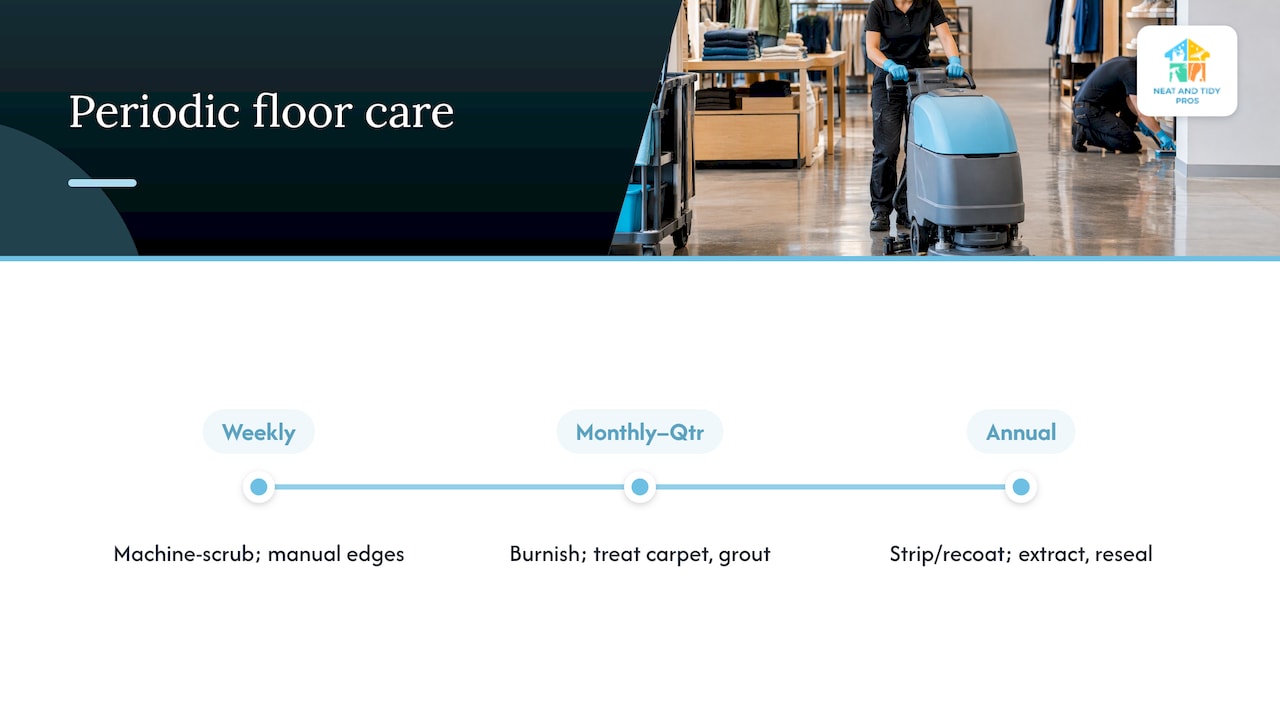
Annually or as needed: full strip and recoat, hot-water carpet extraction and resealing of stone or wood.
The pattern matters more than the exact numbers. Floors fail when the deep cycle is skipped and the finish wears through to the bare material, which is much more expensive to fix than a scheduled recoat.
Products and equipment: what suits a shop floor
Three rules cover most mistakes.
Use the gentlest product that works. The CDC’s facility guidance says to clean hard surfaces, floors included, with soap and water or products appropriate for the surface, to clean high-touch surfaces regularly, and that regular cleaning is enough in most situations. Disinfect only where it is needed, clean first, and follow the label’s contact time and protective equipment directions.
Measure the chemical. The most common error in floor care is improper dilution. Too much product leaves a sticky haze that holds dirt and lowers traction. Some floor-care guidance favors detergent-free solutions in auto-scrubbers where possible because they leave no chemical residue.
Choose tools that use less water. Manufacturers report that microfiber mops use far less liquid than cotton string mops, so floors dry faster. Dual-chamber buckets keep rinse water clean. Less water on the floor means a shorter wet period for customers and less risk to wood, laminate and vinyl seams.
Our overview of professional cleaning tools by job explains the equipment a crew brings to different spaces. For stores that prefer greener chemistry, we use safe, eco-friendly products.
Preventing slips while you clean
Cleaning creates its own hazard: a wet floor. The rules are simple, and skipping them is expensive.
- Sign before you mop. Wet floor signs should go up before mopping begins and stay until the surface is fully dry. Federal guidance puts it as warning signs in wet areas, removed promptly once the floor is clean and dry. Taking signs down early teaches customers to ignore them.
- Keep the floors in a safe condition. OSHA’s walking-working surfaces rule requires workplaces and passageways to be kept clean, orderly and sanitary, with wet surfaces handled safely (29 CFR 1910.22). California workplaces are also covered by Cal/OSHA’s Title 8 rules, so confirm the current requirements with Cal/OSHA for your own situation.
- Mind traction in high-risk areas. CDC/NIOSH retail guidance recommends flooring with a static coefficient of friction above 0.5 where slip risk is high, along with no-skid waxes and soaps that leave no slippery residue.
- Avoid the residue traps. Insurer guidance lists smearing spills instead of removing them, too little drying time, excessive dust-mop spray oil and the wrong mop or storage among the root causes of slippery retail floors. Damp mopping does not mean wet mopping: too much liquid keeps the floor wet longer and lowers traction.
- Equip the crew. Slip-resistant footwear for staff is a basic precaution, and employers should confirm the current standard they require.
If your store serves food, the cleaning calendar matters too. A foodservice cleaning calendar shows how to schedule and document recurring tasks, a habit that also helps retail floors.
For wider background on workplace housekeeping duties, see our guide to OSHA housekeeping rules for managers.
Cleaning during business hours and after closing
Most retailers do both, split by the type of work.
During open hours, keep the work light and fast: dust mopping, spill response, mat care and restroom checks. Use clear signage, clean in sections rather than blocking whole aisles, and schedule scrubbing passes during slower periods. Build the schedule around your own traffic peaks, which usually means mornings before the lunch rush and mid-afternoon on weekdays. In Orange County, tourist-heavy centers and weekend shopping districts follow different curves, so review your door counts or sales data.
After closing, do the heavy work: auto-scrubbing, burnishing, stripping, recoating and carpet extraction. These jobs use more water and chemicals, and finishes need time to cure before customers return. Never open onto a floor that is still wet or tacky.
Decide in advance who is responsible for what. Staff handle spills and small messes. The scheduled deep work belongs to a dedicated crew, because it takes equipment and time that sales staff do not have.
Doing it yourself, or hiring a crew
In-house floor care works for the daily layer. The weekly and periodic layers are where stores slip: the auto-scrubber is not charged, the strip-and-recoat date passes, nobody knows the dilution ratio. The cost shows up later as dull, worn or damaged flooring.
A recurring commercial service gives you a consistent cycle with trained people and the right equipment, and it frees your team to sell. When you compare providers, ask what floor types they handle, how they manage dilution and water use, and how they handle signage. It also helps to know our professional cleaning and health overview if cleanliness standards are part of your customer promise.
A store that has just been built or remodeled has a different problem: fine construction dust and residue on new floors. That is a construction cleaning job, and it should happen before fixtures and stock go in.
Our perspective
Most floor failures we see in stores are not caused by a bad product. They come from an inconsistent routine: the daily layer gets done, the weekly layer gets skipped, and the periodic layer gets forgotten until the finish is gone.
That is why we treat retail floors as a schedule, not a one-off clean. With 15 years of experience, our approach is a consistent, customizable plan for each space, carried out by fully equipped teams using safe, eco-friendly products.
A store that books recurring service gets the same standard every visit, and a floor that ages on purpose rather than by accident. That consistency is what we are designed to deliver, and it comes with our customer satisfaction guarantee.
Neat
Floor care for your Orange County or Corona store
We provide commercial cleaning for retail shops, offices, showrooms, display centers, medical facilities, hotels and restaurants across Orange County and Corona. Customers can book one-time or recurring appointments online or by phone, and each plan is customized to the space.

To set up floor care for your store, start with our commercial cleaning service, or see everything we offer on our services page.
FAQ
How often should a retail floor be cleaned?
Dust mop or vacuum daily, and twice on busy sales floors. Machine-scrub hard floors weekly, and burnish monthly or more often if you want a high shine. Plan a deep strip and recoat for VCT, or extraction for carpet, a few times a year to annually depending on wear.
What is the safest cleaner for a shop floor?
If you do not know the floor type, a neutral pH cleaner mixed exactly to the label is the safe default. Always follow the flooring manufacturer’s care instructions, since the wrong product can damage the floor or void its warranty. Avoid acidic products on natural stone and alkaline products on VCT.
Do I need wet floor signs every time I mop?
Yes. Place signs before mopping begins and leave them until the floor is fully dry. Removing them early leaves customers and staff exposed to a hazard they cannot see.
Can I clean the floor while the store is open?
Yes, for light work: dust mopping, spill response and spot mopping in sections with clear signage. Save scrubbing, burnishing, stripping and recoating for after closing, when floors can dry and cure undisturbed.
Sources
- General Floor Care Maintenance Guide
- How to Clean Different Types of Floor, Ferguson
- Choosing Chemicals Based On Varying Floor Types, CleanLink
- PRSM Cleaning Various Floors Best Practices Guide, Tennant
- Wholesale and Retail Trade Establishments, CDC/NIOSH
- Floor Cleaning and Maintenance, CNA
- 5 Retail Store Cleaning Best Practices, Nilfisk
- When and How to Clean and Disinfect a Facility, CDC
- OSHA walking-working surface checklist
- Waterproof vinyl and SPC flooring
- Commercial asphalt maintenance
- Foodservice cleaning calendar