Janitorial supplies are defined as the complete set of tools, chemicals, and consumables that enable effective cleaning and maintenance in commercial and institutional facilities. The role of janitorial supply in cleaning extends far beyond stocking a closet with mops and bleach. The right supplies, used correctly, determine whether a facility meets hygiene standards, controls costs, and protects the health of everyone inside. Products like all-purpose cleaners, EPA-registered disinfectants, microfiber mops, touchless dispensers, and odor control agents each serve a specific function that no other product can replace. Cleaning professionals and facility managers who treat supply selection as a strategic decision consistently outperform those who treat it as a purchasing afterthought.
What is the role of janitorial supply in cleaning operations?
Janitorial supplies fall into three distinct categories: tools, chemicals, and consumables. Each category performs a different job, and gaps in any one of them create measurable failures in cleaning outcomes.
Tools include mops, brooms, microfiber cloths, scrubbers, and dispensers. These items deliver the mechanical action that physically removes soil, biofilm, and debris from surfaces. Mechanical cleaning removes 90–99% of microbes from a surface before any chemical agent is applied. That number matters because it means tools, not chemicals, do the majority of the microbial removal work in routine cleaning.
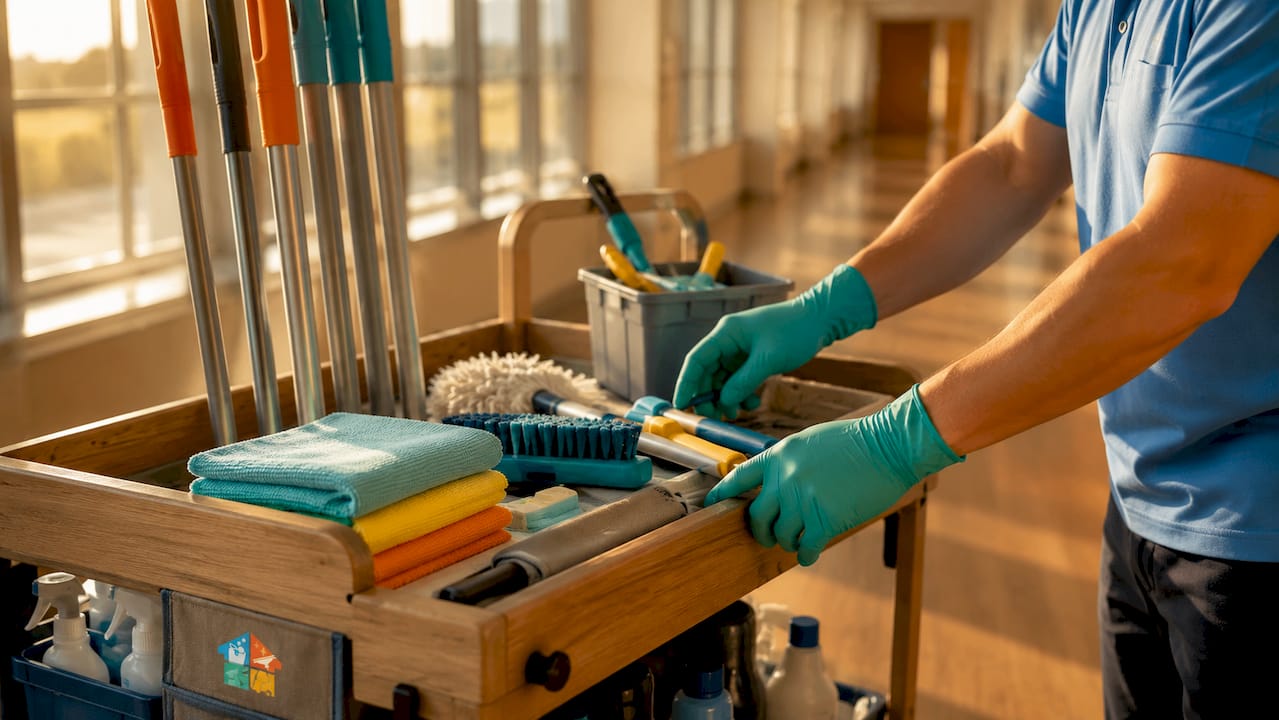
Cleaning chemicals include all-purpose cleaners, degreasers, disinfectants, and floor care products. Their job is to break down soil chemically and, when required, kill pathogens that mechanical action alone cannot eliminate. Disinfectants are not a substitute for cleaning. Organic soil reacts with disinfectant chemistry and limits its effectiveness, which is why cleaning must always precede disinfection.
Consumables include paper towels, trash liners, wipes, and restroom supplies. These items support hygiene between full cleaning cycles. Facilities that understock consumables create conditions where surfaces stay contaminated longer than necessary.
- Microfiber mops trap particles rather than pushing them across floors, reducing cross-contamination between zones
- Closed-loop dispensers deliver pre-measured chemical doses, eliminating guesswork at the point of use
- Odor control agents address volatile organic compounds at the source rather than masking them with fragrance
- Color-coded cleaning tools prevent cross-contamination between restrooms, kitchens, and general areas
Pro Tip: Assign a specific color to each zone in your facility and enforce it with labeled storage hooks. This single practice eliminates one of the most common sources of cross-contamination in commercial cleaning.
How does janitorial supply management cut costs and improve efficiency?
Supply management is where most facilities leave money on the table. Consolidating purchases with a single commercial vendor reduces total supply costs by 20–40%. Switching to concentrated chemical systems saves 50–75% per unit compared to ready-to-use products. One unit of bulk concentrate can yield up to 160 gallons of working solution. That math changes the entire economics of a cleaning program.
Inventory control prevents two equally damaging problems: overstock and stockout. Overstock ties up cash and creates storage hazards when incompatible chemicals sit near each other. Stockout forces staff to improvise, which introduces inconsistency and safety risk. A simple par-level system, where each product has a defined minimum quantity that triggers reordering, solves both problems without requiring expensive software.
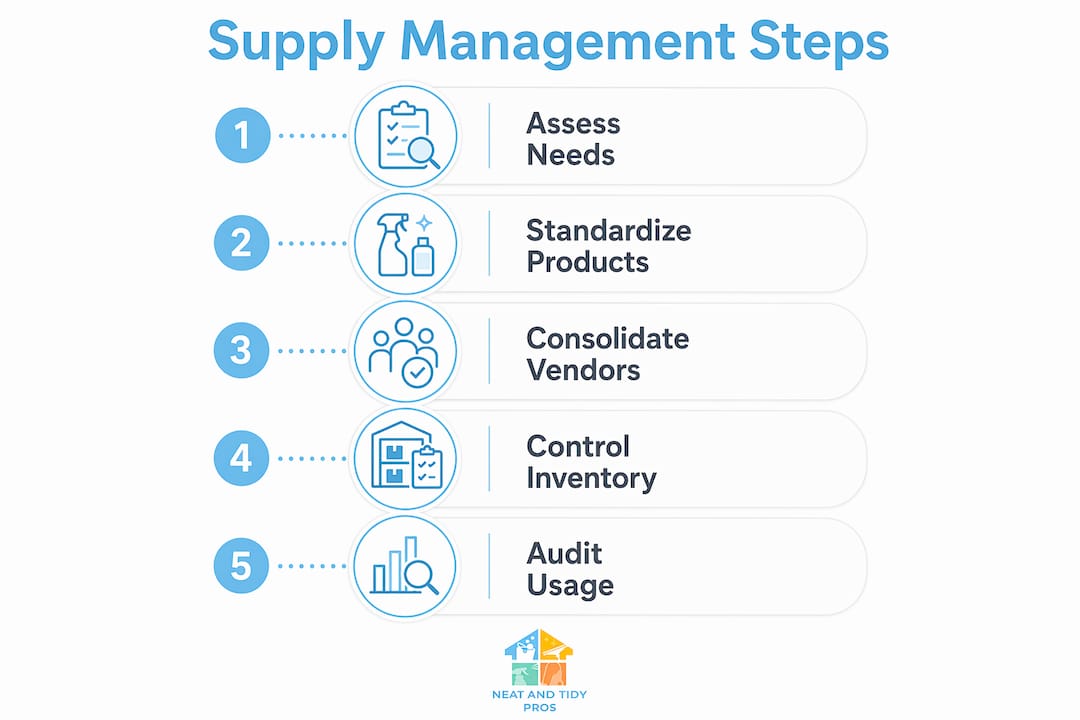
Standardizing which products are used across a facility also eliminates performance variability. Consistent product use enables standardized procedures that prevent chemical mixing risks and produce predictable results across every shift. When every crew member uses the same diluted all-purpose cleaner in the same dispenser, quality control becomes measurable.
| Supply strategy | Benefit | Impact level |
|---|---|---|
| Single-vendor consolidation | Reduces total supply costs by 20–40% | High |
| Concentrated chemical systems | Saves 50–75% per unit vs. ready-to-use | High |
| Par-level inventory control | Prevents stockout and overstock | Medium |
| Standardized product selection | Eliminates performance variability | High |
| Closed-loop dispensing | Reduces waste and improves dilution accuracy | Medium |
Pro Tip: Request a product usage audit from your vendor once per quarter. Most commercial janitorial suppliers will run this at no charge, and it consistently reveals 10–20% in avoidable waste.
Efficient supply management also connects directly to professional cleaning costs. Facilities that control their supply spend predictably are better positioned to evaluate outside cleaning contracts and negotiate from a position of knowledge.
What is the impact of supply quality and staff training on cleaning outcomes?
Product quality matters, but training determines whether that quality reaches the floor. The most common failure in janitorial operations is not a bad product choice. It is inadequate staff training on dilution ratios. A premium disinfectant used at the wrong concentration is either ineffective or wasteful, and often both.
Improper dilution is more common than most managers realize. Manual pouring produces unpredictable results and excess chemical waste. Closed-loop dilution systems solve this by delivering a fixed ratio every time, regardless of who is filling the bottle. Facilities that switch from manual pouring to closed-loop systems report immediate improvements in both chemical use and surface cleanliness.
Disinfectant contact time is the most misunderstood concept in commercial cleaning. Disinfectants require 3–10 minutes of wet contact time to achieve the kill claims on their labels. Most staff wipe surfaces within seconds of application. The surface gets cleaned, but not disinfected. Training staff to read and follow contact time instructions is the single highest-return training investment a facility manager can make.
High-quality supplies tailored to specific tasks also reduce labor time. A microfiber cloth rated for glass surfaces outperforms a general-purpose rag on windows and leaves no streaks, cutting rework. A pH-neutral floor cleaner designed for luxury vinyl tile prevents the surface dulling that requires costly restoration treatments.
- Train staff on dilution ratios before they touch any chemical product
- Post contact time requirements at every chemical storage station
- Use professional cleaning tools matched to specific surface types
- Conduct quarterly refreshers on Safety Data Sheet access and chemical labeling
Proper janitorial supplies and cleaning standards boost workplace productivity by up to 15% by reducing absenteeism and strengthening a facility’s professional reputation. That figure reflects the direct connection between clean environments and employee health outcomes.
How do eco-friendly janitorial supplies fit into modern cleaning programs?
Green cleaning supplies are products formulated to reduce environmental and human health impact without sacrificing cleaning performance. They include plant-based surfactants, concentrated formulas with minimal packaging, microfiber systems that replace single-use disposables, and certified products carrying labels from organizations like Green Seal or EPA Safer Choice.
The performance data on green cleaning protocols is strong. Implementing green cleaning protocols can reduce chemical consumption by 82.6%, textile waste by 92.4%, and global warming potential by 47.7%. One documented facility reduced its CO2e emissions by 908 kg per year while maintaining full microbiological safety. These are not marginal gains. They represent a fundamental shift in how a facility’s cleaning program affects the environment.
The concern that green products sacrifice disinfection power is largely outdated. EPA Safer Choice-certified disinfectants meet the same kill-claim standards as conventional products. The difference is in the residual chemical load left on surfaces and in the air, which affects indoor air quality and long-term occupant health.
| Factor | Conventional supplies | Eco-friendly supplies |
|---|---|---|
| Chemical consumption | Baseline | Reduced by up to 82.6% |
| Textile waste | Higher with disposables | Reduced by up to 92.4% |
| Carbon footprint | Higher per cleaning cycle | Lower with concentrates |
| Microbiological safety | Maintained | Maintained with certified products |
Facility managers looking to start a green transition can explore eco-friendly cleaning options as a practical starting point. Switching to concentrated formulas and microfiber systems typically delivers the fastest return with the least disruption to existing cleaning procedures.
What best practices ensure safety and compliance in janitorial supply use?
Safety in janitorial supply programs starts with proper labeling and storage. Every chemical container must carry its original label or a clearly printed secondary label. Incompatible products, such as bleach-based cleaners and ammonia-based products, must be stored in separate cabinets. Mixing them produces toxic chloramine gas, a risk that proper storage eliminates entirely.
Safety Data Sheets (SDS) must be accessible to every staff member who handles chemicals. ISSA guidelines and regulatory requirements under OSHA’s Hazard Communication Standard require SDS access at the point of use, not locked in a manager’s office. Digital SDS management systems make compliance straightforward for multi-site operations.
The “disinfection trap” is a real operational risk. Overdisinfecting all surfaces offers minimal health benefits and increases risks from chemical exposures. Routine cleaning with surfactants and mechanical action removes most microbes. Disinfectants should be reserved for high-risk areas: restrooms, food preparation surfaces, and areas used by immunocompromised individuals. Applying hospital-grade disinfectants to low-risk surfaces like lobby floors wastes product and increases VOC exposure for building occupants.
- Separate chemical storage by product type and compatibility
- Post SDS documents at every chemical storage and mixing station
- Limit disinfectant use to high-risk zones and follow label contact times
- Use dispensing equipment to maintain correct dilution and reduce VOC exposure
- Audit chemical inventory quarterly to remove expired or discontinued products
Antimicrobial surface sprays often show no significant reduction in bacteria compared to controls in real-world conditions. Biofilm and fingerprint oils form physical barriers that protect bacteria from chemical agents. This finding reinforces why mechanical cleaning must precede any chemical application, and why novel antimicrobial products should not replace proven cleaning protocols.
Key takeaways
The role of janitorial supply in cleaning is defined by three factors: product selection matched to the task, correct usage through trained staff, and supply management that controls cost and consistency.
| Point | Details |
|---|---|
| Mechanical action comes first | Tools remove 90–99% of microbes before any chemical is applied. |
| Consolidation cuts costs sharply | Single-vendor purchasing reduces supply costs by 20–40% across facilities. |
| Training drives chemical effectiveness | Improper dilution and missed contact times are the leading causes of cleaning failure. |
| Green protocols deliver real results | Eco-friendly programs reduce chemical consumption by up to 82.6% without sacrificing safety. |
| Disinfection has limits | Reserve disinfectants for high-risk zones; routine cleaning handles most microbial removal. |
What I’ve learned from watching supply programs succeed and fail
Facility managers consistently underestimate the dispenser. They spend hours evaluating which disinfectant to buy and then install a cheap wall-mounted dispenser that delivers inconsistent doses. The product never performs to spec because the delivery system is broken. I have seen this pattern in office buildings, medical offices, and food service facilities. The dispenser is not a commodity. It is the quality control mechanism for every chemical in your program.
The second thing most programs get wrong is treating training as a one-time event. Staff turnover in commercial cleaning is high. A training session from six months ago did not reach the three people who started last month. The facilities that maintain consistent cleaning quality are the ones that build training into onboarding and run brief refreshers every quarter. They post contact time charts at every station. They label every dilution station with the correct ratio in large print.
Sustainability goals and cleaning performance are not in conflict. The facilities I have seen make the most progress on both fronts are the ones that switched to concentrated formulas and microfiber systems at the same time. They cut chemical spend, reduced waste, and improved surface cleanliness in the same quarter. The trade-off between green and effective is largely a myth built on outdated product assumptions.
— Neat
Neatandtidypros brings professional supply expertise to every clean
Choosing the right supplies is only half the equation. Knowing how to use them correctly, at the right dilution, with the right tools, in the right sequence, is what separates a clean facility from a truly hygienic one.
Neatandtidypros delivers commercial cleaning services built on exactly this foundation. Every service, from basic office cleaning to post-construction cleanup and Airbnb turnovers, uses high-quality, task-matched supplies applied by trained professionals. The team follows proven protocols for chemical use, contact times, and surface-specific tools. Facility managers who want consistent, documented results without managing a supply program themselves can review the full range of cleaning service options and connect with the Neatandtidypros team directly.
FAQ
What are janitorial supplies?
Janitorial supplies are the tools, cleaning chemicals, and consumables used to clean and maintain commercial and institutional facilities. They include mops, disinfectants, microfiber cloths, paper products, and dispensing equipment.
Why does cleaning always come before disinfection?
Organic soil chemically reacts with disinfectants and blocks their effectiveness. Mechanical cleaning first removes 90–99% of microbes, allowing disinfectants to work on the remaining pathogens in high-risk areas.
How do concentrated cleaning chemicals save money?
Concentrated formulas reduce per-unit costs by 50–75% compared to ready-to-use products. A single unit of bulk concentrate can produce up to 160 gallons of working solution, dramatically lowering both purchase and storage costs.
What is the disinfection contact time problem?
Disinfectants require 3–10 minutes of wet contact time to achieve their labeled kill claims. Most staff wipe surfaces within seconds, which cleans the surface but does not disinfect it. Training on contact time is the highest-return investment in any cleaning program.
Are eco-friendly cleaning products as effective as conventional ones?
Yes, when products carry certifications from Green Seal or EPA Safer Choice. Documented green cleaning protocols reduce chemical consumption by 82.6% and global warming potential by 47.7% while maintaining full microbiological safety.