A well-run commercial lobby cleaning routine covers every critical surface, from entrance mats to reception desk, in a single well-managed shift — no rework, no missed touchpoints. Hand this checklist to your opening-shift cleaner and run it every business day before the first visitor walks through the door.
Daily Lobby Cleaning Checklist (print and post):
- Shake or vacuum entrance mats; reposition them squarely
- Sweep or dry-mop the full floor area
- Mop hard floors with a pH-balanced cleaner
- Dust furniture, ledges, and signage with a microfiber cloth
- Spot-clean upholstery and seating
- Wipe glass doors and kick plates
- Disinfect all high-touch surfaces (door handles, elevator buttons, reception desk, light switches, phones)
- Empty trash cans and replace liners; sort recycling
- Restock reception supplies (hand sanitizer, pens, brochures, tissues)
- Conduct a final walk-through quality check and sign the log
Who runs it and when: Assign this routine to your opening-shift cleaner or a dedicated lobby attendant. Run the full pass before business hours open, then schedule spot-cleaning checks at midday and again before close.
Table of Contents
- What are the daily steps for commercial lobby cleaning?
- How long does a daily lobby cleaning pass actually take?
- What supplies do you need for daily lobby cleaning?
- How do you verify and document a completed daily pass?
- What mistakes do lobby cleaners make most often?
- Key Takeaways
- Why daily consistency matters more than occasional deep cleans
- Neatandtidypros can run this routine for your building
- Useful sources
What are the daily steps for commercial lobby cleaning?
The sequence below is the operational order that prevents rework. Follow it top-to-bottom every shift.
1. Arrival and setup
Collect your cart: vacuum, flat mop, mop bucket, microfiber cloths, spray bottles, glass cleaner, disinfectant, wet-floor signs, fresh liners, gloves, and apron. Check that your disinfectant is the correct dilution before you start. Place wet-floor signs at the entrance before any mopping begins.
2. Entrance mats
Shake or vacuum entrance mats outside (or use a mat shaker). Check for curled edges that create a trip hazard. Reposition mats flat and centered. Regular mat maintenance is one of the highest-leverage steps in the whole routine because mats trap the dirt that would otherwise spread across the entire floor.
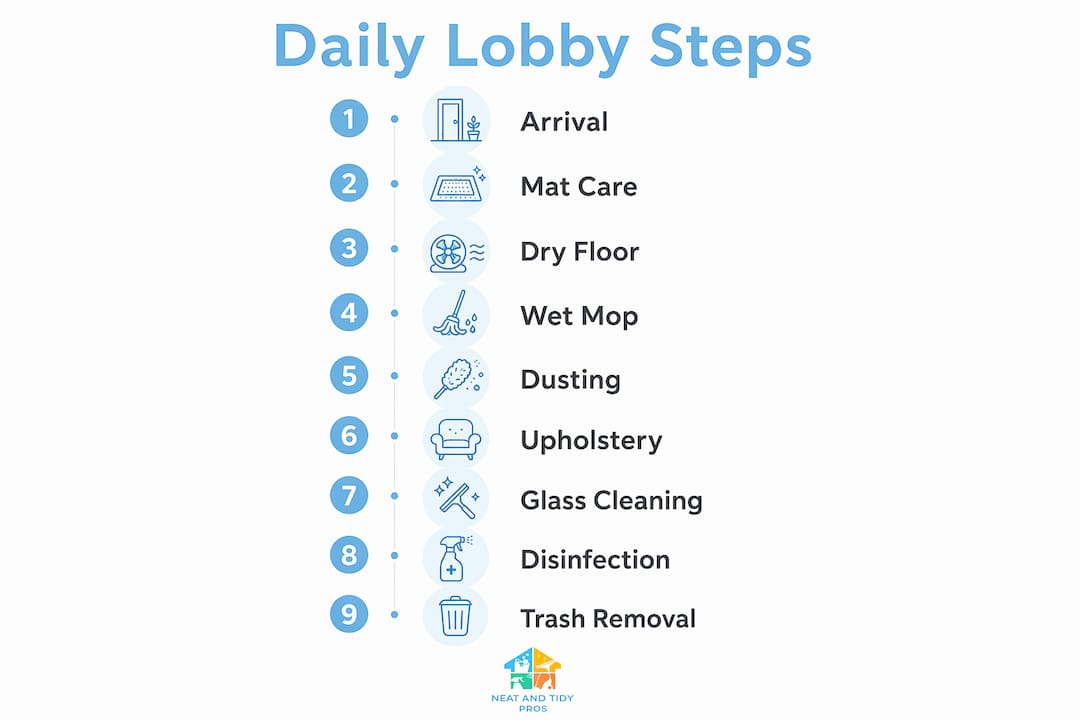
3. Dry floor care
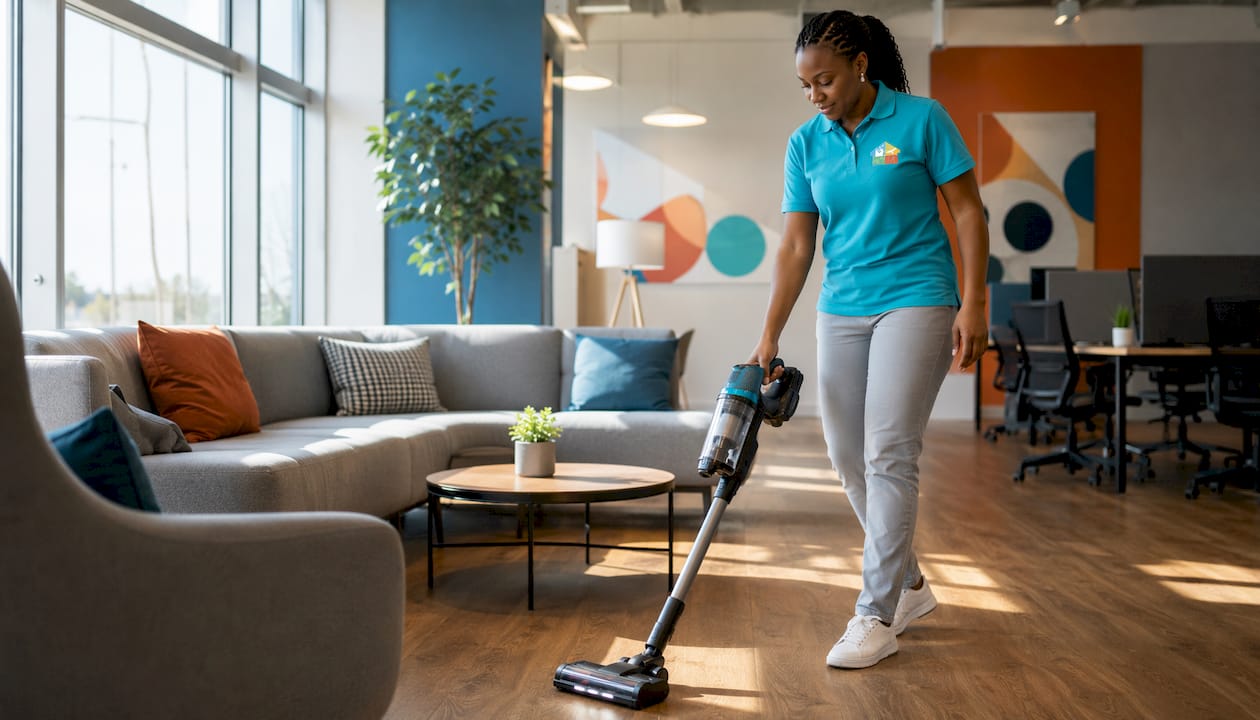
Sweep or dry-mop the full lobby floor, working from the far corners toward the entrance. Vacuum carpet edges and any area rugs. Pick up visible debris, gum wrappers, and crumbs before any wet work touches the floor.
4. Wet mopping
Fill the bucket with a pH-balanced floor cleaner at the manufacturer’s recommended dilution. Mop in overlapping figure-eight strokes, starting at the far wall and backing toward the exit. Keep wet-floor signs visible throughout. Let the floor dry completely before removing signs.
5. Dusting and ledges
Use a dry microfiber cloth on furniture surfaces, windowsills, signage frames, baseboards, and any decorative elements. Work top-to-bottom so dust falls to the floor you have already swept, then do a quick final sweep of the area.
6. Upholstery and seating
Inspect each chair and sofa cushion. Blot fresh stains with a clean damp cloth; never scrub, which spreads the stain. For leather seating, wipe with a barely damp cloth and apply a leather conditioner weekly. Upholstery and leather require material-specific care — using an all-purpose spray on leather can crack the finish within weeks.
7. Glass doors and kick plates
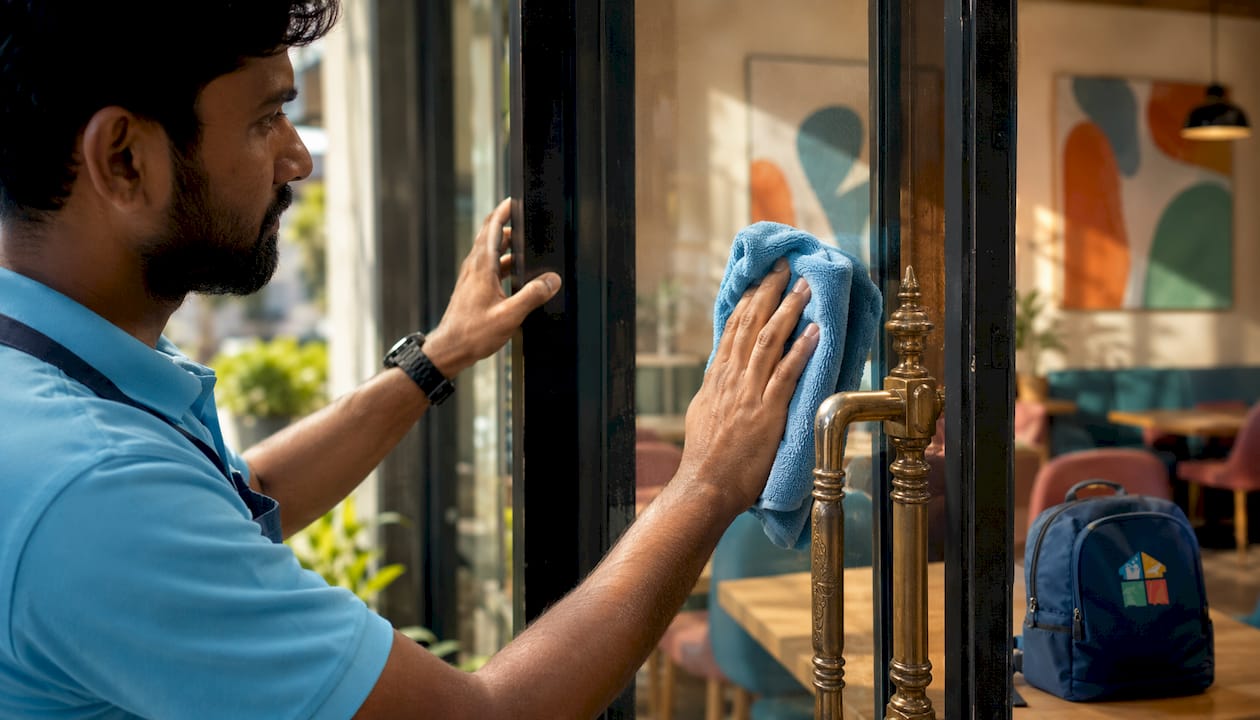
Spray glass cleaner on a microfiber cloth (not directly on the glass) and wipe in a single direction to avoid streaks. For interior door surfaces, a damp microfiber cloth followed by a dry buff works on most finishes — check surface-safe cleaner options when you are unsure about a painted or stained door. Wipe kick plates with an all-purpose cleaner and dry immediately.
8. High-touch surface disinfection
This step cannot be rushed. Apply an EPA-registered disinfectant to door handles, elevator call buttons, reception desk surface, light switches, phones, and any shared pens or styluses. The CDC recommends allowing the disinfectant to remain wet on the surface for the full contact time listed on the product label — typically 30 seconds to 4 minutes depending on the product. Wiping immediately defeats the purpose.
Pro Tip: While the disinfectant dwells on high-touch surfaces, use that wait time to empty trash cans. You recover two to three minutes per shift without skipping any step.
9. Trash and recycling
Lift liners by the top, tie them, and carry them to the designated waste area. Wipe the inside of each can with a damp cloth before inserting a fresh liner. Separate recycling into the correct stream. Strategic bin placement and regular cleaning of the cans themselves prevents odor buildup that visitors notice before they notice anything else.
10. Reception area restock
Refill hand sanitizer dispensers, replace any empty pen cups, straighten brochures, and wipe the reception counter one final time. Check that the visitor sign-in sheet or tablet is accessible and clean.
11. Final quality walk-through
Stand at the entrance and look at the lobby the way a visitor would. Check for streaks on glass, missed debris near seating, and any wet-floor signs still out. Sign and date the completion log.
Safety note: Wear nitrile gloves throughout and add eye protection when mixing or pouring chemical concentrates. Never mix bleach-based products with ammonia-based cleaners. Store all chemicals in labeled containers with Safety Data Sheets (SDS) accessible to every staff member.
How long does a daily lobby cleaning pass actually take?
A standard daily pass runs a practical duration per shift for a typical commercial lobby. That estimate holds for a single cleaner in a moderately sized lobby with moderate foot traffic. Larger lobbies or those with multiple seating zones will require more time, approaching an hour.
The sequence in the previous section is not arbitrary. Dry work before wet work prevents you from mopping dirt you missed with the broom. Dusting before the final floor check means any dust that falls gets caught in the walk-through sweep. Skipping that order is the most common reason a cleaner finishes and the lobby still looks half-done.
Scheduling guidance:
- Run the full pass before the building opens (typically 7:00–8:00 AM)
- A full clean before the morning rush, followed by continuous spot-cleaning during peak hours, keeps lobbies presentable without a second full shutdown
- Schedule a midday spot-check (10–15 minutes) for high-traffic buildings
- Run a brief end-of-day reset (5–10 minutes) to address afternoon accumulation
| Task | Estimated Time | Notes |
|---|---|---|
| Mat care and setup | 3–5 minutes | Includes wet-floor sign placement |
| Dry floor care | 5–7 minutes | Sweep + vacuum edges |
| Wet mopping | 6–8 minutes | Includes drying time buffer |
| Dusting and upholstery | 5–7 minutes | Top-to-bottom order |
| Glass and doors | 3–5 minutes | Both sides of entry glass |
| High-touch disinfection | 3–6 minutes | Full dwell time required |
| Trash and recycling | 3–5 minutes | Includes liner replacement |
| Restock and final check | 2–4 minutes | Sign log before leaving |
Staffing: One trained cleaner handles a standard lobby comfortably within the 45-minute window. For lobbies over 2,000 square feet or buildings with multiple entry points, a two-person team cuts the time roughly in half and allows one person to maintain dry tasks while the other handles wet work.
Pro Tip: Assign ownership for each checklist item by name, not just by role. When a specific person is responsible for restocking sanitizer, it gets done. When “whoever has time” is responsible, it gets skipped.
What supplies do you need for daily lobby cleaning?
Having the right equipment staged and ready before the shift starts is what separates a 30–45 minute pass from a 60-minute scramble.
Equipment:
- Commercial upright or canister vacuum with edge attachment
- Flat mop with washable microfiber pad (avoids cross-contamination from string mops)
- Mop bucket with wringer
- Microfiber cloths (color-coded: one color for glass, one for surfaces, one for restrooms)
- Trigger spray bottles (labeled by product)
- Squeegee for large glass panels
- Hand-held spot cleaner for upholstery
- Mat shaker or handheld vacuum for entrance mats
- Wet-floor signs (minimum two per lobby)
For a deeper look at commercial-grade tool selection, including which vacuum types hold up to daily lobby traffic, Neatandtidypros has a full breakdown by job type.
Consumables:
- All-purpose cleaner (neutral pH for general surfaces)
- pH-balanced floor cleaner (matched to your floor type: tile, LVT, hardwood, or polished concrete)
- EPA-registered disinfectant with published dwell time
- Glass cleaner (streak-free formula)
- Trash liners (correct size for each can)
- Hand sanitizer refills
- Nitrile gloves (one pair per task category minimum)
- Disposable apron or washable uniform
Pro Tip: Choose dilution-controlled or ready-to-use (RTU) disinfectants for lobby work. Concentrated products save money in high-volume facilities, but incorrect dilution is the leading cause of both surface damage and ineffective disinfection. If your team mixes concentrates, post the dilution ratio on the bottle itself.
PPE and chemical safety: Nitrile gloves are the minimum for disinfecting tasks. Add splash-rated eye protection when pouring concentrates. Keep SDS sheets in a binder on the cleaning cart, not locked in a back office. OSHA 29 CFR 1910.1200 (the Hazard Communication Standard) requires workers to have access to SDS for every chemical they handle.
How do you verify and document a completed daily pass?
A completed checklist that no one reviews is just paper. A quick end-of-shift QA audit takes under five minutes and catches the issues that compound into complaints.
End-of-shift QA checklist:
- Entrance: mats flat, no debris, glass streak-free
- Floors: dry, no visible dirt or scuff marks
- Seating: no stains, cushions straight
- Trash: liners replaced, cans wiped
- Reception: sanitizer full, counter clean, supplies stocked
- High-touch surfaces: disinfected and logged
A lobby inspection should also cover vents, lighting, and furniture condition — items that are easy to overlook during the cleaning pass itself but visible to visitors.
Photo logs and timestamped notes are the most reliable documentation method. A photo of a completed reception desk or a freshly mopped floor takes three seconds and creates an undeniable record for client SLAs or internal audits.
| QA Item | Pass Criteria | Action if Fail |
|---|---|---|
| Entrance mats | Flat, centered, debris-free | Re-vacuum; reposition |
| Hard floors | Dry, no visible soil | Spot-mop; re-sign wet area |
| Seating | No stains, aligned | Spot-treat; flag for deep clean |
| Glass/doors | No streaks or smudges | Re-wipe with dry microfiber |
| Trash cans | Fresh liner, no odor | Replace liner; wipe interior |
| Restock items | Sanitizer, pens, brochures full | Restock from supply room |
Escalation: If you find a damaged fixture, persistent HVAC odor, or furniture that needs repair, file a maintenance request the same day with a photo attached. Well-documented SOPs that include escalation steps reduce the time between discovery and resolution significantly. Manager spot audits should happen at least once per week; for high-traffic lobbies, twice weekly catches patterns before they become complaints.
Pro Tip: Digital photo logs beat paper in one specific way: they are searchable. When a client asks “when was the last time the reception desk was disinfected?” you can answer in 30 seconds instead of flipping through a binder.
What mistakes do lobby cleaners make most often?
Most lobby cleaning failures are not about effort. They are about sequence, product choice, or skipped steps that seem minor until a visitor slips or a client complains.
Common mistakes and quick fixes:
- Mopping during peak hours — creates slip hazards and forces visitors to detour. Schedule wet mopping before opening or after close; use a dry microfiber pad for midday spot-cleaning instead.
- Skipping mat maintenance — a dirty entrance mat defeats every other step. Mats that are not shaken or vacuumed daily redistribute grit across the floor you just mopped.
- Over-wetting hard floors — excess water seeps into grout lines and under LVT edges, causing long-term damage. Wring the mop until it is barely damp.
- Using the wrong cleaner for the floor type — an alkaline cleaner on polished concrete strips the finish; an acidic cleaner on natural stone etches the surface. Match the product to the floor spec.
- Wiping disinfectant off immediately — the product cannot work without its full contact time. This is the most common reason high-touch surfaces remain contaminated despite appearing clean.
- Missing high-touch spots — elevator call buttons, door push bars, and shared pens are touched dozens of times per hour and are frequently skipped. Use a checklist with named items, not a general “disinfect surfaces” instruction.
Quick fixes for common problems:
- Scuff marks on hard floors: apply a small amount of all-purpose cleaner to a damp microfiber cloth and rub in a circular motion; buff dry.
- Gum on hard floors: harden with an ice pack for 60 seconds, then scrape with a plastic scraper; clean residue with a citrus-based remover.
- Sticky spills: blot first, never scrub; apply neutral cleaner, let it dwell 30 seconds, then wipe outward from the center.
- Lingering odors: check trash can interiors, HVAC vents, and upholstery. HVAC filter maintenance and subtle air management resolve most persistent odor complaints that surface cleaning alone cannot fix.
Biohazardous or suspicious waste: Do not handle it with standard cleaning supplies. Isolate the area, notify your supervisor immediately, and follow your facility’s biohazard response policy. Never place unknown substances in regular trash.
Ergonomic reminders: Adjust mop and vacuum handles to hip height to avoid back strain. Alternate between pushing and pulling motions. For heavy entrance mats, use a two-person lift — a mat saturated with water can exceed 40 pounds.
Key Takeaways
A daily lobby cleaning routine done in the right sequence, with the right products and documented properly, keeps a commercial space presentable and reduces the need for costly deep cleans.
| Point | Details |
|---|---|
| Sequence prevents rework | Always dry-clean before wet-mopping; dust top-to-bottom before the final floor check. |
| Typical shift duration | A single trained cleaner covers a standard lobby in one shift when supplies are staged in advance. |
| Dwell time is non-negotiable | Disinfectants must stay wet on surfaces for the full contact time listed on the label to be effective. |
| Document every pass | Photo logs and signed checklists create accountability and support client SLAs or audits. |
| Neatandtidypros handles it for you | Neatandtidypros provides daily commercial cleaning with trained staff, QA sign-off, and supply management. |
Why daily consistency matters more than occasional deep cleans
The conventional wisdom in facility management is that a quarterly deep clean fixes everything. It does not. What a deep clean actually does is recover ground that daily passes should have held. By the time a lobby needs a deep clean for visible soil, the damage to visitor perception has already happened — and so has the wear on floor finishes, upholstery, and door hardware that daily care would have slowed.
The real cost of skipping daily passes is not the cleaning bill. It is the compounding effect: grit ground into floor finishes, stains that set into upholstery fibers, and the slow deterioration of surfaces that were designed to last decades. A consistent daily routine, even an imperfect one, outperforms an intensive monthly effort every time.
There is also a staff accountability angle that most guides skip. When cleaning tasks are documented with ownership assigned to specific people, missed items drop sharply. The SOP research from GoAudits is clear: documented procedures with named responsibilities reduce variability more than any single product upgrade or equipment investment. A checklist with a signature line is worth more than a premium disinfectant used inconsistently.
Neatandtidypros can run this routine for your building
Knowing the right steps and having a trained team execute them every morning are two different things. Neatandtidypros provides commercial cleaning services that map directly to the daily lobby routine described here: trained staff who follow documented SOPs, QA sign-off after every shift, and supply management so your team is never caught without a liner or a disinfectant refill.
If your current routine has gaps — missed high-touch spots, inconsistent documentation, or a floor that looks worse every week despite daily mopping — Neatandtidypros can audit your existing process and build a site-specific SOP your staff can train against in a single session. The full range of commercial services includes recurring daily programs, deep-clean escalations, and post-construction cleanup for lobbies coming out of renovation. Contact Neatandtidypros to schedule a lobby audit and get a written routine your team can start using the next business day.
Useful sources
The following resources were used in building this guide and are worth bookmarking for templates, SOP frameworks, and inspection checklists.
- POPProbe Lobby Maintenance Checklist — Free digital checklist covering 30 items across seven sections including floor care, surfaces, glass, and safety. Useful for daily sign-off and manager audits.
- POPProbe Lobby & Reception Checklist — ISSA-aligned monthly inspection checklist with 35 items across seven sections; covers PPE, chemical documentation, and QA sign-off for compliance and client SLAs.
- SafetyCulture Lobby Inspection Checklist — Digital inspection tool covering doors, mats, carpets, furniture, trash, vents, and lighting; supports photo documentation and timestamped records.
- GoAudits Cleaning SOP Guide — Practical framework for writing and implementing cleaning SOPs, including task frequency, product specifications, and staff training guidance.
- CDC Facility Cleaning and Disinfection Guidance — Primary reference for disinfectant contact times, surface-type guidance, and PPE requirements for commercial facilities.
- ChecklistGuro Lobby Appearance Checklist — Covers floor care, upholstery, HVAC odor management, and bin placement with practical daily and weekly task breakdowns.
| Resource | Best Used For |
|---|---|
| POPProbe Lobby Checklist | Daily sign-off and 30-item digital tracking |
| SafetyCulture Inspection | Manager QA audits with photo documentation |
| GoAudits SOP Guide | Writing and training staff on cleaning SOPs |
| CDC Disinfection Guidance | Verifying contact times and PPE requirements |
| ChecklistGuro Lobby Guide | Floor care and upholstery material-specific advice |