Vacuuming is a core, evidence-backed component of any thorough deep clean — but it has clear mechanical limits that determine when it’s sufficient and when other methods are required. For dry, abrasive soils like sand, grit, pet hair, and loose dust, a well-executed vacuuming session is genuinely restorative. For bonded oils, set-in stains, biological contamination, or moisture damage, you need wet extraction or professional treatment. Regular deep vacuuming on carpets and hard floors handles the vast majority of surface and near-surface soils; hot-water extraction or professional deep cleaning becomes necessary when odors persist, fibers mat, or visible staining won’t lift.
Table of Contents
- What does vacuuming actually remove from your floors?
- How vacuuming fits into the deep-clean process
- What vacuuming can’t do — and the signs you need more
- Which vacuum features actually improve deep-clean results?
- How to vacuum for a deeper, more restorative clean
- When should you hire a professional deep cleaner?
- What does the research say about vacuuming, air quality, and flooring life?
- Key Takeaways
- The part most homeowners get wrong about vacuuming
- Neatandtidypros handles what your vacuum leaves behind
- Sources and further reading
What does vacuuming actually remove from your floors?
Vacuuming targets dry and mechanically dislodged soils — the category that makes up most of what accumulates in a typical home. On the surface, that means crumbs, loose pet hair, visible dust, dry granular grit like sand and mineral particles tracked in from outside, and loose lint. These are the soils a vacuum handles best.
One level deeper, a motorized brush roll can agitate compacted grit out of carpet pile, loosen dander and dust-mite fragments from fiber bases, and pull fine particulate matter that has settled into upholstery creases. Pet hair embedded in sofa seams, sand tracked into entryways, and crumbs under furniture are all recoverable with the right attachments and technique.
What vacuuming cannot reliably remove:
- Oily residues and grease that have bonded to fibers or hard surfaces
- Set-in stains from spills that have dried and penetrated the carpet backing
- Sticky residues from adhesives or food
- Biological contamination (pet urine, mold spores embedded in padding) that requires moisture-based treatment
- Deep pad-level deposits that sit below the reach of suction and agitation
Regular vacuuming removes abrasive grit — sand and mineral particles that otherwise act like sandpaper on carpet fibers and hard flooring. That distinction matters for flooring longevity, not just cleanliness.
How vacuuming fits into the deep-clean process
Vacuuming belongs early in a deep-clean sequence, and sometimes again at the end after wet work dries. The reason is mechanical: loose soils left on a surface before wet treatment turn into muddy residue that spreads rather than lifts. Vacuum before any wet or steam cleaning to prevent exactly that.
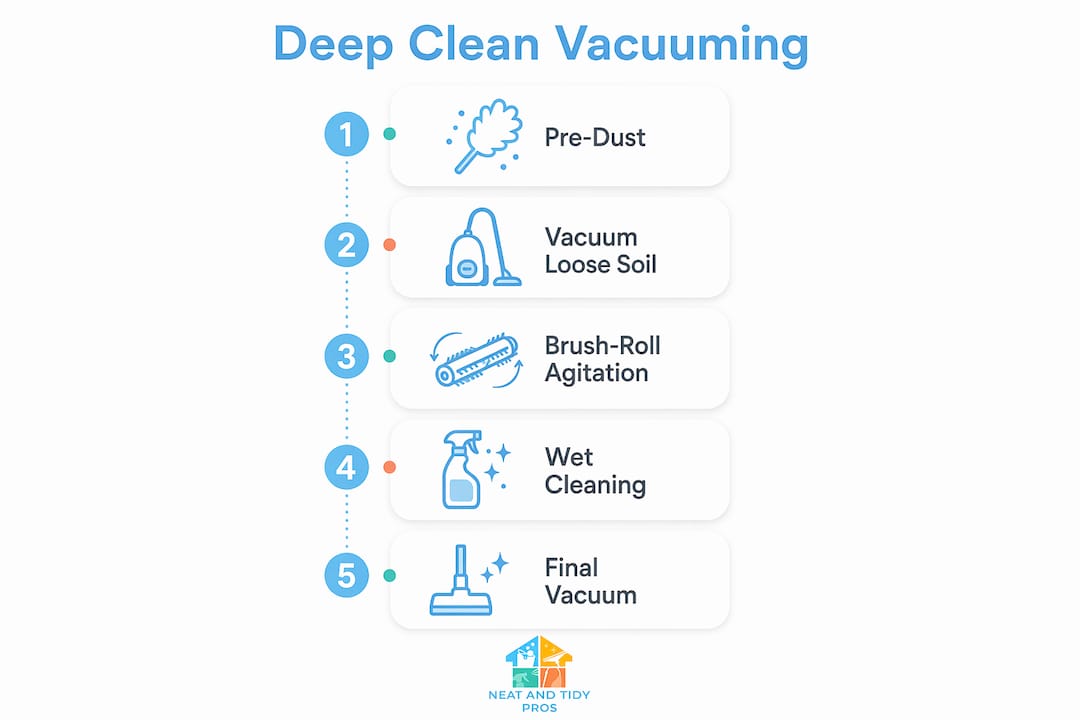
The mechanical process works through three actions working together. Brush-roll agitation breaks the bond between compacted particulates and carpet fibers. Suction lifts those dislodged particles into the collection system. Sealed filtration prevents fine particles from being exhausted back into the room air. When all three work properly, you get genuine extraction, not just surface tidying.
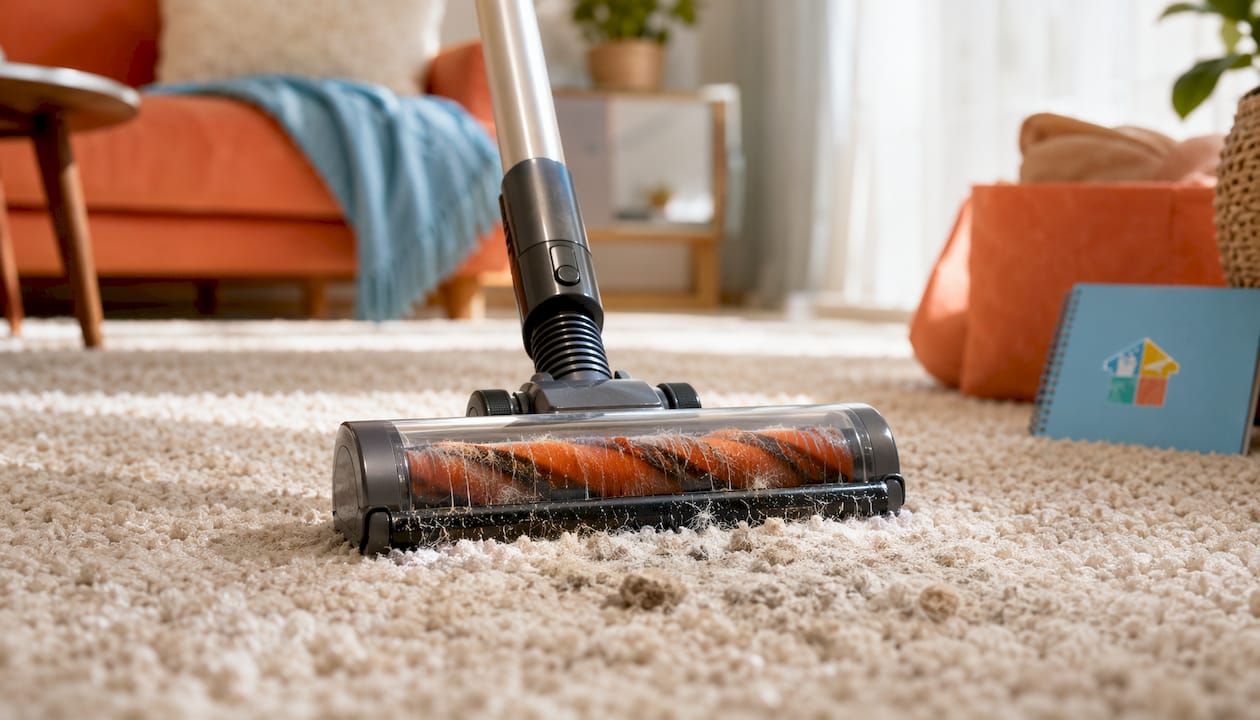
Sequencing follows a top-to-bottom logic. Professional cleaners dust and clean high surfaces first — ceiling fans, shelving, baseboards — so that any dislodged dust falls to the floor before vacuuming begins. Vacuuming floors last avoids re-cleaning surfaces you’ve already finished.
Pro Tip: Slow your forward pass speed by roughly 50% compared to a routine maintenance pass. That dwell time is what allows brush-roll agitation and suction to work on compacted debris rather than just skimming the surface.
What vacuuming can’t do — and the signs you need more
Vacuums remove dry and mechanically dislodged soils. They don’t remove bonded oils, set-in stains, moisture problems, or mold. That’s the short version.
Signs that vacuuming alone isn’t enough and professional or wet methods are required:
- Lingering odors after vacuuming. Pet urine, smoke, and biological odors embed at a molecular level in carpet fibers and padding. Suction doesn’t reach them.
- Matted fibers that don’t recover. When pile stays flat after vacuuming, the fiber structure is compacted beyond what dry agitation can restore.
- Visible persistent staining. Any stain that remains after a thorough vacuuming session is bonded to the fiber and needs wet treatment.
- Pet urine or biological contamination. These require moisture-based extraction and often enzymatic treatment to neutralize odor at the source.
- Recent flooding or moisture intrusion. Vacuuming a wet or damp carpet without proper extraction equipment spreads contamination and risks mold growth.
- Heavy grease or adhesive residues. These require solvent-based or hot-water extraction methods.
When you encounter any of these, vacuum first to remove loose soils, then call a professional. Wetting a heavily soiled carpet without vacuuming first makes the problem worse, not better.
Which vacuum features actually improve deep-clean results?
The highest-impact features for deep-clean outcomes are a motorized brush roll with adjustable height, sealed HEPA filtration, strong sustained airflow, a sealed system (bagged or sealed canister), and a reliable brush-roll design that limits hair wrap. These aren’t marketing specs — each one directly affects how much embedded soil a vacuum can recover.
Here’s what each feature does in practice:
- Motorized brush roll with adjustable height. Agitates carpet fibers from the base, dislodging compacted grit that suction alone can’t reach. Height adjustment prevents the roll from riding over pile instead of engaging it.
- HEPA filtration. HEPA-grade filters capture particles down to 0.3 microns, including fine dust, pollen, and dander. Without sealed HEPA, a vacuum can exhaust fine particles back into the room, worsening indoor air quality.
- Sealed system. The American Lung Association notes that all air must pass through the filter before being exhausted — a sealed system enforces this. Bagged uprights tend to perform better here than bagless designs, which often release dust clouds when emptied.
- Strong sustained airflow (suction + CFM). Suction rating alone is misleading; airflow volume (cubic feet per minute) determines how much debris actually reaches the collection bin.
- Adjustable suction settings. Hardwood and tile need lower suction to avoid lifting area rugs or damaging grout; carpet needs maximum power.
| Feature | What it improves |
|---|---|
| Motorized brush roll | Embedded grit removal from carpet pile |
| Sealed HEPA filtration | Indoor air quality; prevents fine-particle re-release |
| Sealed system (bagged) | Allergen containment; prevents exhaust leakage |
| Strong sustained airflow | Extraction depth; debris transport to collection bin |
| Adjustable height/suction | Surface suitability; prevents damage on hard floors |
Vacuum types and their deep-clean limits. Upright vacuums with motorized brush rolls are the standard for restorative carpet cleaning. Canister vacuums offer better reach for stairs, upholstery, and hard-to-access areas. Cordless vacuums from brands like Dreametech have improved significantly in suction, but battery-limited runtime can cut a deep session short. Robot vacuums from brands like Ecovacs are excellent for daily maintenance passes, but robot vacuums generally cannot reproduce the airflow and brush-roll dwell time required for restorative extraction on dense carpet pile. For a genuine deep clean, an upright or canister with a motorized head is still the right tool.
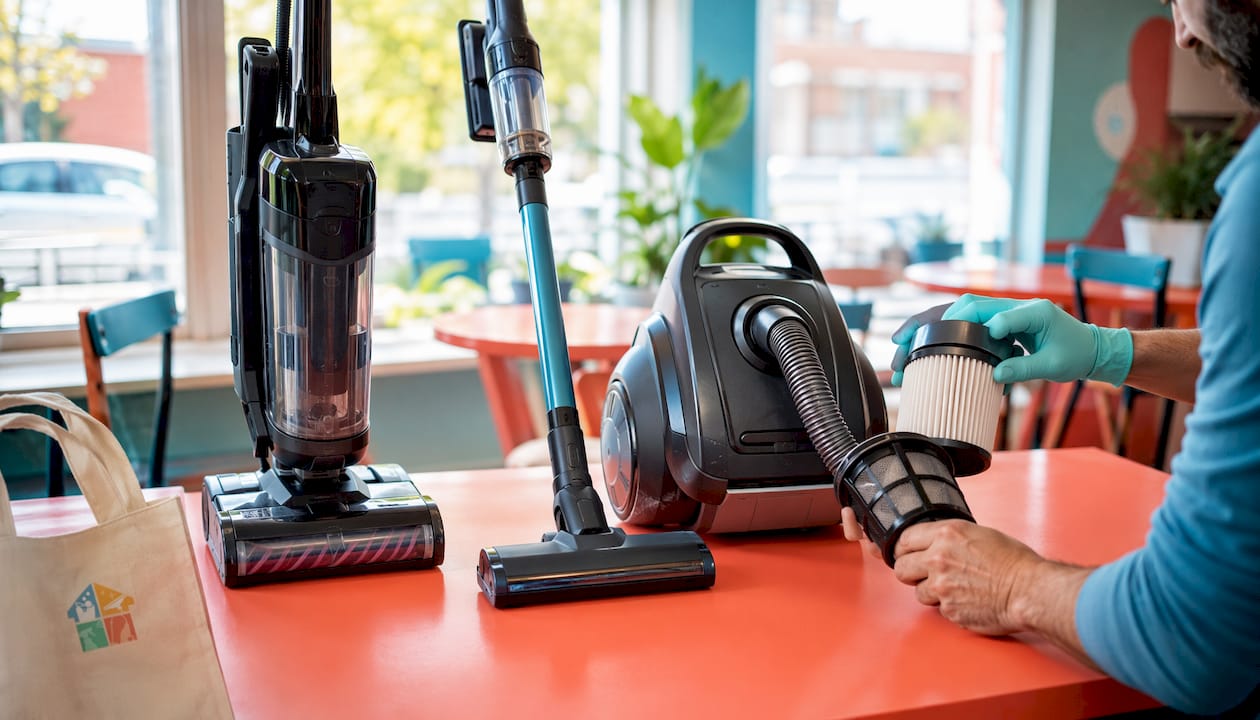
Poor vacuum maintenance undercuts all of these features. A full canister, clogged filter, or tangled brush roll drastically reduces suction and extraction performance — sometimes to the point where the vacuum is doing almost nothing useful. Empty the bin and clean or replace the filter before any deep session.
How to vacuum for a deeper, more restorative clean
Technique and machine readiness matter as much as the equipment itself. A well-maintained vacuum used with proper technique will outperform a premium machine used carelessly.
Before you start:
- Empty the canister or check the bag — anything over half-full reduces suction noticeably.
- Clean or replace the filter. A clogged filter is the single most common reason a vacuum underperforms.
- Clear the brush roll of tangled hair and debris.
- Move furniture to expose the full floor area.
The deep-clean pass sequence:
- Start at the far end of the room and work toward the exit to avoid walking over cleaned areas.
- Make slow, overlapping forward-and-back passes. Reducing pass speed by about half compared to a routine maintenance pass gives the brush roll and suction time to work on embedded debris.
- Complete a second pass in the perpendicular direction (north-south, then east-west). Two cross-directional passes agitate fibers from opposing angles and unlock debris that single-direction passes miss. More than three passes gives diminishing returns and can cause unnecessary wear.
- Use the crevice tool along baseboards, under furniture edges, and in upholstery seams.
- Use the upholstery attachment on sofas, chairs, and fabric headboards.
Common mistakes that undercut a deep session:
- Moving too fast — the most common error; it turns a deep clean into a maintenance pass
- Starting with a full bin or dirty filter
- Skipping edge and crevice work (a significant share of debris accumulates along baseboards)
- Ignoring upholstery attachments
- Over-vacuuming a single spot more than 2–3 passes, which risks fiber damage without additional extraction benefit
Pro Tip: Use a sealed HEPA system whenever indoor air quality is a priority — especially in homes with allergy or asthma sufferers. Pair the session with open windows or an air purifier running afterward to clear any briefly resuspended particles.
When should you hire a professional deep cleaner?
Hire a pro when soils are bonded, moisture is involved, odors persist after dry cleaning, or when a structural condition like mold, heavy urine saturation, or flood residue exists. Vacuuming is the right first step in every case, but it’s not the last step in these situations.
What professional methods add that a vacuum cannot:
- Hot-water extraction (steam cleaning). The industry-standard method for embedded soils and moisture-based stain removal. Hot water and cleaning solution are injected into the carpet pile under pressure, then extracted along with dislodged soils. This is what most people mean by “professional carpet cleaning.”
- Low-moisture encapsulation. A faster-drying alternative for commercial settings or situations where long drying times are impractical.
- Bonnet or rotary agitation. Used for surface restoration on some carpet types, typically in commercial applications.
- Professional odor remediation. Enzymatic treatments that neutralize biological odors at the source rather than masking them.
Frequency guidance. For high-traffic homes and households with pets, a professional restorative deep clean every 6–12 months is a practical baseline. Between professional sessions, deep vacuuming every 2–8 weeks depending on traffic keeps surface soils from compacting further into the pile. Homes with allergy sufferers or young children on the floor benefit from the shorter end of that range. Signs your home needs professional attention include rising allergy symptoms, persistent odors, dull-looking carpet, and matted fibers that don’t recover after vacuuming.
A professional deep clean follows a predictable sequence: pre-inspection to assess soil type and surface condition, vacuum-first protocol to remove loose debris, targeted pretreatment of stains and high-traffic zones, hot-water extraction or the appropriate method for the surface, a drying period, and post-inspection. Understanding how deep cleaning differs from regular cleaning helps set realistic expectations for what each service tier delivers.
What does the research say about vacuuming, air quality, and flooring life?
Peer and industry research consistently show that vacuuming reduces total settled particulate load, improves indoor air quality when paired with HEPA filtration, and can meaningfully extend flooring life by removing abrasive grit before it damages fibers.
Regular vacuuming can double flooring lifespan by removing sand and mineral particles that otherwise grind against carpet fibers and hard-floor finishes with every footstep. That’s not a minor benefit — flooring replacement is one of the more expensive home projects most owners face.
On the extraction effectiveness side, well-executed deep vacuuming can remove up to 80% of embedded particulate matter in carpets under controlled conditions. Technique accounts for most of the difference between that figure and what a rushed maintenance pass achieves.
The resuspension question comes up often. Indoor air quality experts acknowledge that vacuuming briefly resuspends some dust, but the net effect is a reduced total surface particle load over time. The long-term benefit of removing settled dust outweighs the short-term increase in airborne particles — particularly when using a sealed HEPA system. The EPA classifies HEPA filters as capturing 99.97% of particles at 0.3 microns, which is the most penetrating particle size for standard filtration.
| Metric | Finding | Practical takeaway |
|---|---|---|
| Flooring lifespan | Regular vacuuming can double it by removing abrasive grit | Consistent vacuuming is a flooring investment, not just tidying |
| Embedded particulate removal | Up to 80% with proper deep technique | Slow passes and cross-direction strokes make a measurable difference |
| HEPA filtration | Captures 99.97% of particles at 0.3 microns | Sealed HEPA systems protect IAQ during and after vacuuming |
| Resuspension | Temporary increase, net reduction in surface particle load | Open windows or run an air purifier after vacuuming |
Combining regular vacuuming with HVAC filter maintenance compounds the indoor air quality benefit — a clean HVAC system doesn’t recirculate what the vacuum just removed.
Key Takeaways
Vacuuming is a proven, essential component of a deep clean for dry soils, flooring longevity, and indoor air quality — but wet extraction or professional treatment is required for bonded stains, biological contamination, and persistent odors.
| Point | Details |
|---|---|
| Vacuum first, always | Remove loose soils before any wet treatment to prevent debris from spreading as residue. |
| Technique drives results | Slow passes at half normal speed plus one cross-direction pass can remove up to 80% of embedded particulate, based on controlled testing. |
| HEPA filtration matters | Sealed HEPA systems capture particles down to 0.3 microns and protect indoor air quality during vacuuming. |
| Know when to call a pro | Persistent odors, matted fibers, visible staining, or biological contamination require hot-water extraction or professional treatment. |
| Neatandtidypros fills the gap | Professional deep cleaning from Neatandtidypros covers what vacuuming can’t: extraction, odor remediation, and restorative carpet treatment. |
The part most homeowners get wrong about vacuuming
Most people treat vacuuming as either everything or nothing. Either they vacuum and consider the job done, or they dismiss it as surface-level and wait for a professional. Both miss the point.
Vacuuming done well is genuinely restorative for dry soils. The technique gap between a two-minute maintenance pass and a proper deep vacuuming session is enormous, and most homeowners never close it. Slowing down, running a cross-direction pass, and maintaining the machine before the session would recover far more embedded debris than most people realize. The allergen-reduction benefits alone justify the extra ten minutes.
Where the conventional wisdom breaks down is the assumption that more vacuuming can substitute for wet extraction. It can’t. Once a soil is bonded to a fiber or embedded in carpet padding, suction and agitation won’t dislodge it. Professionals aren’t just doing what you do with better equipment. They’re using a fundamentally different method — hot-water extraction injects and recovers moisture that a vacuum never touches. Understanding that distinction is what separates a homeowner who maintains their floors well from one who replaces them early.
Neatandtidypros handles what your vacuum leaves behind
When vacuuming reaches its limit, Neatandtidypros picks up exactly where it stops. Every professional deep clean starts with a vacuum-first protocol to remove loose soils, then moves to the methods that actually address bonded grit, stains, and biological odors: hot-water extraction, targeted pretreatment, and professional odor remediation.
Services that go beyond what any vacuum can do include deep carpet extraction, upholstery cleaning, post-construction cleanup, move-in/move-out deep cleans, and Airbnb turnovers where odor and soil levels demand more than a maintenance pass. Neatandtidypros serves homeowners, property managers, and businesses across Orange County and Corona, California.
Ready to schedule a professional deep clean? See what’s included in a Neatandtidypros deep-clean service, or get a full picture of residential cleaning to know exactly what to expect before you book.
Sources and further reading
For readers who want to go deeper on the research and standards behind this article:
- EPA: What Is a HEPA Filter? — The primary source for HEPA filtration standards and the 99.97% capture rate at 0.3 microns. Start here for IAQ and filtration questions.
- American Lung Association: Pick the Best Vacuum for Your Health — Practical guidance on sealed systems, bagged vs. bagless, and HEPA certification for allergy and asthma households.
- Linea: How to Deep Clean Carpets with a Vacuum — Technique-focused guide covering pass speed, cross-direction strokes, and embedded particulate extraction rates.
- Dyson: How to Clean Your Carpet — Practitioner-level detail on cross-pattern vacuuming and diminishing returns beyond two passes.
- CNET: Are Vacuum Cleaners Bad for Your Air Quality? — Expert commentary on resuspension and the net IAQ benefit of regular vacuuming.
- Simply Solved: Why Vacuuming Is Important — Covers abrasive grit removal and the flooring lifespan case for consistent vacuuming.