Employers must keep office workplaces clean, orderly, and sanitary, and maintain safe walking-working surfaces free of trip and fall hazards, under 29 CFR 1910.22 and 29 CFR 1910.141. That single obligation branches into a handful of specific, checkable rules.
This article covers six rule groups: walking-working surfaces, sanitation, storage and stacking, trip and electrical hazards, inspections and repairs, and training and recordkeeping. Bookmark 1910.22 and 1910.141 as your two primary references. Everything else in office housekeeping compliance traces back to one of those standards.
Key Takeaways
Office housekeeping compliance under OSHA comes down to keeping walking surfaces clean and hazard-free, sanitation facilities functional, and inspections documented on a schedule.
| Point | Details |
|---|---|
| Two standards govern everything | 1910.22 covers walking surfaces; 1910.141 covers sanitation and waste removal. |
| Storage has a sprinkler rule | Keep materials 18 inches below sprinkler heads and heavy items stored low. |
| Cords cause hidden risk | Inspect behind furniture for pinched or frayed cords during every walk-through. |
| Inspections need paper trails | Log every inspection and repair; undocumented compliance is hard to prove. |
| Recurring cleaning fills the gaps | Neatandtidypros supports daily and weekly housekeeping tasks that back up your inspection records. |
Table of Contents
- Which OSHA Standards Cover Office Housekeeping
- What OSHA Actually Requires of Your Office
- Storage and Materials-Handling Rules Offices Overlook
- Trip Hazards, Cords, and Electrical Outlet Rules
- Sanitation, Restrooms, and Janitorial Standards
- Inspection, Maintenance, and Repair Obligations
- A Daily, Weekly, and Monthly Office Housekeeping Checklist
- Training and Written Housekeeping Policies
- OSHA Enforcement and What to Do Next
- A Cleaning Provider’s Practical Note
- Where Professional Office Cleaning Fits In
- Sources
Which OSHA Standards Cover Office Housekeeping
Two federal standards do almost all the work here. 29 CFR 1910.22 governs walking-working surfaces: floors, aisles, and passageways must stay clean, dry when practicable, and free of protruding objects or debris. 29 CFR 1910.141 covers sanitation: it requires clean facilities, functioning toilets and washing stations, and prompt removal of waste.
For field-level detail, OSHA’s own SHMS Chapter 6 fills the gaps the code leaves general, spelling out things like closed filing cabinet drawers and cord management.
Aisles and passageways must be free of obstructions, filing cabinet drawers closed when not in use, and cords routinely inspected to avoid tripping hazards.
If your office sits in a state with its own OSHA-approved plan, check that state’s rules too. State Plans can set requirements equal to or stricter than the federal standard, and enforcement priorities sometimes differ from region to region.
What OSHA Actually Requires of Your Office
The code language is dense, but the obligations underneath it are specific. Here’s what 1910.22 and 1910.141 translate to in a real office:
- Walking-working surfaces: Passageways, floors, and work areas must stay clean, dry when practical, and free of protruding nails, splinters, holes, or loose boards.
- Sanitation: Toilets and washing facilities must be sanitary, and waste must be removed before it becomes a hazard or odor problem.
- Access and egress: Aisles, exits, and fire equipment (extinguishers, alarm pulls, sprinkler risers) must stay unobstructed at all times.
- Storage and stacking: Store heavy items low, keep stacks stable, and maintain 18 inches of clearance below sprinkler heads.
- Inspection and correction: Inspect surfaces regularly, guard any hazard you can’t fix immediately, and route structural repairs to a qualified person under 1910.22(d).
Pro Tip: Assign one person per floor to own the daily walk-through. Diffused responsibility is how blocked exits and frayed cords slip past everyone for weeks.
Storage and Materials-Handling Rules Offices Overlook
Office storage hazards rarely look dangerous, which is exactly why they cause problems. A leaning stack of banker’s boxes or an overloaded bookshelf can topple or block an exit route just as easily as a warehouse pallet.
- Keep stacked materials stable and store heavier items at lower shelf levels to reduce topple risk.
- Maintain clearance below sprinkler heads, even when the stack is just paper and office supplies.
- Never load bookcases or shelving beyond the manufacturer’s stated weight limit.
- Don’t let boxes, files, or equipment block air vents, return grilles, or secondary escape routes.
Trip Hazards, Cords, and Electrical Outlet Rules
Slips, trips, and falls are among the most common office injuries, and NIOSH’s own guidance points to clear walking surfaces and disciplined cord management as the two biggest levers for reducing them.
Walk your space looking for these specific problems:
- Frayed or curling carpet edges near desks, doorways, and copier stations.
- Extension cords or charging cables crossing open walkways instead of running along walls.
- Outlet boxes or floor plates that protrude above floor level.
- Low file or desk drawers left open into an aisle.
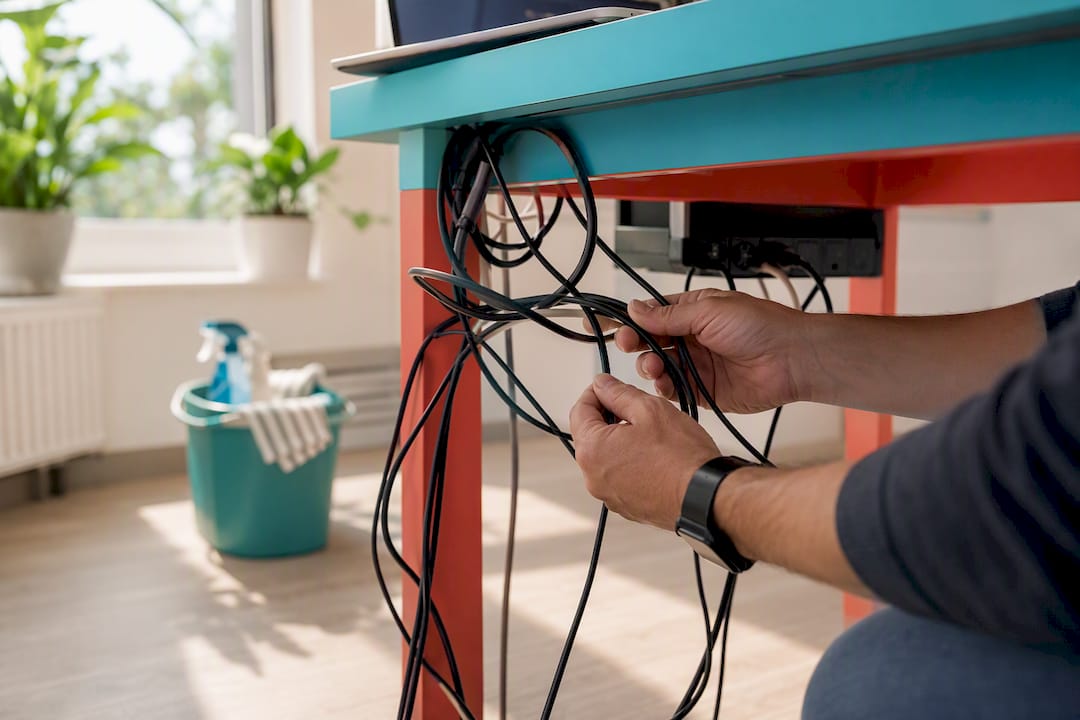
Cords need their own rule set. Use grounding-type cords, keep them in good repair, and never route them through doorways or under rugs where damage goes unnoticed. High-load appliances like space heaters, full-size refrigerators, and microwaves belong in a wall outlet directly, not on a power strip, which cuts down on overload and overheating risk.
Pro Tip: Check behind desks and file cabinets during every inspection, not just open floor space. Bent or pinched cords hiding behind furniture are a common source of both fire risk and hidden trip hazards.
Sanitation, Restrooms, and Janitorial Standards
The sanitation rule is deceptively simple: keep the workplace clean to the extent the nature of the work allows, per 1910.141(a)(3). In practice, that means three things happen consistently.
- Toilets and washing facilities stay stocked, functional, and cleaned on a set schedule, not an ad hoc one.
- Wet mopping or spill cleanup gets drainage or a dry standing area so floors don’t stay slick.
- Trash and recycling get emptied before bins overflow, and anything hazardous gets labeled correctly before disposal.
Good ventilation and dust control reinforce the same goal; if your building has recurring air quality complaints, that’s often a housekeeping and indoor air quality issue as much as an HVAC one.
Inspection, Maintenance, and Repair Obligations
OSHA doesn’t set a fixed inspection interval for office walking-working surfaces, but 1910.22(d) requires inspecting them regularly and documenting what you find. Roughly one in three general-industry inspections still turns up a housekeeping-related citation, which is why a written schedule matters more than an informal “someone will notice” approach.
- If a hazard can’t be fixed on the spot, block or guard the area and keep employees away until it’s corrected.
- Anything affecting structural integrity, a sagging floor panel, a damaged stair tread, must be repaired or supervised by a qualified person.
- Log every inspection and repair. A blank maintenance log is one of the first things an OSHA inspector will ask to see.
A Daily, Weekly, and Monthly Office Housekeeping Checklist
Compliance sticks when it’s built into a rhythm instead of handled reactively. Here’s a workable schedule:
- Daily: Clear aisles and exits, pick up anything on the floor, spot-clean spills immediately, empty visible trash, check restroom supplies.
- Weekly: Inspect cords and carpet edges, secure loose or wobbly furniture, review storage stacks for sprinkler clearance, deep-clean high-touch surfaces.
- Monthly: Run a full walking-working-surface inspection, confirm emergency exit signage and lighting are visible, review inspection logs with facilities staff.
| Task | Typical owner |
|---|---|
| Daily aisle and spill checks | Individual staff / office manager |
| Cord and carpet inspection | Facilities staff |
| Restroom sanitation | Contract cleaner |
| Storage and sprinkler clearance review | Facilities staff |
| Structural repairs | Qualified person (employer-arranged) |
Pro Tip: Use a simple sign-off sheet, initials and date, for every inspection. That log becomes your evidence of a good-faith compliance effort if OSHA ever asks.
Training and Written Housekeeping Policies
A checklist only works if people know it exists. A written housekeeping policy should name who’s responsible for each task, how often inspections happen, and where staff report a hazard they spot.
- Train staff to recognize trip and electrical hazards, correct stacking and storage, waste labeling, and spill response.
- Cover these topics during onboarding, then refresh annually.
- Document every training session. Recordkeeping is what turns “we told people” into proof.
OSHA Enforcement and What to Do Next
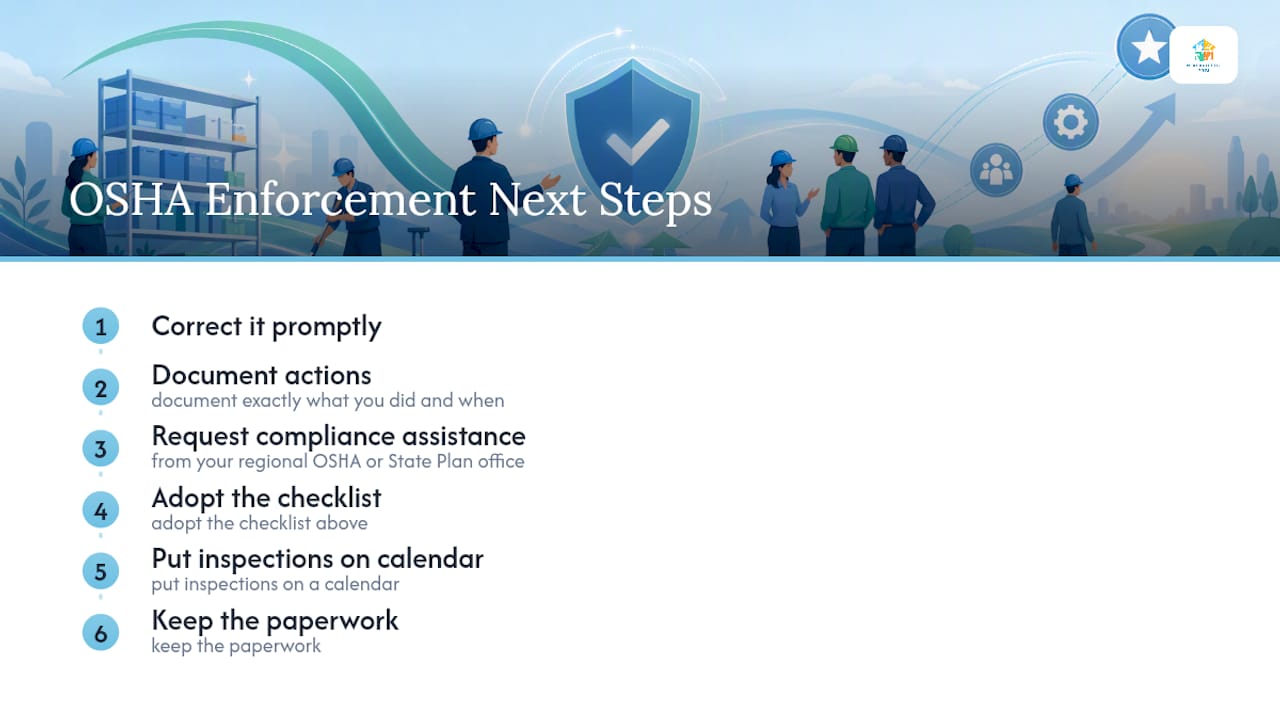
Blocked exits, unsafe walking surfaces, poor sanitation, and unsafe stacking are the housekeeping issues that show up most often in citations. If an inspector flags something, correct it promptly, document exactly what you did and when, and don’t hesitate to request compliance assistance from your regional OSHA or State Plan office.
The fastest path to lower enforcement risk is the boring one: adopt the checklist above, put inspections on a calendar, and keep the paperwork.
A Cleaning Provider’s Practical Note
Contracted cleaning fills the gaps daily staff miss, weekly deep vacuuming, restroom sanitation, and flagging repairs before they become citations.
Where Professional Office Cleaning Fits In
Reading the standards is one thing. Keeping every floor, restroom, and storage room compliant week after week is another job entirely, and it’s usually the first thing to slip when facilities staff are stretched thin.
Neatandtidypros handles the recurring housekeeping tasks that inspectors actually check: high-touch surface cleaning, restroom sanitation, floor maintenance, and spotting cords or storage issues before they turn into hazards. That steady cadence gives you documentation, cleaning logs and completed visits, to show alongside your own inspection records. If your office is due for a walkthrough or you want recurring service built around your inspection schedule, visit our commercial cleaning page or browse our full service offerings to request a site assessment.
Sources
Bookmark these for quick reference during audits or inspection prep:
- 1910.22 – General requirements. | Occupational Safety and …
- Office Environments and Your Safety | Office | CDC