Green commercial cleaning means maintaining a facility with products, equipment, and procedures that cut chemical exposure and environmental impact while still meeting real cleaning standards. Done right, it lowers irritant exposure for staff and visitors, supports better indoor air quality, and signals genuine sustainability to tenants and clients. If you manage a facility, the next move is simple: request a documented green cleaning plan or a pilot from a provider who can show you the products and procedures behind the claim.
TL;DR:
- Using certified and third-party-verified products ensures actual green cleaning practices, verified through product lists and Safety Data Sheets available upon request.
- Proper staff training on dilution, dwell times, and zone-specific procedures is critical to maintaining the effectiveness of green cleaning methods.
- The costs for green cleaning are driven by equipment upgrades, specialized products, and staff training, with a pilot program recommended to evaluate benefits before full implementation.
- Genuine green programs extend equipment lifespan and improve indoor air quality by avoiding harsh chemicals that cause surface degradation and residue buildup.
Table of Contents
- What Does a Green Commercial Cleaning Program Actually Include?
- Why Does Green Cleaning Matter for Health and Business Performance?
- How Do Cleaners Make a Program Actually Green?
- What Should You Ask Before Hiring a Green Cleaning Provider?
- What Drives the Cost of Green Commercial Cleaning?
- How Neat and Tidy Pros Approaches Green Commercial Cleaning
- How Are Cleaning Staff Trained in Green Practices?
- What Gets in the Way of Going Green, and How Do You Fix It?
- Does Green Cleaning Actually Extend Equipment and Facility Life?
- A Pragmatic Way to Start a Green Cleaning Program
- Get a Green Cleaning Plan Built Around Your Facility
- Sources
What Does a Green Commercial Cleaning Program Actually Include?
A real green commercial cleaning program covers the same ground as a conventional one. The difference is in the materials and methods, not the task list. Daily janitorial work, like trash removal, restroom sanitation, and surface wiping, runs alongside specialized services such as carpet extraction, hard-floor stripping and finishing, and targeted disinfection in high-touch zones.
What changes underneath is the substance. Providers swap in biodegradable, low-VOC, fragrance-free products, follow stricter dilution ratios, and extend dwell times so disinfectants actually work instead of getting wiped off too soon.
A commercial-grade program typically includes:
- Daily janitorial service using certified or third-party-verified cleaning products
- Carpet and upholstery cleaning with low-moisture, low-residue methods
- Hard-floor care using pH-neutral strippers and finishes instead of ammonia-heavy formulas
- Disinfection protocols that target high-touch surfaces rather than blanket-spraying entire rooms
- Waste sorting and recycling built into the janitorial routine, not bolted on afterward
Ask any vendor to walk you through their eco-friendly cleaning approach room by room. If they can’t name specific product swaps, that’s a sign the “green” label is marketing, not practice.
Why Does Green Cleaning Matter for Health and Business Performance?
The health case for green cleaning starts with indoor air quality. Conventional cleaners release volatile organic compounds that linger in enclosed office air far longer than they do outdoors, and employees with asthma or chemical sensitivity often notice the difference within days of a switch to low-VOC products.
The business case follows close behind. Facilities that document their sustainability practices tend to see better tenant retention and stronger positioning in ESG reporting, since more corporate tenants now screen vendors on environmental criteria before signing leases.
The catch: none of this works automatically. A green product used with the wrong dilution ratio, skipped dwell time, or untrained staff performs worse than a conventional one used correctly. Editorial testing of natural and nontoxic cleaning products has found that several plant-derived and refill-based brands match conventional performance when applied properly, but the applying-properly part is where most programs fall short.
How Do Cleaners Make a Program Actually Green?
Vendor claims are cheap. Documentation is not. Before signing a contract, ask for the specific product list and Safety Data Sheets (SDS) for everything that will touch your facility. A provider serious about green practices will hand these over without hesitation.
Third-party verification narrows the field fast. Labels like EWG VERIFIED®, Safer Choice, and Green Seal each check ingredient transparency and hazard profiles against a defined standard, and EWG’s own guide to safer cleaning products breaks down what those distinctions actually mean. None of these labels replace an on-site performance check, but they’re a reliable first filter.
On equipment, three upgrades separate a genuine green program from a repainted conventional one:
- Microfiber cloths and mops trap particulates mechanically instead of relying on harsher chemical agents to break them down.
- HEPA-filtered vacuums capture fine particulates and allergens that standard vacuums recirculate into the air.
- Concentrated refill systems cut packaging waste and shipping weight. Blueland’s refill and tablet systems and similarly structured concentrates from Branch Basics both report meaningful plastic reductions versus bottled cleaners bought new every time.
Procedural controls matter just as much as the products themselves. Color-coded tools prevent cross-contamination between restrooms and food areas, documented dilution systems keep concentrates at the right strength, and targeted disinfection of high-touch surfaces beats indiscriminate spraying every time.
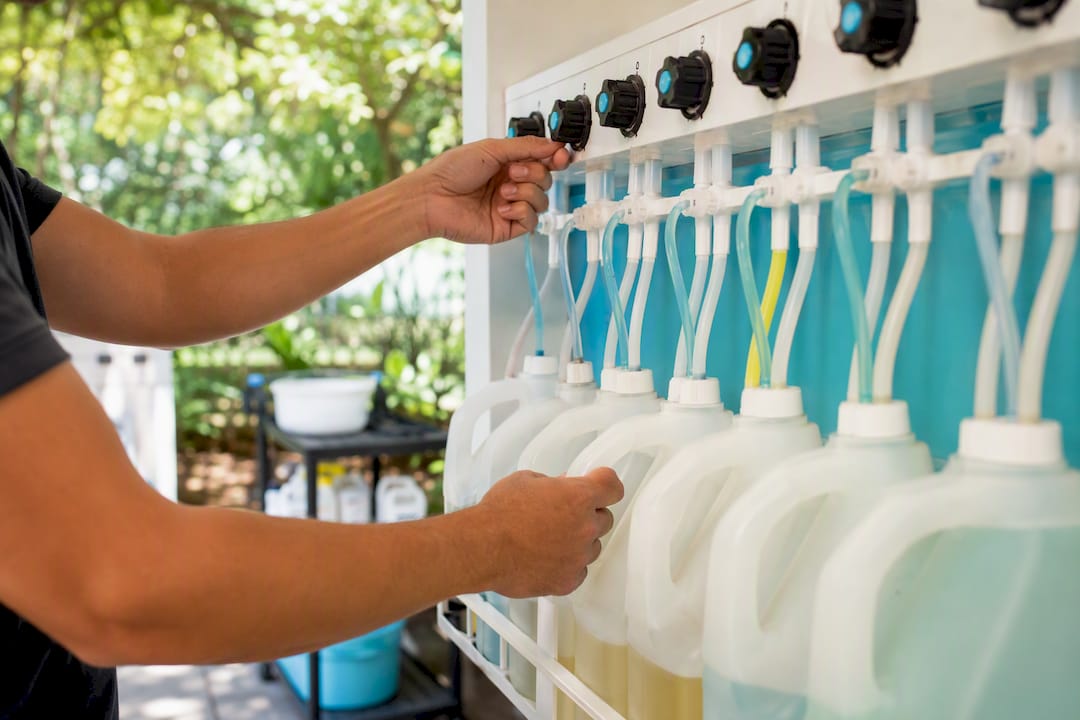
Pro Tip: Ask a vendor to show you their dilution station, not just tell you about it. A properly labeled, calibrated dispensing system is one of the fastest tells that a “green” program is operational, not aspirational.
What Should You Ask Before Hiring a Green Cleaning Provider?
Vetting a green commercial cleaner comes down to five things: product transparency, staff training, insurance coverage, references, and contract clarity. Skip any one of those and you’re buying a marketing claim, not a service.
During the RFP or interview stage, ask directly:
- Can you provide a full product list and current SDS for everything used in my facility?
- What certifications back your green claims, and can I verify them independently?
- What does your staff training program cover, and how often is it refreshed?
- Can you run a pilot cleaning in one zone before we commit to a full contract?
- What’s your staff turnover rate, and how do you onboard new hires on your procedures?
A vendor who can’t produce an SDS on request, or who answers “we use eco-friendly products” without naming a single one, is telling you the claim hasn’t been tested by anyone who’d notice.
Vague language is the biggest red flag in this entire process. “Environmentally conscious,” “green-friendly,” and similar phrasing with no product names, no certifications, and no willingness to pilot usually means the marketing outran the operations. A provider confident in their process will welcome a trial run, not resist one.
What Drives the Cost of Green Commercial Cleaning?
Green commercial cleaning generally costs more per square foot than conventional service, and the gap comes down to a handful of specific factors rather than a flat markup.
- Frequency and square footage set the baseline labor cost, same as any janitorial contract.
- Floor type matters more than people expect. Stripped-and-finished hard floors need different equipment than carpet extraction, and specialized green-certified floor equipment carries a premium.
- Certified product costs run higher than bulk conventional chemicals, though concentrate systems narrow that gap over time.
- Staff training and onboarding add cost upfront but reduce misapplication and product waste later.
A transparent quote itemizes labor, products, and equipment separately rather than bundling everything into one number. That structure lets you see exactly what you’re paying the green premium for. Most providers recommend starting with a pilot area, running it for 30 to 60 days, then adjusting scope based on staff feedback and measurable results before rolling the program facility-wide.
How Neat and Tidy Pros Approaches Green Commercial Cleaning
Neat and Tidy Pros offers residential and commercial cleaning across basic cleaning, deep cleaning, move-in and move-out cleaning, post-construction cleaning, Airbnb turnovers, and office cleaning. On the commercial side, our office and business cleaning solutions are built around the same green principles covered above: documented product choices, trained staff, and procedures that hold up to a client walkthrough, not just a sales pitch.
How Are Cleaning Staff Trained in Green Practices?
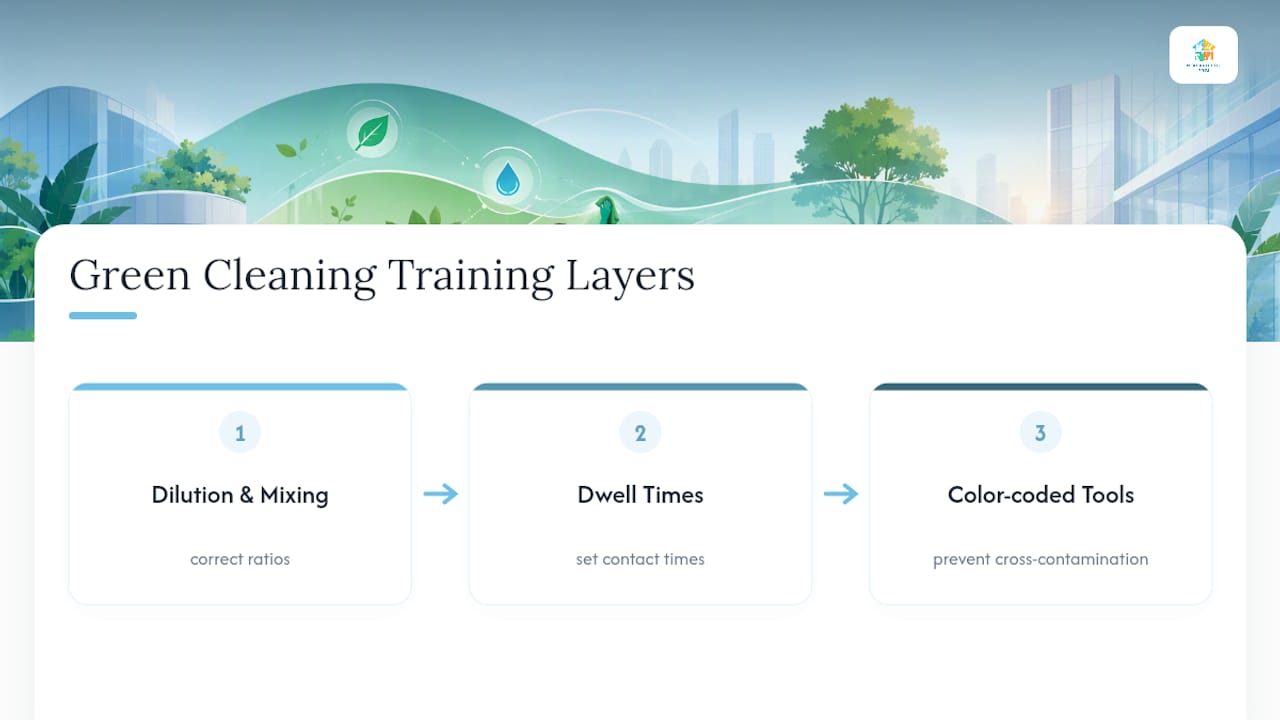
Products alone don’t make a program green. The staff applying them do. Training typically covers three layers: correct dilution and mixing procedures, proper dwell times for disinfectants, and color-coded tool systems that prevent cross-contamination between zones like restrooms, break rooms, and general office space.
New hires generally shadow experienced staff through a facility’s specific protocol before working solo, since every building has different surface types, traffic patterns, and sensitivity concerns. A hospital-adjacent office suite needs different disinfection discipline than a standard corporate floor.
Ongoing training matters more than initial certification. Product reformulations happen, dilution equipment gets recalibrated, and staff turnover means new team members need the same grounding as the people they’re replacing. Programs that skip refresher training tend to drift back toward old habits, like over-spraying instead of targeted application, within a few months. Ask any provider how often their crews retrain and what that training actually covers beyond a one-time onboarding session.
What Gets in the Way of Going Green, and How Do You Fix It?
The most common obstacle isn’t cost. It’s inconsistency between what a contract promises and what a crew actually does on a Tuesday morning. A facility manager signs on for a green program, then finds a conventional all-purpose spray under the sink three weeks later because a substitute cleaner grabbed whatever was closest.
The fix is procedural, not aspirational: documented supply lists posted at each cleaning station, locked storage for approved products only, and spot-checks built into the management routine rather than left to trust.
A second challenge is performance skepticism. Facility staff who’ve used weak “eco” products in the past sometimes assume every green cleaner underperforms. That’s often a formulation problem, not a category problem. Editorial testing across more than 15 natural and nontoxic products found real performance variation between brands, which means the right products, chosen carefully, close the gap entirely.
Budget friction shows up too, especially when certified products cost more upfront than bulk conventional chemicals. Concentrate and refill systems help here, since they reduce shipping weight and packaging cost over the life of a contract even when the initial unit price looks higher. Running a pilot zone before full rollout catches most of these issues before they become facility-wide problems.
Does Green Cleaning Actually Extend Equipment and Facility Life?
Harsh chemical cleaners don’t just affect air quality. They degrade the surfaces and equipment they’re meant to protect. Ammonia-based floor strippers used too frequently or at the wrong concentration break down floor finishes faster, forcing more frequent stripping and refinishing cycles than a properly diluted, pH-balanced product would require.
Carpet fibers show similar wear patterns. Harsh solvent-based spot treatments can degrade fiber backing over repeated use, while low-moisture, pH-neutral extraction methods common in green carpet cleaning programs tend to preserve fiber integrity longer.
HVAC systems benefit indirectly, too. Fewer airborne particulates and aerosolized chemicals mean less residue building up in filters and ductwork, which can extend filter life and reduce strain on air handling equipment over time. None of this shows up in a single monthly invoice, but it shows up in a five-year facility maintenance budget. Providers who track equipment lifespan alongside cleaning contracts often find the correlation isn’t subtle: gentler, correctly applied products mean fewer replacement and refinishing cycles down the line.
A Pragmatic Way to Start a Green Cleaning Program
Skip the label-chasing and start small. Pick one zone, run a documented pilot, and ask occupants what they actually notice, not just what the contract promises. Training and written procedures matter more than which certification logo appears on the bottle. If you’re not sure where to start, request an audit or a pilot cleaning plan and judge the results firsthand before committing facility-wide.
— Neat
Get a Green Cleaning Plan Built Around Your Facility
Neat and Tidy Pros isn’t just adding “eco-friendly” to a service menu. Our commercial cleaning services are built for offices and business environments from the ground up, using the same documented product and procedure standards covered throughout this guide, so you get a scope of work you can actually verify, not a vague promise.
We cover the full range, from residential and commercial cleaning services like basic cleaning and deep cleaning to move-in and move-out turnovers, post-construction cleanup, and Airbnb service. If your facility needs a documented green program, the next step is simple: request a quote for your space, ask us to walk through the products and SDS you’d expect, and start with a pilot zone before rolling the program building-wide.
Sources
- Your guide to safer cleaning products | EWG
- Branch Basics – Human Safe Cleaning Products
- I tested 15+ natural and nontoxic cleaning products – The Good Trade