Surface disinfection is the process of applying a registered chemical agent to an inanimate surface to inactivate disease-causing microorganisms. It is not the same as cleaning, and it only works when you do it in the right order. Here is what to do immediately:
- Clean first. Remove visible dirt, grease, and debris with soap or detergent before any disinfectant touches the surface. Organic matter blocks disinfectant action, and skipping this step is the single most common reason disinfection fails, according to CDC guidance.
- Choose an EPA-registered product. Check the EPA’s list of registered disinfectants and match the product to your target pathogen and surface type.
- Read the label before you open the bottle. Contact time, dilution ratio, PPE requirements, and surface compatibility are all on the label. Follow them exactly.
- Keep the surface visibly wet for the full contact time. Wiping dry too soon cancels the disinfectant’s effect.
- Ventilate and use PPE as the label directs. Gloves are the minimum for most products.
The WHO and EPA both publish step-by-step guidance that aligns with this sequence. When the job is large, involves a known illness event, or covers a commercial space, a professional service like Neatandtidypros handles the process with documented protocols and EPA-registered products.
Key Takeaways
Effective surface disinfection requires cleaning first, using an EPA-registered product at the correct concentration, maintaining the labeled contact time, and combining it with hand hygiene for reliable infection risk reduction.
| Point | Details |
|---|---|
| Clean before you disinfect | Organic matter blocks disinfectant action; skipping this step is the most common reason disinfection fails. |
| Contact time is non-negotiable | Keep the surface visibly wet for the full label-specified time; wiping dry early cancels the disinfectant’s effect. |
| Match product to pathogen and surface | Check the EPA’s registered disinfectants list and confirm the product covers your target organism and surface type. |
| Disinfection is one layer, not the whole system | Combine surface disinfection with hand hygiene and ventilation; no disinfectant eliminates all transmission risk on its own. |
| Neatandtidypros for complex jobs | For post-illness events, commercial facilities, or move-in/move-out cleans, Neatandtidypros provides documented, EPA-registered disinfection in Orange County and Corona, CA. |
Table of Contents
- Why does surface disinfection matter for infection control?
- Cleaning, sanitizing, disinfecting, and sterilization: what is the difference?
- Which surfaces should you disinfect, and how often?
- Step-by-step surface disinfection process for homes and facilities
- What disinfectants actually work, and when should you use each one?
- No-touch disinfection methods: when do they actually add value?
- What factors undermine disinfectant effectiveness?
- Safety for users and workers: PPE, ventilation, and disposal
- What disinfection can and can’t do
- How professional cleaners perform surface disinfection
- Sources
Why does surface disinfection matter for infection control?
The goal of disinfection is not to make a surface look clean. It is to reduce pathogen levels low enough that the surface no longer poses a meaningful infection risk. Pathogens transferred from contaminated surfaces to hands, and then to eyes, nose, or mouth, are a recognized transmission route for respiratory viruses, gastrointestinal illness, and healthcare-associated infections.
Disinfection matters most in specific situations: after a household member has been ill, in high-traffic spaces where many people touch the same surfaces, in food-preparation areas, and in any setting that serves people with weakened immune systems. Routine disinfection of a low-traffic guest room that no one has used is largely unnecessary. Targeted, well-executed disinfection of a bathroom used by someone with a stomach virus is not.
The CDC notes that environmental surface contamination transfers mainly through hands, which is why surface disinfection and hand hygiene work together rather than either one replacing the other.
MedlinePlus reinforces that prioritizing the right surfaces at the right times, rather than disinfecting everything constantly, is the practical approach for homes and small facilities.
Cleaning, sanitizing, disinfecting, and sterilization: what is the difference?
These four terms describe four different outcomes. Using the wrong one means either under-protecting a surface or wasting time and money on a level of treatment the situation does not require.
- Cleaning removes visible soil, dust, and organic matter using soap, detergent, and mechanical action. It does not kill pathogens reliably, but it is a required first step before any of the others.
- Sanitizing reduces the number of bacteria on a surface to a level considered safe by public health standards. Dishwashers and food-contact surface sanitizers work at this level.
- Disinfecting inactivates a broad range of viruses, bacteria, and fungi on a surface. It does not reliably destroy bacterial spores. This is the level most homes and commercial facilities need for infection control.
- Sterilization destroys all microorganisms, including spores. It requires autoclaves, dry heat, or chemical sterilants and is reserved for surgical instruments and critical medical devices, not household surfaces.
The CDC’s Guideline for Disinfection and Sterilization in Healthcare Facilities formalizes this through Spaulding’s framework, which classifies items as critical, semicritical, or non-critical and assigns the required level of treatment to each. For non-critical environmental surfaces, which covers nearly everything in a home or office, disinfection is the appropriate target.
| Level | Intent | Typical agents | Common use-cases |
|---|---|---|---|
| Cleaning | Remove soil and debris | Soap, detergent, water | All surfaces before disinfection |
| Sanitizing | Reduce bacteria to safe levels | Food-safe sanitizers, hot water | Dishes, food-contact surfaces |
| Disinfecting | Inactivate most pathogens | Bleach, alcohol, quats, H₂O₂ | Countertops, bathrooms, high-touch surfaces |
| Sterilization | Destroy all microorganisms including spores | Autoclave, ethylene oxide, chemical sterilants | Surgical instruments, critical medical devices |
Understanding how deep cleaning differs from regular cleaning helps clarify where disinfection fits into a broader cleaning plan for homes and facilities.
Which surfaces should you disinfect, and how often?
Not every surface needs disinfection on the same schedule. The surfaces that transfer pathogens most efficiently are the ones touched repeatedly by multiple people throughout the day.
High-touch surfaces to prioritize, per MedlinePlus:
- Doorknobs and door handles
- Light switches
- Faucet handles and toilet flush levers
- Countertops and kitchen surfaces
- Remote controls and shared electronics
- Refrigerator handles, stove knobs, and cabinet pulls
- Shared phones and keyboards in office settings
When to disinfect:
- After a known illness event: disinfect high-touch surfaces and bathrooms immediately after someone in the household has a contagious illness, and again after they recover.
- Daily in high-use areas: commercial kitchens, restrooms, and healthcare-adjacent spaces (home care for elderly or immunocompromised residents) warrant daily disinfection of high-touch points.
- Weekly for most homes: under normal conditions, a weekly disinfection pass on bathrooms and kitchen surfaces is adequate for most households.
- After spills of bodily fluids: treat these as event-driven disinfection regardless of your regular schedule.
Electronics and porous surfaces need special handling. Porous materials like fabric and unfinished wood absorb disinfectants rather than letting them sit on the surface, which limits efficacy. For electronics, use pre-saturated wipes rated for electronics or a lightly dampened cloth rather than spraying directly.
Step-by-step surface disinfection process for homes and facilities
The EPA’s six-step framework and CDC guidance both follow the same logical sequence. Here it is translated into practical steps.
-
Prepare. Gather your supplies: EPA-registered disinfectant, clean cloths or pre-saturated wipes, gloves, and any additional PPE the label requires. Read the label completely before starting. Remove visible debris from the surface.
-
Clean the surface. Apply soap or detergent with water and scrub with mechanical action. Rinse and allow to dry or proceed immediately if the label permits. This step is non-negotiable. Organic matter physically blocks disinfectant molecules from reaching pathogens.
-
Apply the disinfectant correctly. For most indoor surfaces, wiping with a saturated cloth or pre-saturated wipe is preferred over spraying. The WHO advises against routine spraying of disinfectants in occupied indoor spaces because it increases inhalation exposure without improving surface coverage. Apply enough product to keep the surface visibly wet.
-
Maintain contact time. This is where most DIY disinfection fails. The label specifies how long the surface must stay wet, often 30 seconds to 10 minutes depending on the product and target pathogen. If the surface dries before that time elapses, reapply. The CDC confirms that wiping a disinfectant off before contact time ends negates its effect.
-
Allow drying, rinse if required, and ventilate. Some products, especially those used on food-contact surfaces, require a water rinse after contact time. Others air-dry safely. Open windows or run ventilation during and after the process. Remove gloves and perform hand hygiene immediately after.
Statistic callout: The CDC’s facility guidance notes that environmental surface contamination transfers primarily via hands, reinforcing that surface disinfection and hand hygiene together reduce risk more than either alone.
Pro Tip: Never double-dip a cloth back into your disinfectant solution after it has touched a surface. A contaminated cloth re-introduced to the solution contaminates the whole batch. Use the clean-to-dirty sequence, and swap cloths when they become visibly soiled or stop keeping surfaces wet, as Alberta Health Services’ environmental cleaning principles and WHO guidance both recommend.
What disinfectants actually work, and when should you use each one?
Common disinfectant classes and their uses:
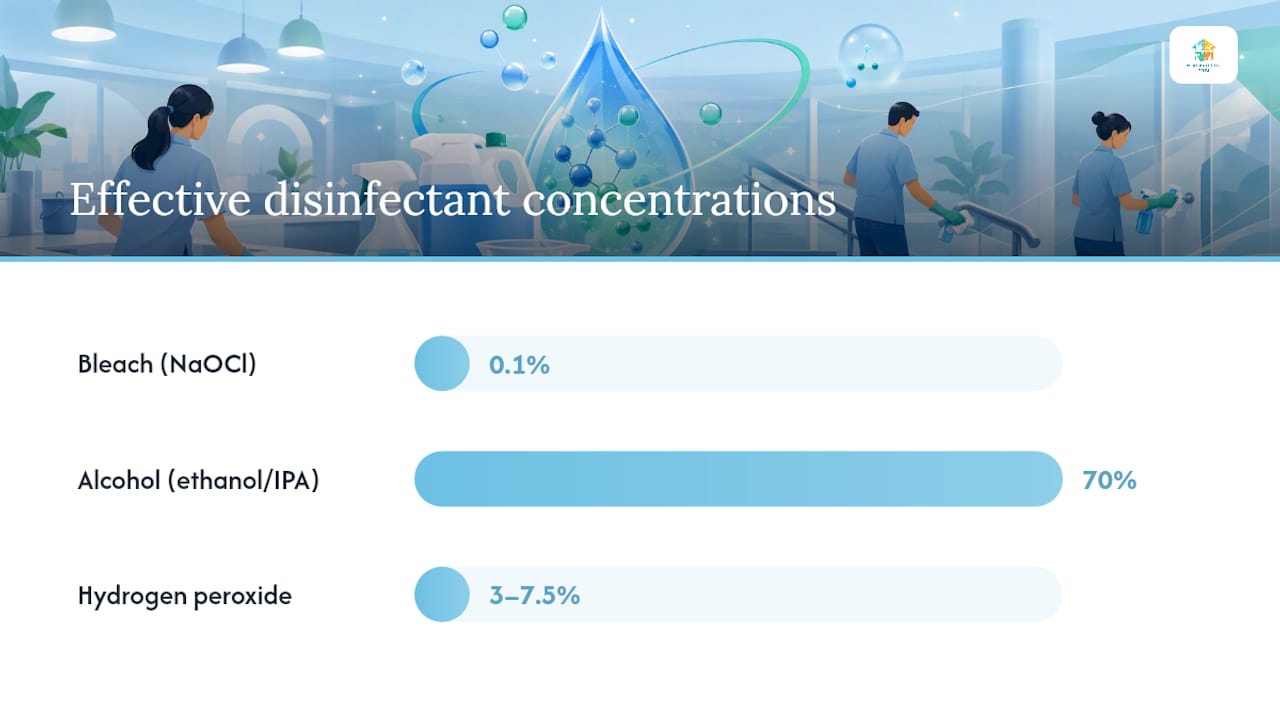
- Sodium hypochlorite (bleach): Broad-spectrum, inexpensive, and effective against most viruses and bacteria. A 0.1% solution (1,000 ppm) is the WHO-recommended dilution for general surface disinfection. Corrosive to metals, degrades fabrics, and loses potency quickly in sunlight. Store in a cool, opaque container and discard diluted solutions after 24 hours.
- Alcohol (ethanol or isopropanol at 70%): Fast-acting against bacteria and enveloped viruses. Evaporates quickly, which means contact time is short but must still be respected. Not effective against non-enveloped viruses like norovirus at standard concentrations. Safe for most hard surfaces and electronics when applied carefully.
- Hydrogen peroxide (3–7.5%): Effective against bacteria, viruses, and fungi. Less corrosive than bleach and breaks down into water and oxygen. Higher concentrations are used in healthcare settings and vaporized systems. Can bleach some fabrics and damage certain metals with repeated use.
- Quaternary ammonium compounds (quats): Widely used in commercial and food-service settings. Effective against bacteria and enveloped viruses, less effective against non-enveloped viruses and mycobacteria. Low odor and relatively low toxicity at use concentrations. Hard water and organic matter reduce their efficacy significantly.
- Phenolics: Used in healthcare and veterinary settings. Effective against a broad range of bacteria and some viruses. Not appropriate for food-contact surfaces and can be absorbed by porous materials.
- Peracetic acid: A high-level disinfectant used in healthcare and food processing. Effective against bacteria, viruses, fungi, and spores at appropriate concentrations. Corrosive and requires careful handling and PPE.
Sporicidal vs. non-sporicidal agents:
Most household disinfectants, including standard bleach solutions, alcohol, and quats, are not reliably sporicidal. Bacterial spores (such as Clostridioides difficile) require high-level disinfectants or sterilants, prolonged exposure times, or professional-grade approaches. The CDC’s Spaulding framework defines which agent classes reach sporicidal activity and under what conditions. For most homes, spore-forming pathogens are not the primary concern, but in healthcare-adjacent or post-illness scenarios, consulting a professional service is the safer call.
For product selection, always cross-reference the EPA’s registered disinfectants list and check that the product’s EPA registration number appears on the label. See also safe cleaning product guidance for homes for a practical breakdown of family-safe options.
No-touch disinfection methods: when do they actually add value?
No-touch and advanced disinfection technologies have moved from hospital corridors into commercial facilities and, in some cases, residential settings. A peer-reviewed review published in PMC summarizes the main options and their practical limits.
| Method | Typical applications | Advantages | Major limitations |
|---|---|---|---|
| UVC light | Healthcare rooms, HVAC systems, some commercial spaces | No chemical residue, effective in line-of-sight conditions | Shadowing blocks coverage; requires cleaned surfaces; eye and skin hazard |
| Vaporized hydrogen peroxide (VHP) | Hospital rooms, pharmaceutical facilities, large outbreaks | Penetrates hard-to-reach areas, sporicidal at sufficient concentration | Long aeration time required; room must be vacated; equipment cost |
| Fogging/fumigation | Large-area disinfection, post-outbreak remediation | Covers large areas quickly | Uneven distribution; inhalation risk; not a substitute for prior cleaning |
| Robotic UVC platforms | Healthcare, airports, large commercial facilities | Consistent dosing, reduces worker exposure | High cost, limited to line-of-sight, requires room clearance |
The PMC review also notes that combining UVC with low-dose hydrogen peroxide (advanced oxidation) can be faster and more thorough than either method alone in some settings.
These technologies make sense for healthcare facilities, large contamination events, or spaces where chemical residue is problematic. For routine home use, they are unnecessary and, in the case of UVC and VHP, carry real safety risks if operated without training. The WHO’s guidance discourages routine indoor spraying and fogging in occupied spaces for exactly this reason.
What factors undermine disinfectant effectiveness?
Even a correctly chosen, EPA-registered disinfectant can fail if the conditions are wrong. These are the variables that most commonly reduce efficacy:
- Organic load: Blood, mucus, food residue, and soil physically shield pathogens from the disinfectant. Cleaning first is not optional.
- Surface porosity: Porous surfaces (grout, unfinished wood, fabric) absorb the disinfectant before it can act on the surface. Non-porous hard surfaces are far easier to disinfect reliably.
- Incorrect concentration: Too dilute and the product lacks killing power. Too concentrated and it may damage surfaces, leave residue, or create safety hazards. Follow label dilution instructions precisely, as CDC efficacy guidance confirms that concentration is one of the primary variables controlling kill rates.
- Temperature: Most disinfectants work best at room temperature. Cold conditions slow chemical reactions and may extend the required contact time beyond what the label specifies.
- Insufficient contact time: The most common failure point. A surface that dries in 15 seconds when the label requires 4 minutes has not been disinfected.
- Application method: Spraying a mist and walking away is not the same as saturating the surface and keeping it wet. Wiping with a dry cloth immediately after applying defeats the purpose entirely.
- UV-specific factors: For UVC systems, shadowing behind objects, surface soiling, and insufficient dose (measured in mJ/cm²) all reduce effectiveness. A UVC device aimed at a cluttered surface disinfects only what it can directly illuminate.
Safety for users and workers: PPE, ventilation, and disposal
Disinfectants are, by definition, chemicals capable of killing living organisms. Treating them casually is how people end up with chemical burns, respiratory irritation, or accidental poisoning.
PPE basics:
- Nitrile or rubber gloves are the minimum for any disinfectant application.
- Eye protection (safety glasses or goggles) is required when mixing concentrates or using spray applications.
- A respirator or N95 mask is required when the label specifies it, when working in confined spaces, or when operating fogging or vaporized systems.
- Change and wash clothing after working with concentrated bleach or peracetic acid solutions.
Ventilation:
Open windows and run exhaust fans during and after disinfection. Never mix bleach with ammonia-based cleaners, acids, or other disinfectants. The resulting gases (chloramine, chlorine gas) are acutely toxic. This is not a theoretical risk; it is a documented cause of household poisoning incidents in the U.S.
Storage and disposal:
- Store disinfectants in their original, labeled containers. Transferring bleach to an unlabeled bottle is a household hazard.
- Keep all products out of reach of children and away from heat sources and direct sunlight.
- Bleach solutions degrade quickly. Discard diluted solutions after 24 hours.
- Dispose of empty containers per label instructions. Most household disinfectant containers go in regular trash; concentrated commercial products may require hazardous waste disposal.
The EPA’s six-step guidance explicitly includes safe disposal and storage as steps in the disinfection process, not afterthoughts. See cleaning supply safety guidance for a practical household reference on handling and storing these products.
What disinfection can and can’t do
Disinfection reduces pathogen levels on a surface. It does not guarantee zero transmission risk, and it does not replace the other layers of infection control.
- Spores survive standard disinfection. Bacterial spores, including those from Clostridioides difficile, are not reliably killed by alcohol, standard bleach solutions at household concentrations, or quats. High-level disinfectants or sterilants are required, and these are not appropriate for routine home use.
- Heavy soiling blocks disinfectants. A surface with significant organic contamination that was not properly cleaned first may have active pathogens protected beneath the soil layer even after disinfectant application.
- Disinfection is one layer, not the whole system. Hand hygiene, respiratory precautions, and ventilation all reduce transmission through routes that surface disinfection does not address.
Common mistakes that limit effectiveness:
- Skipping the cleaning step before applying disinfectant
- Using an expired or improperly stored product
- Wiping the surface dry before contact time ends
- Using the wrong product for the pathogen (e.g., alcohol against norovirus)
- Applying too little product to keep the surface wet for the required time
- Reusing a contaminated cloth (double-dipping)
How professional cleaners perform surface disinfection
Professional disinfection services follow a structured workflow that differs from a DIY approach in two important ways: product selection is matched to the specific pathogen and surface, and the process is documented.
Typical professional steps:
- Pre-job assessment: identify contamination type, surface materials, and any sensitive items (electronics, fabrics, food-contact surfaces).
- Cleaning phase: remove all visible soil before any disinfectant is applied.
- Disinfectant application: use EPA-registered products matched to the target pathogen, applied by trained staff using the correct method (wipe, spray-and-wipe, or no-touch system where appropriate).
- Contact time monitoring: professionals track wet time or reapply to maintain it, rather than estimating.
- Post-job ventilation and disposal: proper airing of the space and disposal of used materials per label and local regulations.
- Documentation: product EPA registration numbers, contact times achieved, PPE used, and areas covered are logged. This audit trail matters for facility managers, property managers, and healthcare-adjacent settings.
What to ask a service provider before booking:
- Which EPA-registered products will be used, and for which pathogens?
- What contact times are maintained, and how are they verified?
- What PPE do technicians wear?
- Is a post-job report or documentation provided?
- How are used materials and chemical waste disposed of?
| Scenario | DIY approach | Professional service |
|---|---|---|
| Post-illness home disinfection | Feasible with correct products and process | Recommended for immunocompromised residents or severe illness |
| Office or commercial facility | Manageable for small spaces with trained staff | Preferred for consistent documentation and compliance |
| Large contamination event or outbreak | Not recommended | Required for safe, thorough remediation |
| Sensitive electronics or specialty surfaces | Requires careful product selection | Professionals carry appropriate tools and products |
When a contamination event is large, when residents are vulnerable, or when a facility requires documented compliance, hiring a trained service is the more reliable path. Commercial cleaning services and deep cleaning services that include disinfection protocols are the practical answer for those situations.
The part most guides skip: following the label is the whole job
Most surface disinfection failures come down to one thing: people treat the label as optional fine print. They spray and wipe in one motion, skip the cleaning step because the surface looks fine, or grab whatever is under the sink without checking whether it covers the pathogen they are worried about.
The label is not bureaucratic padding. It is the result of EPA-reviewed efficacy testing against specific organisms at specific concentrations and contact times. When you deviate from it, you are not improvising a better method. You are running an untested one.
The same principle applies at scale. A facility that disinfects daily but never documents contact times, product selection, or surface coverage has no way to know whether the process is working. Documentation is not just for compliance; it is how you find out where the gaps are.
*— Neat
Neatandtidypros handles the process when it needs to be done right
When a household illness, a move-in, a post-construction cleanup, or a commercial facility requires disinfection that goes beyond a quick wipe-down, Neatandtidypros brings EPA-registered products, trained technicians, and a documented process to homes and businesses across Orange County and Corona, California.
Every job follows the clean-first, apply, maintain-contact-time sequence this guide describes, with products matched to the surface and the situation. Whether you need a residential deep clean after an illness, a move-in or move-out clean with targeted disinfection, or recurring commercial cleaning with consistent documentation, the team handles it without shortcuts. Book directly at Neatandtidypros to get a quote and schedule your clean.
Sources
- When and How to Clean and Disinfect Your Home – CDC
- Coronavirus disease (COVID-19): Cleaning and disinfecting surfaces in non-health care settings – WHO
- Physicochemical methods for disinfection of contaminated surfaces — peer-reviewed review (PMC)
- Six Steps for Safe & Effective Disinfectant Use – EPA
- Selected EPA-registered disinfectants – EPA
- Cleaning, disinfecting, and sanitizing – MedlinePlus
2 Responses