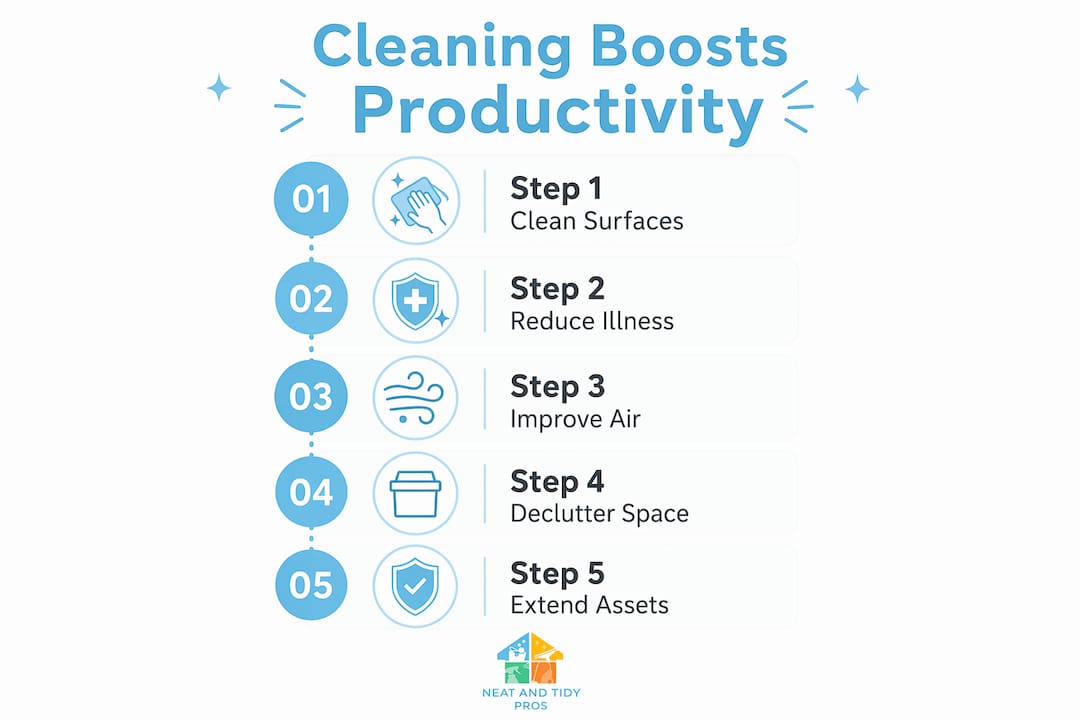
Regular office cleaning measurably raises productivity by cutting illness-related absences, lowering cognitive load from visual clutter, improving indoor air quality, protecting equipment, and sending a clear cultural signal that management invests in its people. A study across five organizations found that objective cleanliness correlated significantly with both perceived productivity and job satisfaction. If you manage an office and haven’t audited your cleaning program in the last quarter, that’s the immediate next step: a one-week cleanliness audit or a trial professional clean will give you a baseline to measure against.
The core productivity channels cleaning addresses:
- Illness and absenteeism: High-touch surfaces are primary vectors for bacterial and viral transmission; targeted cleaning interrupts those chains before they spread through a team.
- Indoor air quality: Lower ambient particle counts correlate directly with fewer respiratory complaints and higher self-reported output.
- Cognitive load: Visual clutter forces the brain to filter irrelevant stimuli continuously, depleting working memory available for complex tasks.
- Equipment longevity: Dust and particulates accelerate wear on HVAC systems, carpets, electronics, and upholstery, driving up replacement costs.
- Culture and morale: A well-maintained workspace signals organizational investment, raising job satisfaction and reducing turnover intent.
Stat to know: A large survey of office workers found that 90% believed a cluttered workspace negatively impacted their productivity and mood.
Table of Contents
- 1. A clean office tells employees you take them seriously
- 2. Fewer sick days start with cleaner surfaces
- 3. Cleaner air means sharper thinking
- 4. Clutter is a cognitive tax your team pays every hour
- 5. Regular cleaning extends the life of your office assets
- 6. How to estimate the ROI of a professional cleaning program
- 7. How often should your office be cleaned, and what comes first?
- 8. When does hiring professional cleaners make sense?
- 9. Manager’s practical checklist: daily, weekly, and monthly routines
- Key Takeaways
- The case for treating cleaning as a business process, not a chore
- Neatandtidypros office cleaning services: what to expect
- Useful sources and further reading
1. A clean office tells employees you take them seriously
Environmental psychology research is consistent on this point: the physical condition of a workspace shapes how employees interpret organizational priorities. A well-maintained environment signals investment in the people who work there, which raises job satisfaction and lowers stress markers including cortisol levels. That’s not a soft benefit. Lower cortisol means fewer stress-related sick days, clearer decision-making, and employees who are more likely to stay.
The morale effect compounds. When employees see that management keeps shared spaces clean, they tend to take more personal ownership of their own workstations. That self-reinforcing cycle is one of the strongest arguments for making cleanliness a visible, documented program rather than an ad-hoc effort.
Talking points for leadership:
- Cleanliness is a proxy for how the organization treats its people. Dirty break rooms and grimy restrooms communicate neglect faster than any survey can capture.
- High-performing employees have options. A poorly maintained office is a retention risk, not just a hygiene issue.
- Documented cleaning programs give HR and facilities teams a concrete, auditable proof point when positioning the company as an employer of choice.
Pro Tip: Post a simple cleaning log in shared spaces. When employees see that the kitchen was wiped down at 8 AM and the restrooms were checked at noon, it signals accountability. That visibility alone shifts how people perceive the organization’s standards.
2. Fewer sick days start with cleaner surfaces
The health-to-productivity chain is straightforward: high-touch surfaces such as door handles, elevator buttons, shared keyboards, and conference room remotes are the primary vectors for bacterial and viral spread in office settings. Targeted, documented cleaning of those surfaces interrupts transmission chains before they reach multiple employees.
Stat to know: Absenteeism costs U.S. employers a substantial amount per employee annually, and respiratory infections are among the leading causes. Even a modest improvement in sick days from better surface hygiene can justify the expense of a cleaning program.
Beyond outright absences, there’s presenteeism: employees who show up but are operating at reduced capacity because they’re fighting a cold or dealing with allergy symptoms. Presenteeism is harder to measure but often more costly than absenteeism because the productivity loss is invisible. Cleaner surfaces and better air quality reduce both.
For a quick ROI estimate, use this chain:
- Calculate the average daily salary cost per employee.
- Estimate your current sick-day rate (industry average is roughly 4–5 days per employee per year for office workers).
- Apply a conservative 10–15% reduction from improved cleaning protocols.
- Multiply the recovered days by the daily salary cost. That figure is your floor-level productivity recovery.
3. Cleaner air means sharper thinking
Indoor air quality is the most underestimated productivity lever in most offices. A systematic review of environmental intervention studies found that improving ventilation, replacing filters, and reducing indoor pollutants produced measurable improvements in worker health, comfort, and productivity. The mechanism is direct: lower airborne particle counts mean fewer respiratory complaints, fewer headaches, and less afternoon fatigue.
Carpets, upholstered furniture, and HVAC ducts are the three biggest reservoirs of particulates in a typical office. Professional commercial carpet maintenance removes the embedded allergens and dust that daily vacuuming misses. Filter changes and duct cleaning address the recirculation problem, where the HVAC system redistributes what was swept off surfaces back into the breathing zone.
Practical IAQ actions with the highest impact:
- Replace HVAC filters on the manufacturer’s recommended schedule (typically every 60–90 days for commercial systems; more frequently during high-occupancy or allergy seasons).
- Schedule professional carpet extraction quarterly, or monthly in high-traffic zones.
- Dust horizontal surfaces, monitor frames, and ceiling vents weekly to prevent particulate buildup.
- Keep a filter change log. It’s a simple record that doubles as documentation for OSHA compliance and lease requirements.
The performance impact managers should expect: short-term, employees report fewer headaches and less fatigue within weeks of an IAQ intervention. Long-term, the gains compound as the baseline particle load drops and respiratory complaints become genuinely rare rather than a background constant.
4. Clutter is a cognitive tax your team pays every hour
The Princeton University Neuroscience Institute demonstrated using fMRI scans that physical clutter actively competes for attention, restricting the brain’s processing capacity and directly impairing focus. Every irrelevant object in an employee’s field of view requires the visual cortex to suppress its signal so the person can concentrate on the actual task. That suppression burns energy. Over a full workday, it produces the afternoon brain fog that most office workers recognize but rarely trace back to their physical environment.

The cognitive load reduction from a clean workspace is the principal neurological benefit: fewer irrelevant stimuli means more working memory available for complex tasks, faster task initiation, and longer sustained focus. Clean workspaces also support executive functioning and sustained concentration over time, which matters most for employees doing analytical or creative work.
The six most common clutter sources in offices:
- Stacked papers and unfiled documents on workstations
- Tangled cables and charging equipment left on desk surfaces
- Ad-hoc storage (boxes, bags, personal items) pushed into shared walkways
- Unmaintained shared areas: break rooms with expired food, conference rooms with leftover materials
- Unused equipment left on desks or in open areas
- Excessive personal items that crowd the functional workspace
Pro Tip: Build a 5-minute end-of-day clear-down into the team’s closing routine. Each person clears their surface, files or discards loose papers, and puts cables away. It takes less time than a coffee break and means everyone starts the next morning with a workspace primed for focus rather than one that immediately triggers cognitive filtering.
5. Regular cleaning extends the life of your office assets
Dirt and particulates don’t just make a space look bad. They accelerate wear on the physical assets that represent real capital expenditure. HVAC systems clogged with dust run harder, consume more energy, and fail sooner. Carpets ground with embedded grit lose fiber integrity faster than carpets that are regularly extracted. Keyboards and monitors accumulate particulates that cause overheating and component failure.
Asset classes that benefit most from routine cleaning:
- Carpets: Professional extraction every 3–6 months removes embedded grit that cuts fiber from the inside. Extending carpet life by even two years across a mid-size office eliminates one full replacement cycle.
- HVAC systems: Clean filters and ducts reduce mechanical strain, lower energy consumption, and extend compressor life.
- Electronics: Keyboards, monitors, and shared AV equipment accumulate dust that causes overheating. Compressed air and appropriate surface cleaning extend hardware life noticeably.
- Upholstered furniture: Regular vacuuming and periodic deep cleaning prevent fiber breakdown and staining that forces early replacement.
A compact cost-savings frame for vendor conversations: if a commercial carpet replacement costs $8–$15 per square foot installed, and routine professional cleaning extends the replacement cycle from 7 years to 10 years in a 2,000-square-foot office, the avoided cost is substantial even before accounting for the disruption of a full replacement project. That math is worth putting in front of a CFO.
Quick operational actions to protect high-value assets:
- Log every filter change, carpet extraction, and equipment cleaning with dates and the technician responsible.
- Schedule quarterly deep cleans for conference rooms and high-use shared spaces.
- Add keyboard and monitor cleaning to the weekly workstation routine.
6. How to estimate the ROI of a professional cleaning program
The calculation doesn’t need to be complex to be persuasive. Use three input categories: cleaning cost, productivity recovery, and equipment savings.

| Input | Example figure | Notes |
|---|---|---|
| Monthly cleaning cost | — | Varies by office size and frequency |
| Avg. daily salary cost per employee | — | Use fully loaded cost including benefits |
| Estimated sick days reduced per employee/year | a modest reduction | Conservative improvement attributed to enhanced cleaning protocols |
| Employees in office | — | Adjust to your headcount |
| Annual productivity recovery | — | (Days recovered × daily cost × headcount) |
| Equipment life extension savings | $1,000/yr | Carpet, HVAC, electronics combined |
| Estimated net annual benefit | — | Before factoring in morale/retention gains |
The sensitive assumptions to test: your baseline absenteeism rate, the average fully loaded daily cost per employee, and the percentage productivity improvement you attribute to cleaning. Even at the conservative end, most offices with 20 or more employees will see a positive return from a structured cleaning program within the first year.
Pro Tip: Run a 90-day pilot with a professional cleaning service and track two metrics before and after: sick-day usage and a short employee satisfaction survey with one question about workspace cleanliness. Those two data points are enough to build a budget justification.
7. How often should your office be cleaned, and what comes first?
Cleaning frequency should match occupancy, space function, and seasonal risk. A hybrid office with 40% desk utilization on any given day has different needs than a fully staffed call center. Here’s a practical framework.
Recommended cadence by zone:
| Zone | Daily | Weekly | Monthly | Quarterly |
|---|---|---|---|---|
| Workstations | Wipe high-touch surfaces | Full desk wipe, keyboard/monitor | Deep clean, cable management | — |
| Meeting rooms | Wipe table, AV equipment | Full clean, chairs, whiteboard | Upholstery vacuum | Deep clean |
| Kitchen/break room | Wipe surfaces, empty trash | Appliance exteriors, microwave interior | Refrigerator clean-out | Deep clean |
| Restrooms | Full clean and restock | Grout and fixture scrub | — | Deep clean |
| HVAC/carpet | — | — | Filter check | Filter change, carpet extraction |
Adjust cadence upward during flu season (October through March in most U.S. regions) and during periods of higher occupancy. For hybrid teams, clean high-touch surfaces on every day the office is occupied, not just on a fixed weekly schedule.
A structured weekly cleaning service that documents tasks and completion times gives managers an auditable record and a clear baseline for evaluating whether the program is being executed consistently.
Pro Tip: Use a simple digital cleaning log, even a shared spreadsheet, where each completed task is timestamped and initialed. When an employee raises a concern about cleanliness, you have a record to reference. When a vendor claims a task was completed, you have a verification mechanism.
For a more detailed schedule tailored to smaller offices, the office cleaning schedule for small businesses guide covers zone-by-zone cadences with task-level specificity.
8. When does hiring professional cleaners make sense?
For most offices with 10 or more employees, professional cleaning is the more cost-effective choice. Here’s why: professional services bring specialized equipment (commercial extractors, HEPA-filter vacuums, color-coded microfiber systems), documented quality control, insurance coverage, and background-checked staff. They also bring programmatic discipline. Documented cleaning logs, color-coded segregation, and targeted routines consistently outperform reactive surface dusting, which is what most in-house arrangements default to over time.
Advantages of professional cleaning services:
- Specialized equipment that reaches IAQ-relevant surfaces (HVAC vents, carpet fibers, grout lines) that standard janitorial supplies can’t address effectively.
- Documented SOPs that create accountability and allow managers to audit quality against a written standard.
- Insurance and liability coverage that protects the business if a cleaning-related incident occurs.
- Consistent staffing and backup coverage, so a sick day on the cleaning team doesn’t mean the office goes uncleaned.
When an in-house arrangement is reasonable:
- Very small offices (fewer than 8–10 people) where the scope is genuinely limited to daily surface wipes and trash removal.
- Controlled schedules where an employee can reliably dedicate 30–45 minutes daily without it conflicting with their primary role.
- Situations where the cleaning scope is narrow enough that specialized equipment isn’t needed.
Questions to ask when evaluating a professional cleaning vendor:
- Do you provide written SOPs for each cleaning task?
- Are your staff background-checked and insured?
- Can you provide references from comparable office environments?
- What quality control process do you use, and how do you document it?
- Do you have HVAC and carpet maintenance capabilities, or do you subcontract those?
- What is your protocol if a task is missed or a quality standard isn’t met?
Understanding common office cleaning oversights before you sign a contract helps you write a tighter scope and avoid the gaps that most standard cleaning agreements leave unaddressed.
Pro Tip: Before committing to a long-term contract, negotiate a 30-day pilot at full scope. Evaluate the vendor against your checklist at the end of week two and week four. A reputable provider will welcome the structure; a weak one will resist it.
9. Manager’s practical checklist: daily, weekly, and monthly routines
Use this checklist as a starting point for your own cleaning program or as a template for a vendor job brief.
Daily tasks
- Wipe all high-touch surfaces: door handles, light switches, elevator buttons, shared keyboards, printer controls.
- Empty trash and recycling bins at all workstations and common areas.
- Wipe kitchen counters, stovetop, and sink after each use period (morning and afternoon).
- Restock restroom supplies and complete a full restroom clean.
- Sweep or vacuum high-traffic entry areas and corridors.
Weekly tasks
- Full workstation wipe-down including monitors, keyboards, and desk surfaces.
- Clean and disinfect conference room tables, chairs, and AV equipment.
- Wipe appliance exteriors and clean microwave interior in break rooms.
- Vacuum all carpeted areas with a HEPA-filter vacuum.
- Mop hard-floor areas with an appropriate cleaning solution.
- Check and restock cleaning supplies.
Monthly tasks
- Deep clean kitchen appliances including refrigerator interior.
- Vacuum upholstered furniture in meeting rooms and reception areas.
- Wipe ceiling vents and horizontal surfaces that accumulate dust.
- Check HVAC filter condition and replace if needed.
- Review cleaning log for missed tasks or recurring gaps.
Sample job brief for a cleaning vendor
Scope: Commercial office cleaning for [X] square feet, [Y] employees, [Z] days per week.
Key zones: Workstations, conference rooms (quantity), kitchen/break room, restrooms (quantity), reception, corridors.
KPIs: 100% task completion per shift log; zero missed high-touch surface cleans; restrooms fully stocked and cleaned by 8 AM daily.
Reporting cadence: Weekly digital log submitted to facilities manager; monthly quality review meeting.
Special requirements: HEPA-filter vacuums required; eco-friendly products preferred; all staff background-checked.
Neatandtidypros covers all of the above task categories in its commercial cleaning programs, including documented logs, eco-friendly products, and periodic deep-clean scheduling. For workstation-level detail, the office cubicle cleaning routine guide provides step-by-step task breakdowns you can adapt directly into a vendor brief.
Key Takeaways
A professional, documented office cleaning program raises productivity by reducing illness, improving air quality, lowering cognitive load, protecting assets, and reinforcing a culture of organizational investment.
| Point | Details |
|---|---|
| Health and absenteeism | Targeted high-touch cleaning interrupts viral transmission; a conservative 10–15% reduction in sick days recovers significant salary cost annually. |
| Indoor air quality | Lower particle counts from professional carpet and HVAC maintenance reduce respiratory complaints and improve self-reported focus and output. |
| Cognitive load | Visual clutter depletes working memory; 90% of office workers in a 1,000-person survey said clutter hurt their productivity and mood. |
| Equipment protection | Routine cleaning extends carpet, HVAC, and electronics life, reducing replacement cycles and capital expenditure. |
| Neatandtidypros | Offers documented commercial cleaning programs with eco-friendly products, written SOPs, and periodic deep-clean scheduling for offices. |
The case for treating cleaning as a business process, not a chore
The conventional framing around office cleaning is that it’s a facilities cost to minimize. That framing gets it exactly backwards. The evidence from environmental psychology and intervention studies points consistently in one direction: the physical condition of a workspace is an active input into employee performance, not a neutral backdrop.
What most managers underestimate is the compounding nature of the gains. A single deep clean produces a visible short-term improvement. A sustained, documented cleaning program produces something different: a baseline environment where employees aren’t fighting their surroundings to do their best work. The cognitive load reduction, the lower sick-day rate, the IAQ improvements from consistent HVAC and carpet maintenance — none of these are one-time events. They accumulate.
The mistake worth avoiding is treating cleaning as a reactive measure. Offices that clean only when something looks visibly dirty are already operating with degraded air quality, elevated surface pathogen loads, and employees absorbing a cognitive tax they can’t name but definitely feel. The managers who get the most out of a cleaning program are the ones who treat it the way they treat any other operational process: with written standards, documented completion, and periodic review.
One thing clients consistently notice after introducing a structured program is that the conversation about cleaning stops. Before, it was a recurring complaint. After, it’s simply not a topic anymore, which means employees are spending that mental energy on their actual work.
Neatandtidypros office cleaning services: what to expect
Neatandtidypros delivers commercial cleaning services built specifically for offices and business environments, covering everything from daily high-touch surface programs to quarterly deep cleans and carpet maintenance. The difference from a generic janitorial arrangement is the structure: every engagement starts with a walkthrough and written job brief, so the scope is documented before the first visit.
For office managers, the practical reassurances matter as much as the service list:
- All staff are background-checked.
- Eco-friendly, commercially appropriate cleaning products are used throughout.
- Cleaning logs are maintained and available for review.
- Deep cleaning and carpet maintenance are available as add-ons to recurring programs, not separate vendor relationships to manage.
The next step is straightforward. Review the full services menu, then request a quote or schedule a walkthrough. Neatandtidypros serves offices in Orange County and Corona, California, and can structure a program around your occupancy schedule, hybrid work patterns, and budget.
Useful sources and further reading
-
Impact of Cleanliness on the Productivity of Employees — Peer-reviewed study across five organizations linking objective cleanliness measures to perceived productivity and job satisfaction. The primary citation for the cleanliness-productivity correlation.
-
A Systematic Review of Environmental Intervention Studies in Offices — Comprehensive review of HVAC, ventilation, and filtration interventions and their effects on worker health and productivity. Strongest available evidence for IAQ-related cleaning investments.
-
Clean and Organized Desk Helps Improve Your Productivity (IJRPR) — Research paper summarizing the Princeton Neuroscience Institute clutter study and a 1,000-person office worker survey. Useful for the cognitive load and clutter sections.
-
Why Clean Workspaces Improve Cognitive Performance — Practitioner-facing summary of environmental psychology and neuroscience findings on clutter, working memory, and focus. Good further reading for managers building the case internally.
-
The Science Behind Clean Workspaces and Cognitive Performance — Reviews executive functioning and sustained concentration research; supports the long-term productivity argument for clean environments.
-
How Office Cleanliness Directly Drives Workplace Productivity — Practitioner guide covering culture signaling, high-touch cleaning protocols, and programmatic cleaning frameworks. Useful for the morale, health, and checklist sections.