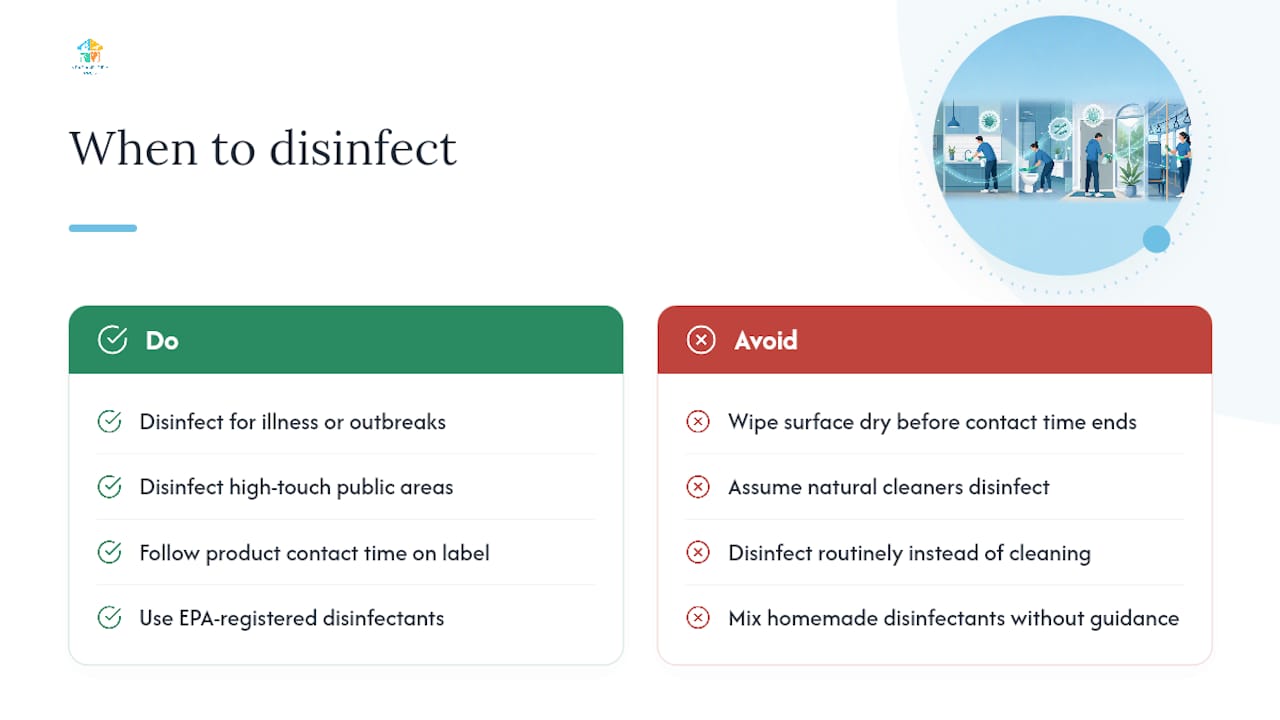
Disinfection chemically inactivates the pathogens that survive after a surface has been cleaned. It’s the step that kills what soap and water leave behind. You need it when someone in the space is sick, when a high-risk person lives or works there, during an outbreak, or on high-touch surfaces in public settings like door handles and shared counters.
The gold standard is a two-step process:
- Clean first to strip away dirt, grease, and organic material.
- Disinfect second, using an EPA-registered product left wet for its full contact time.
- Skip either step and you’re either scrubbing germs around or wasting chemical on a dirty surface.
Key Takeaways
Disinfection works by chemically inactivating pathogens that survive cleaning, and it only succeeds when a surface is cleaned first and kept wet for the product’s full labeled contact time.
| Point | Details |
|---|---|
| Clean before you disinfect | Soil and organic matter block disinfectants, so wash away dirt and grease first. |
| Match the trigger to the action | Disinfect for illness, high-risk people, outbreaks, or high-touch public surfaces; otherwise routine cleaning is enough. |
| Follow the label exactly | Dilution ratio and contact time on the product label determine whether disinfection actually works. |
| Handle special cases differently | Blood spills, electronics, and porous fabrics each need their own protocol, not the standard routine. |
| Call a professional for complex jobs | Neatandtidypros uses EPA-registered products and trained staff for deep cleans, move-outs, and commercial janitorial work where documented disinfection matters. |
Table of Contents
- What’s the Difference Between Cleaning, Sanitizing, and Disinfecting?
- When Do You Actually Need to Disinfect?
- What Are the Main Types of Disinfectants and How Do They Work?
- How Do You Disinfect a Surface Step by Step?
- How Do You Handle Blood Spills, Electronics, and Food-Contact Areas?
- What Can’t Disinfection Do, and What Are the Risks of Overusing It?
- When Should You Hire a Professional Disinfection Service?
- Frequently Asked Questions
- Sources
What’s the Difference Between Cleaning, Sanitizing, and Disinfecting?
These three words get used interchangeably at the store, but they describe different jobs. Cleaning physically removes dirt, grease, and some germs using soap or detergent and water. It doesn’t kill anything; it just lifts material off a surface so germs have nowhere to hide. Sanitizing reduces germs to a level public health standards consider safe, which is the target for food-contact surfaces like cutting boards and high chairs. Disinfecting goes further: it kills or inactivates nearly all disease-causing germs on a surface, using chemicals that need time and often a pre-cleaned surface to work.
| Action | What it does | Typical setting |
|---|---|---|
| Cleaning | Removes dirt, debris, and some germs | Countertops, floors, general surfaces |
| Sanitizing | Reduces germs to a safe level | Cutting boards, high chairs, dishware |
| Disinfecting | Kills most remaining germs | Bathroom fixtures, doorknobs, sickroom surfaces |
Getting this right matters because each action solves a different problem. Using a sanitizer where a disinfectant is needed, or grabbing a disinfectant wipe on a greasy stovetop, wastes product and leaves you with a false sense of protection.
When Do You Actually Need to Disinfect?
Not every surface needs a disinfectant every day. The decision comes down to risk, not habit.
- Someone in the home or building is currently sick with a contagious illness.
- A household or workplace member is elderly, immunocompromised, pregnant, or otherwise higher risk.
- There’s been a known exposure to a contagious disease or a local outbreak.
- The surface is high-touch (doorknobs, light switches, remote controls, shared phones) or in a high-traffic public space.
- Local health guidance or a workplace policy specifically calls for it.
For everything else, routine cleaning with soap and water is generally enough. In offices, gyms, and other shared facilities, the practical rule is to clean on a regular schedule and add disinfection specifically when a surface is visibly soiled or someone has been sick, not as a blanket daily task on every surface in the building.
What Are the Main Types of Disinfectants and How Do They Work?
Walk down the cleaning aisle and you’ll find five families of active ingredients, each with a different mechanism and a different set of trade-offs.
- Chlorine (bleach): Oxidizes and destroys microbial cell components. Fast-acting and broad-spectrum, but corrosive to metal and can bleach fabric or discolor surfaces.
- Alcohols (ethanol, isopropyl): Denature proteins and disrupt membranes. Evaporate quickly, which is convenient but can shorten contact time below what’s needed.
- Quaternary ammonium compounds (quats): Disrupt cell membranes. Gentle on most surfaces and common in wipes, but some bacteria show reduced susceptibility with heavy, repeated use.
- Hydrogen peroxide and peracetic acid: Cause oxidative damage to cell structures. Effective and often marketed as eco-friendlier, though concentration matters a lot.
- Phenolics: Disrupt cell walls and denature proteins. Used in some hospital-grade products, but not recommended around infants due to toxicity concerns.
The mechanism matters less than the label. Every one of these chemistries has a specific dilution ratio, material compatibility list, and required contact time, and product labels and Safety Data Sheets are the actual authority on safe, effective use, not the marketing copy on the front of the bottle.
For reusable medical instruments and devices, cleaning quality is measurable: manual and mechanical cleaning typically achieves a significant reduction in microbial load, while washer-disinfectors can achieve an even greater reduction when the equipment makes proper contact with every surface. That gap is why hospitals often prefer automated reprocessing over hand-scrubbing for complex instruments.
Pro Tip: Never assume a shorter contact time works “close enough.” A product rated for a 10-minute wet time that dries in three minutes on a warm countertop has done a fraction of its job.
How Do You Disinfect a Surface Step by Step?
A reliable disinfection routine follows the same sequence whether you’re doing a kitchen counter or a rental property turnover.
- Put on appropriate PPE. Gloves at minimum; add eye protection for stronger chemicals.
- Clean the surface first with soap or detergent and water to remove visible dirt, grease, and debris; for specific tips, see the best thing to clean interior doors with.
- Choose an EPA-registered disinfectant matched to the pathogen or risk you’re targeting.
- Prepare the dilution exactly as the label states. Guessing on ratio is the most common way to weaken a product’s effectiveness.
- Apply the disinfectant so the entire surface is visibly wet.
- Let it sit undisturbed for the full contact time listed on the label, often somewhere between one and ten minutes depending on the product.
- Rinse if the label requires it, particularly for food-contact surfaces.
- Ventilate the room and store the product safely away from children and pets.
A few safety notes apply across every step:
- Never mix bleach and ammonia-based cleaners; the combination produces toxic gas.
- Keep windows open or a fan running while disinfecting enclosed spaces.
- Store concentrates in their original, labeled containers.
Pro Tip: If a surface dries before the contact time is up, reapply. Some professional-grade wipes are specifically rated to maintain wetness for the label’s full contact time, which solves this problem without extra steps. Our surface disinfection process guide walks through this in more detail if you want the full breakdown.
How Do You Handle Blood Spills, Electronics, and Food-Contact Areas?
Standard disinfection steps don’t apply cleanly to every situation. A few scenarios need their own protocol.
- Blood or body fluids: Contain and absorb the spill first, clean the area with a neutral detergent and water, then disinfect with a facility-approved intermediate-level disinfectant. Combined detergent-disinfectant products aren’t recommended for this two-step process because the organic material interferes with the disinfectant.
- Electronics: Use a product specifically labeled safe for screens and keep application damp, not wet, following manufacturer guidance for the device.
- Porous surfaces and fabrics: Upholstery, carpet, and some wood can’t be reliably disinfected. Laundering on the hottest safe setting is often the better option; heavily contaminated soft items sometimes need to be discarded.
- Food-contact surfaces: A cutting board usually needs sanitizing rather than full disinfection, and any chemical sanitizer requiring a rinse must be rinsed before food touches the surface again.
What Can’t Disinfection Do, and What Are the Risks of Overusing It?
Disinfection has real limits, and treating it as a cure-all creates its own problems.
- It’s not sterilization. Most disinfectants don’t reliably kill bacterial spores, which require much longer exposure times or specialized sterilants.
- Efficacy drops fast on dirty surfaces, which is exactly why cleaning always comes first.
- Overuse carries health costs: respiratory irritation, skin sensitization, and the danger of mixing incompatible chemicals like bleach and ammonia.
- Undiluted concentrates shouldn’t go down the drain; follow label disposal instructions to limit environmental impact.
Pro Tip: If you’re reaching for a disinfectant every single day on every surface “just in case,” you’re likely creating more chemical exposure than health benefit. Save it for the situations that actually call for it. Our guide on common cleaning supply safety mistakes covers storage and mixing hazards in more depth.
When Should You Hire a Professional Disinfection Service?
Some situations go beyond what a bottle of spray and a roll of paper towels can safely handle.
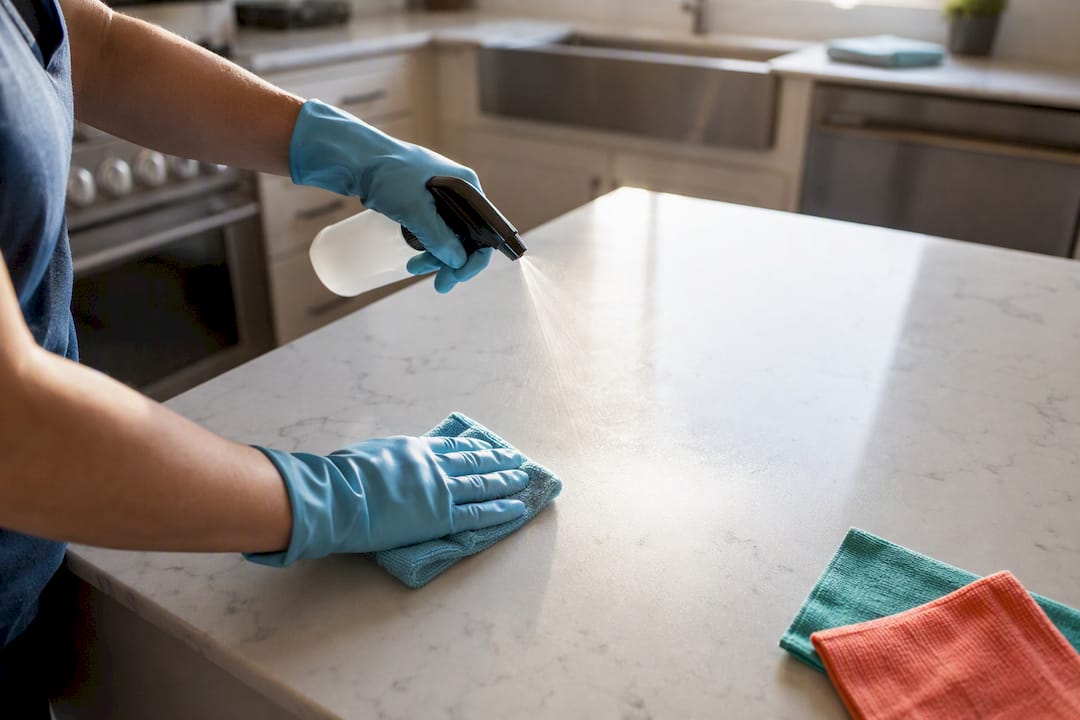
Call in a professional when you’re dealing with large-scale contamination, post-construction dust and debris, a healthcare or medical-adjacent setting, a household member who’s immunocompromised, or a contract that requires documented compliance.
Before hiring anyone, ask these questions:
- Do you use EPA-registered products, and can you name them?
- Do your teams follow labeled contact times, not just a quick wipe-down?
- What PPE and training do your staff have for this type of job?
- How do you verify the work, and can you provide before-and-after documentation?
- How is contaminated waste handled and disposed of?
Reputable services can back this up with checklists, photo documentation, and sometimes ATP testing to confirm surfaces meet a cleanliness threshold. Our commercial cleaning overview covers how scheduled disinfection fits into ongoing facility programs.
Why Balance Matters More Than Intensity
The instinct after a scare, illness, or bad news cycle is to disinfect everything, constantly. That’s the wrong lesson. The CDC’s own guidance leans toward routine cleaning as the default and reserves disinfection for specific, elevated-risk moments. Professional cleaners who work risk-based schedules, matching the level of intervention to the actual exposure, tend to get better outcomes with less chemical use than anyone spraying bleach on every surface daily.
How Neatandtidypros Handles Safe, Documented Disinfection
Getting the sequence right, clean first, disinfect second, with the correct product and full contact time, is harder to execute consistently than it sounds, especially across a whole property or office. Neatandtidypros builds that sequence into every deep clean, move-in/move-out clean, post-construction clean, and commercial janitorial visit, using EPA-registered products and staff trained on label-specific wet times rather than guesswork.
Whether you’re preparing a rental between tenants, clearing construction dust before move-in, or setting up a recurring office cleaning schedule, the goal is the same: pathogens actually inactivated, not just surfaces that smell clean. Check out how residential cleaning works to see what’s included in a standard visit, or head to our services page to book a cleaning that covers both steps properly.
Frequently Asked Questions
Is disinfecting always better than just cleaning?
No. Routine cleaning with soap and water removes most germs and is sufficient for typical daily surfaces. Disinfecting adds chemical exposure and cost, so it’s best reserved for illness, high-risk situations, or high-touch public areas.
How long does a disinfectant need to stay wet to work?
It depends entirely on the product label, often somewhere between one and ten minutes. Wiping it dry early is one of the most common reasons disinfection fails.
Can I mix my own disinfectant at home?
Do natural or “green” cleaners disinfect as well as chemical ones?
Only products that carry EPA registration for disinfection claims have been tested to reliably kill the pathogens listed on their label. A cleaner marketed as natural without that registration is likely a cleaning or sanitizing product, not a disinfectant.
Why does professional cleaning matter for disinfection specifically?
Professionals are trained to sequence cleaning and disinfection correctly, use EPA-registered products at the right dilution, and respect labeled contact times, which is where most DIY attempts fall short.
This article is general information, not a substitute for advice from a qualified doctor. Consult a qualified healthcare professional about your own circumstances before acting on anything here.
Sources
- Environmental cleaning procedures | CDC
- Cleaning before disinfection (CDC review)
- Cleaning, disinfecting, and sanitizing | MedlinePlus